The dog moved across the snow slowly, the way an animal does when it has almost nothing left to spend. Her belly hung low. Each step seemed to cost more than the one before it.
She would later be called Mira. At that moment she had no shelter, no blankets, no dependable food and no protected corner where puppies could be born. Had labor begun out in the open, she and her unborn litter would have faced freezing temperatures with almost nothing between them and the cold.
Someone noticed her first. Rescuers took her out of the weather and into a warm room, believing they had saved one exhausted mother.
They had not yet counted everyone who needed them. Within hours the number would reach sixteen, and the weeks ahead would test Mira, her caregivers and a very large litter in ways no one watching the snow could have predicted.
Slow Steps Across a Frozen Field
When rescuers first saw Mira, she was crossing the snow at a pace that suggested every step had to be negotiated. Her abdomen was heavily swollen, and whatever energy she had seemed to be draining as she walked. She appeared to be searching for a place sheltered enough to stop.
Winter is hard on a pregnant stray, and the dangers pile up quickly. Cold draws energy from a body that is already working to sustain developing puppies. Hunger makes it harder to stay warm. Snow and damp ground offer almost no protection to newborns, which cannot regulate their own body temperature in the first days of life.
Mira had none of the basics she would soon need: no dry place to nest, no reliable meals, and no one watching for complications. The people who found her understood that leaving her outside was not a reasonable choice. They approached with care and brought her indoors.
The account does not say how long she had been wandering, where exactly she was first seen, or who the rescuers were. It concentrates on two moments: the one in which she was noticed and the one in which she was taken in. What it makes clear is how narrow the margin turned out to be.
Video: Mira Is Brought Indoors Out of the Snow
A Rescue Room Turns Into a Maternity Space
Once Mira was settled inside, it became apparent that she was not weeks away from delivery. Labor was close, and the room prepared for one rescued dog quickly took on a different purpose.
Blankets were laid out. Supplies were gathered. Caregivers stayed near enough to step in if Mira or any puppy ran into trouble. A rescue planned around a single animal had changed shape within minutes, and the people who had spotted her in the snow were suddenly working against the clock.
For the first time in a long while, Mira could lie down without snow collecting around her body. She was still tired, and a major physical ordeal still lay ahead. But she would face it in a warm room instead of in the cold.
Soon after she reached safety, the puppies began to arrive. The first was placed close to her warmth, and another followed. Mira cleaned each newborn and drew the small bodies toward her, staying alert to every movement and sound despite her exhaustion.
Nobody in the room yet knew how long the delivery would last.
Ten Girls, Five Boys and a Delivery That Would Not End
The litter kept growing. Even after the tenth puppy was born, labor continued. When the long delivery finally ended, fifteen puppies were curled around Mira: ten females and five males.
Picture the scene from the caregivers’ side of the room. They had come to help one pregnant dog. Now they were watching a nest fill with newborns pressed together for warmth, each one wholly dependent on a mother who had been trudging through freezing snow only a short time earlier.
Mira did not wait to recover before getting to work. She cleaned coats, let the puppies nurse, and shifted her position so the smallest could reach her. When one drifted away from the group, she kept a close watch on it.
The contrast with what might have happened was stark. Outside lay snow, frozen ground and uncertainty. Indoors there were dry blankets, warmth, food for the mother and people ready to help. The rescue team’s responsibility had quietly changed too. They were no longer looking after one dog in danger but an entire family of sixteen.
For the first few days, Mira managed with remarkable patience. She stayed near her litter and supplied the warmth and nourishment the puppies needed. But feeding fifteen newborns asks a great deal of a body that is already depleted, and on the fifth day that strain became an emergency.
Day Five: A Mother Grows Sick
Through the early days, Mira’s attention belonged almost entirely to her puppies. She rarely strayed far from the crowded nest, and although her body was still recovering from the birth, she responded to every cry and every shuffle.
Then something shifted. Mira grew visibly weak and developed a fever. She stopped eating and began to vomit. Her caregivers recognized right away that this was more than ordinary tiredness after labor.
A veterinary assessment found a serious uterine infection. Such an illness is dangerous on its own. For a mother nursing fifteen newborns, it multiplied the stakes. Mira needed prompt treatment and enough rest for her body to recover. The account does not describe which treatments she received, only that she required care and time to heal.
Her puppies were just five days old. They could not eat solid food. They could not stay warm without help. And they needed nourishment every few hours.
As Mira’s health declined, her milk supply began to fall. The rescue team now faced two linked problems: helping Mira through the infection, and making sure all fifteen puppies kept getting enough to eat.
Even while unwell, Mira stayed close to the litter. She watched the puppies and reacted to their sounds. What she could no longer do was provide everything they needed by herself. A single dramatic rescue had become sustained, day-and-night work.

Bottles, Warmth and a Nursery That Never Closed
The caregivers prepared bottles and began supplementing the puppies one at a time. There was no quick way to feed a litter this size. Every puppy had to be handled gently, given enough milk, and kept warm before and after its meal. By the time the last one finished, it was nearly time to begin again.
Caring for one newborn can demand constant attention. With fifteen, each feeding became a managed operation. Caregivers watched to make sure no puppy was repeatedly nudged aside by stronger siblings, and the smallest received individual attention so they could take in enough milk and keep building strength.
Tiny squeaks filled the room. The puppies slept in a warm heap, shifting toward one another whenever someone moved nearby. Mira rested close by while she was treated, and when she was able, she nursed. The caregivers filled in the rest, taking on a job that would otherwise have been hers alone.
For several days the outcome stayed uncertain. Mira’s infection had to respond to treatment. Her fever had to fall. Her appetite had to return. And all the while the puppies had to keep eating and growing despite the disruption to their mother’s milk.
Around Day Seven, the First Good Signs
About a week after the births, the first encouraging changes appeared. Mira’s fever began to come down. She showed interest in food again. Her strength started to return, slowly.
Her milk did not recover completely right away, so bottle-feeding continued alongside nursing. Together, the two methods were enough to keep the puppies nourished, and Mira could look after her litter without carrying all of it herself.
Relief did not mean the work was finished. Fifteen newborns still needed attention at nearly every hour. Their bedding had to stay clean and dry, their warmth had to be maintained, and each puppy had to be watched at feeding time for any sign of weakness or trouble.
Seen from the outside, this stretch of the story looks unremarkable: bottles, fresh bedding, checks and rechecks. Yet those repeated tasks stood between a recovering mother and a litter that still could not feed itself.
Day by day, the puppies gained strength. The family that had come so close to tragedy in the snow was beginning to settle.
From Sleepy Pile to Curious Crowd
In their earliest weeks, life in the nursery followed a plain rhythm: nurse, sleep, press close for warmth. Between roughly nine and eighteen days old, sleep filled most of the puppies’ time. Their growing bodies needed rest, nourishment and protection more than anything else.
Mira stayed patient with her enormous litter. As her health improved, she took back more of their care, while the household continued to top up feedings whenever they were needed.
Then the puppies began to change. Their movements grew stronger. They lifted themselves higher off the bedding. Instead of staying in one drowsy heap, they crawled in different directions and explored the edges of their space.
By the third week, individual personalities were becoming visible. Some pushed ahead with confidence. Others stayed near Mira. A few seemed determined to climb over every sibling in their way.
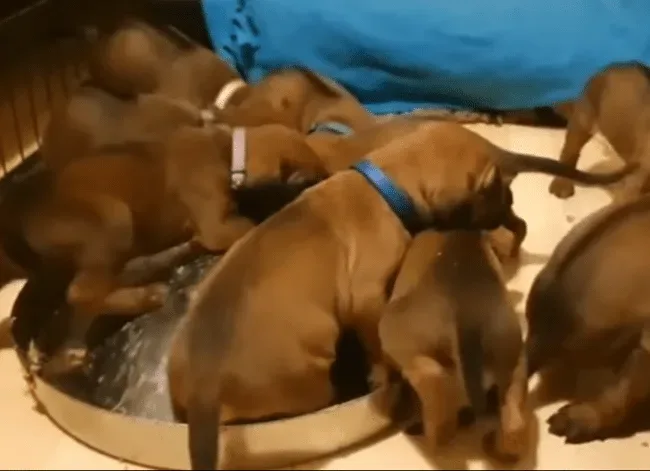
Food changed as well. The puppies began trying soft food from a large feeding tray, and fifteen small bodies gathered around it, stepping in the meal, bumping into one another and turning each feeding into a busy, messy event.
At about three and a half weeks old, they began responding when caregivers called to them. It was a modest milestone, but it said a lot about how quickly they were developing. They recognized familiar voices and showed interest in the people around them. These were no longer fragile newborns doing little more than eating and sleeping. They were becoming curious puppies.
The change was a long way from the anxious fifth day, when it was unclear how the litter would be fed. It also changed the workload. Feeding, cleaning and watching remained constant, but the puppies were now participants rather than only patients.
A Household Overrun by Tiny Paws
By the fourth week, the house was full of motion. Small paws raced across the floor. Toys rolled under furniture. Puppies wrestled, climbed and trailed one another from room to room.
Mealtimes turned into noisy gatherings. Afterward the whole litter often collapsed into a deep sleep, bodies draped across the blankets in every direction.
For Mira, nursing grew harder as her puppies grew bigger and more energetic. At times she had to stand while they crowded around her, fifteen hungry puppies each pushing for the same spot at the same moment.
The scene was chaotic, yet its meaning was hard to miss. Only weeks earlier, Mira had been walking alone through freezing snow. Now she stood among fifteen healthy puppies strong enough to chase, wrestle and compete for her attention.
Others in the household joined the effort. An older dog named Tiya spent time around the growing litter, and a young girl in the home helped care for the puppies and played gently with them. The account does not say how many people shared the work, but it makes clear that the litter had become the center of daily life.
The rescue that began as an urgent response to a pregnant stray had changed the rhythm of the entire house. Every room held some sign of the litter: running paws, squeaky toys, feeding bowls or puppies settling down for another nap. It was tiring, demanding work. It was also the kind of chaos that existed only because Mira had been found in time.
A First Trip to the Garden, and a Family Portrait
At around six weeks old, the puppies reached another milestone: they were ready to explore outdoors. Under careful supervision, the whole litter stepped into the garden together.
Everything about it was new. Grass moved under their paws. Fresh air carried scents they had never met. Birds, distant sounds and shifting leaves offered more to investigate than the nursery ever had.
The puppies reacted in different ways. Some strode forward at once. Others paused in the doorway or stayed close to their siblings. Before long, though, curiosity spread through the group. They sniffed the ground, followed one another across the garden and investigated plants, corners and every object within reach.
These puppies could have been born outside in freezing snow. Had Mira not been noticed, they might have arrived without blankets, warmth, supplemental milk or anyone nearby when their mother became ill. Instead, this outing was a choice. They could explore the garden and then return to the safety of the house, warm, well fed and strong enough to move confidently through a world that had threatened them before they were even born.
Later, Mira stood behind her puppies for a family portrait. All fifteen sat together in front of her, healthy and alert, visibly stronger than the tiny newborns who had once fit against her body in a crowded nest. Mira stayed at the back of the group, watching over them.
The image held sixteen lives connected by a single winter rescue. When Mira was wandering through the snow, no one knew fifteen puppies depended on her. No one knew she would develop a serious infection five days after delivery, or that caregivers would soon be preparing bottle after bottle to feed every puppy around the clock while their mother recovered. By the time the family gathered for the picture, Mira had survived labor and responded to treatment, and her puppies had kept growing through the most vulnerable stage of their lives.
What the account leaves open is as notable as what it records. It does not say where the family lived next, whether the puppies were adopted or what plans were made for Mira. It ends with the portrait: a recovered mother and a healthy litter, together and in good condition.
Her journey began with slow steps through freezing snow. It continued through a long delivery, an unexpected illness and weeks of crowded feedings and puppy chaos. Helping a pregnant animal can also mean helping the young lives that depend entirely on her, and supporting a sick mother can require people to become, for a while, nurses, feeders and guardians for an entire litter. Mira needed warmth before labor and medical treatment when she fell ill. Her puppies needed bottles, supervision and endless patience. The caregivers could not replace her as their mother, but when her body could not manage everything alone, they stood beside her.
By the time she stood behind her fifteen growing puppies, she was no longer a solitary stray looking for a place to stop. She was a mother surrounded by her family, and behind that family stood the people who noticed her before the snow could decide the ending.