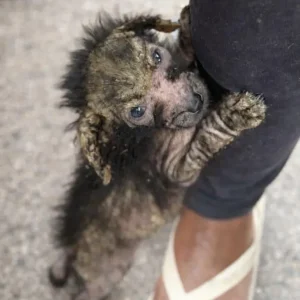
Brown water swirls around a rescuer’s legs while a small dog rides against his chest. Elsewhere, a kitten’s thin cries leak out of a solid wall. A deer slides across a slick pool cover, and a bird dangles from a wire by both legs.
Not one of these animals could say what had gone wrong. All they could do was struggle, then wait to be noticed.
This compilation gathers a dozen such emergencies into a single video. It names no animals, no rescuers and no locations, so the scenes can only be described as they appear. What they share is the response: in each case someone saw trouble, came closer and got involved.
Dry Ground Was Out of Reach
Floods erase the usual map of a neighborhood. Streets vanish under muddy water, and a rooftop or a ledge can become the only dry spot an animal can find.
The opening scene features a rescue worker in bright orange gear moving through a flooded area on foot. A small dog is tucked against his chest, its soaked body held clear of the water, while onlookers watch from higher ground. The danger is easy to read from the footage. He cannot see what lies beneath the surface, and one misstep could pull both of them under. He keeps the dog lifted and keeps wading until the water is shallow enough to stand in.
Another flood victim is stuck above the water instead of in it. A raccoon perches on a damaged roof ringed by water and wreckage. The roof may have kept it dry for a while, but no path down is visible. A rescuer approaches slowly and leads the frightened animal off the unstable structure.
Both animals had gone as far as their own instincts could carry them. Getting out required a person.
Video: Rescuers Help Animals Trapped in Floods, Walls, Pools and Tight Spaces
Carrying Small Lives Through Moving Water
Some flood scenes are less about bravery than about balance. In one, a rescuer picks his way across submerged ground with a basket in his hands. Two tiny dogs sit inside. He holds the basket high, keeping the pair above the current while he decides where each step should land. The dogs play no part in their own escape. Everything rests on his grip and his footing.
A different clip is among the tensest in the video. A dog is caught in fast water that keeps shoving it sideways, and there is no obvious way back to dry land. A man walks into the flow. Every step puts more distance between him and safety, and the current tugs at his legs, but he continues until he can gather the dog in his arms.
Getting out is the harder half. He has to stay upright himself while holding the dog’s head and body clear of the strongest push of the water. He heads for shore slowly, and by the time he reaches firmer ground the dog is still held tightly against him.
When the Trap Is Made of Concrete or Fabric
Weather is not the only thing that corners animals in this video. Some traps are built from concrete and covers that were never meant to hold anyone.
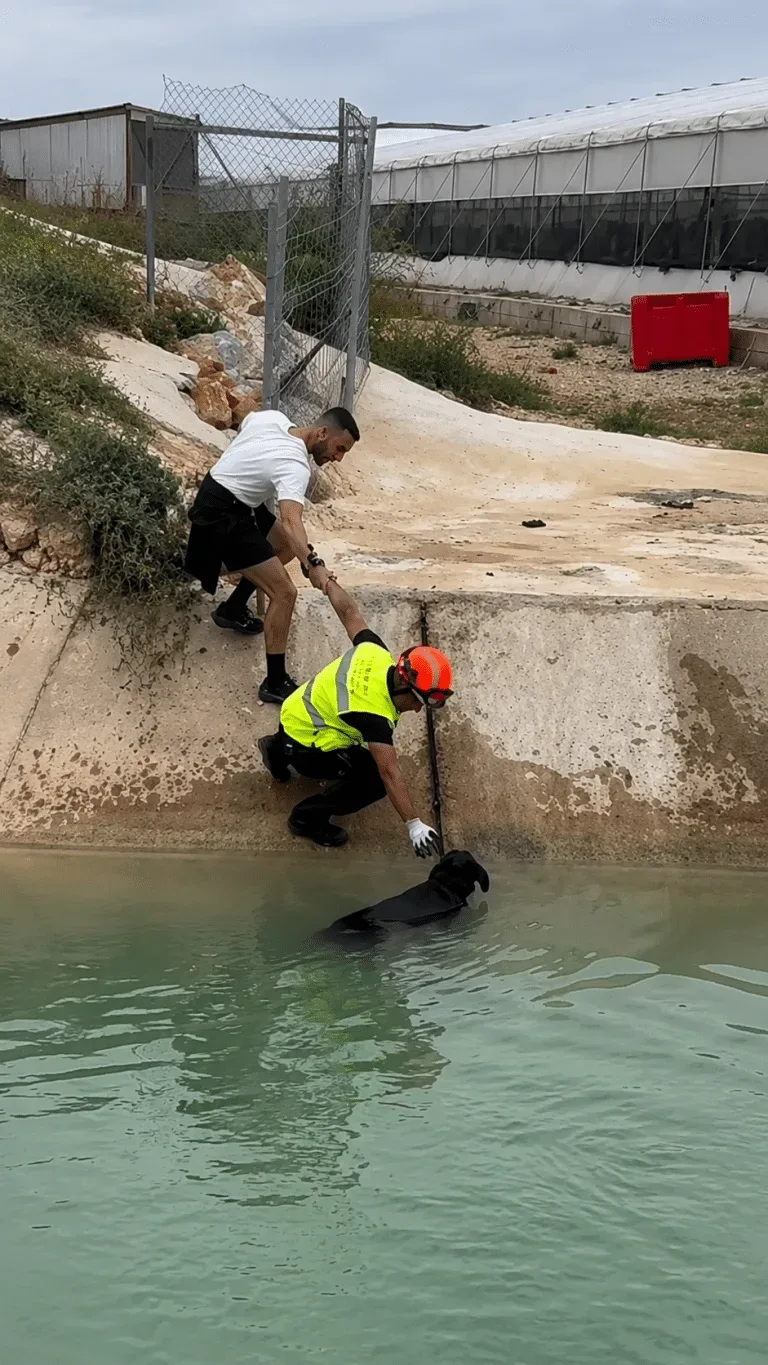
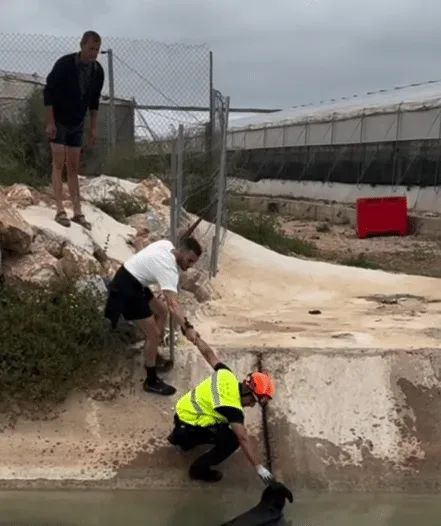
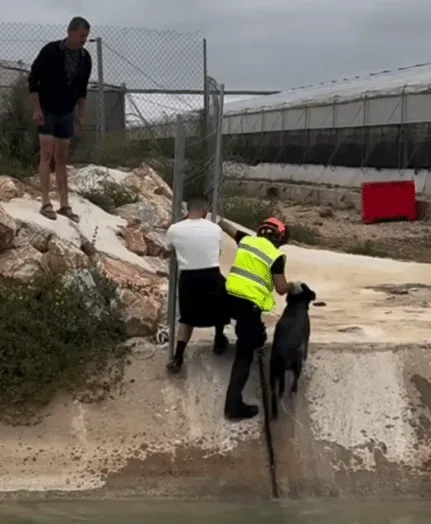
Two men peer down into a deep drainage channel where a large dog is stranded. The walls are steep and there is no ramp or ladder. The dog can walk along the bottom, but nothing lets it climb up to the people above. The men divide the work. They get low enough to secure the dog, then haul its heavy body over the lip onto solid ground. From what the footage shows, neither could have managed this safely alone, since one keeps a firm hold while the other braces.
A swimming pool provides the setting for a second scene. A deer has ended up in the water, and part of the pool is covered in slippery tarp material. Each time the animal moves, its hooves slide without catching. An animal of that size can injure itself or the people nearby if it panics. Two men come at it from separate sides and steer it with care, trying to keep it from getting more tangled in the cover. When the deer reaches an edge it can use, they lift and guide it out.
The deer was not clever or lucky. The rescue worked because the men stayed calm and coordinated while the animal had no way to do either.
Squeezed, Snagged and Stuck: Two Birds in Trouble
One man has to go the opposite direction from the rescuers reaching down into open space. A seagull is wedged in a narrow gap among large rocks, so he squeezes himself into a cramped position to get near it. The bird cannot open its wings, and he must be careful not to hurt it while working at an awkward angle. He reaches in slowly and eases the gull toward the opening. After patient effort, it pulls free.
A much smaller bird is caught by a length of fencing wire, both legs wrapped so tightly that it cannot fly off. A hasty tug could tighten the wire, so the rescuer cradles the bird’s body and loosens the wire a section at a time. The bird fights for a moment. The person does not clamp down harder or rush. When the final strand gives way, the bird is let go.
A Cry From Inside the Wall
One rescue starts with hearing rather than seeing. Faint mewing comes from behind a solid wall, where a kitten is trapped in a spot nobody can pinpoint. Firefighters start opening the structure with care, taking out pieces and listening for any shift in the cries.
Each strike has to be measured. The opening must be wide enough to reach in, yet no debris can drop onto the kitten. In time, hands slip through the broken wall and bring the tiny animal out.
Until that point, the kitten had been entirely out of sight. A passerby could have walked right by without ever suspecting that something was waiting inside.
Gentle Hands for a Foal and a Raccoon
Two scenes depend on softness more than speed. In the first, a man kneels next to a newborn foal as it tries to stand beside its worn-out mother. The foal’s legs wobble, and every try ends with its body sinking down again. He does not haul it upright. He offers support so the young animal can find its balance and let its own legs do the work, and the mother stays nearby. It is a modest kind of help, yet it steadies the foal through its earliest attempts to rise.
In the second, a raccoon has a plastic container stuck over its head. It probably cannot see well and may have trouble breathing or eating, and a frightened raccoon could thrash if handled roughly. A woman moves in a controlled way. She avoids yanking, waits for a workable angle, protects the animal’s body and slips the container off without adding a second scare to the first.
Neither task called for muscle. Both called for patience.
A Hook, a Big Fish and a Quiet Release
The video also wanders well away from floods and walls. A large fish has been hooked, and the hook is still in its mouth. Leaving it there could keep the fish from feeding normally or cause lasting injury.
A woman holds the fish steady and works the hook free. Its size makes the job awkward, since she has to keep the body under control while handling it no more than needed. Once the hook is out, she sets the fish back in the water. It hangs near the surface for a moment, then swims off.
The whole thing takes only seconds on screen, but it fits the video’s repeating pattern: an animal faces a problem it cannot solve, a person understands the danger, and instead of shrugging at a creature that is not theirs, they carefully put it back where it belongs.
People With No Reason to Step In
None of the animals here seem to belong to the people helping them. In many scenes the rescuers appear to have no tie to the animal at all.
The flooded dog could not repay the man who carried it, and the bird freed from the wire had nothing to offer. The raccoons, the deer, the kitten and the fish will probably never see the faces that helped them.
Even so, each person treated someone else’s emergency as worth a few minutes of real effort. Their methods differed widely. Some stepped into water and some wedged themselves between stones. A few used tools, while others had only their hands and steady nerves. Nothing in the footage points to a reward or recognition as the motive.
What the Video Does Not Show
It helps to be plain about what a compilation like this can and cannot tell us. The footage gives no names, no places, and no word on how the foal, the kitten or the flood-stranded dogs fared later. In most clips it shows the moment of help and the first result: a dog on firm ground, a bird released, a fish swimming away. Whatever came after is unknown.
The scenes are also not a how-to guide. Rushing water, deep channels and a panicked deer are hazardous for anyone, and the video records people reacting in the moment rather than setting an example to follow.
What lingers, then, is not the peril but the sequence that repeats. A cry is heard, a movement is spotted, a struggling animal is seen as more than debris, and someone decides to go closer. Each time, that choice changed what happened next for the animal waiting on the other side of it.