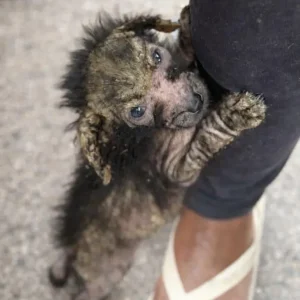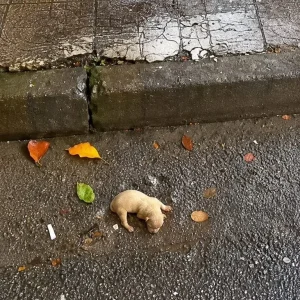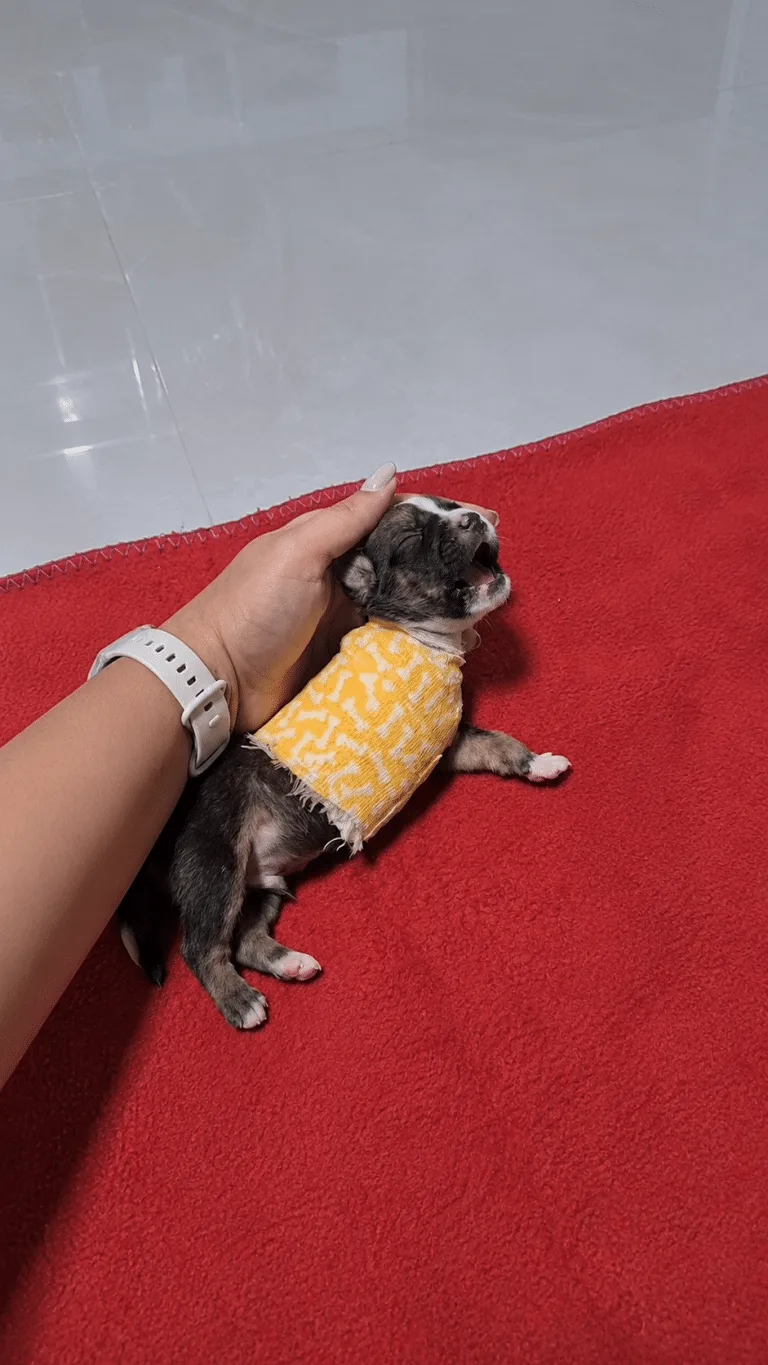
A ten-day-old puppy is usually hard to see at all, because he is meant to be tucked against his mother, warm and asleep. Happy was found beside a pile of garbage instead. He was too small and too weak to move, and one of his legs was severely injured.
He could not search for food or crawl toward shelter. Even crying seemed to take more strength than he had. All he could do was lie where he was until someone noticed him.
Someone did. What followed was a long run of bottles, medication, small victories and clumsy first steps, and it began with a hard decision at a veterinary clinic.
A Hard Verdict for a Very Small Patient
Rescuers lifted the fragile puppy carefully and took him straight to veterinary care. At that age a puppy depends on others for nearly everything: frequent milk, steady warmth and protection while his body builds strength.
The examination brought bad news. The damage to Happy’s leg was too severe for ordinary treatment to repair. The veterinary team decided that leaving the injured portion in place would put the newborn at even greater risk, so they chose to remove it.
Surgery on such a tiny patient carried its own dangers. His body was small and his reserves were limited, and he would need intensive care afterward. Still, the doctors saw a chance to save him and went ahead with the treatment they believed was necessary.
Happy came through the operation. His caregivers now faced the next challenge, which was keeping him alive through the fragile days that followed.
Video: Rescuers Find a Ten-Day-Old Puppy With a Severely Injured Leg
A Bottle Every Two Hours, Day and Night
Surviving surgery did not make Happy ready for ordinary puppy life. He was too young to eat on his own, so his care settled into a demanding schedule. Every two hours he needed milk from a bottle, whether it was the middle of the day, late at night or the early hours of the morning.
Each feeding meant preparing the milk, holding him gently, making sure he took in what he needed and then settling him somewhere warm. His caregivers also cleaned and checked the surgical site and gave his prescribed medication.
They kept asking themselves the same questions. Was he drinking enough? Was his temperature steady? Was he becoming more responsive? For a puppy this young, a small setback could be serious, and recovery was far from guaranteed.
Fevers, Crying Spells and One Tiny Wag
The early days were rough. Happy ran fevers, and on some nights he cried despite the warmth and attention around him. His caregivers could not always tell what was bothering him. They only knew his body had been through a great deal in a very short life.
So they stayed close. They kept up the bottle feedings, watched his temperature, kept his bedding clean and checked the surgical area for signs of healing. For a while, progress was hard to see. Happy stayed fragile and spent most of his time resting.
Then he began taking his milk more eagerly. It was a small change, but it mattered for a puppy who had struggled to get enough nourishment. His weight started to climb and his responses grew stronger. One day his caregivers noticed something that made them smile: a brief wag of his tiny tail.
A Bigger World of Baths, Blankets and Toys
As the weeks passed, Happy’s days became less about emergency treatment. His body kept healing and he kept growing. The things around him began to change as well.
He had warm baths and soft blankets. Toys were placed within reach so he could investigate them. The people who cared for him had become part of his daily routine, and he showed more and more interest in moving toward the ones he recognized.
He mouthed his toys and responded to gentle attention. After a start defined by pain and medical care, he was finally getting something close to ordinary puppyhood: eating, sleeping, playing and discovering new things.
Another milestone was coming, though. Happy was old enough to learn to stand, and unlike most puppies, he would have to work it out with three legs.
Learning to Stand on Three Legs
Balance did not come easily. His small body had to share its weight in a new way, and movements that come naturally to many puppies took real adjustment.
Happy pushed himself upward, wobbled and then lowered himself back down. Sometimes he leaned to one side. Sometimes a promising attempt ended with him sitting down unexpectedly.
He kept trying. His caregivers stayed nearby to keep him safe while giving him room to practice, and they did not expect perfect movement. A few seconds upright were followed by a rest, then another effort and a small shift forward. Bit by bit he learned to move his weight across the legs he had, and those uncertain movements turned into his first steps.
Short Hops, Chasing Toys and Finding Laps
At first Happy moved in short, uneven hops. Turning too quickly could knock him off balance, and crossing a room sometimes took several pauses. But his muscles grew stronger and his coordination improved.
Before long he was heading toward people whenever he wanted attention. He followed familiar caregivers, chased toys, explored the room and climbed toward anyone sitting close enough to offer a lap.
The puppy who once needed help with almost everything was becoming more independent. His missing leg was still part of his life, but it did not stop him from playing. He still wanted to check out unfamiliar objects and still wanted affection.
The veterinarians, meanwhile, had been thinking about something that might support him further as he grew.
The Option Doctors Had Kept Open
During Happy’s early treatment, the veterinary team had preserved part of the affected limb. That left open the possibility of a prosthetic leg later on.
It was not a guarantee, and it did not mean Happy needed one to enjoy life. By this point he had already shown he could stand, get around and play. But a properly fitted prosthetic might give him extra support as he grew and could help spread pressure more evenly across his body.
When a custom device was eventually prepared, Happy faced yet another unfamiliar experience. He had already learned to balance without part of his leg. Now he would have to adjust again, because the prosthetic would change how his body met the ground.
His caregivers knew that attaching it would not be enough. Happy needed practice, encouragement and the freedom to move at his own pace.
Trying a New Leg, One Cautious Step at a Time
When Happy first wore the prosthetic, he seemed unsure. He looked toward the unfamiliar attachment, shifted his body and appeared uncertain about how to fit it into his movements.
His caregivers encouraged him with calm voices and treats, and they gave him time to get used to the sensation. Then he took a careful step. He wobbled, adjusted his balance and tried again. At first he seemed reluctant to put weight through the prosthetic, but with practice he began letting it touch the ground.
It went much the way standing on three legs had gone, with repetition, pauses, awkward attempts and small improvements. Gradually the device felt less strange and his steps became more coordinated. Soon he was moving with the enthusiasm that had become part of his personality.
By Christmas, a Different Dog
Months after his rescue, Happy looked nothing like the tiny puppy found beside the garbage. He had grown, his body was stronger and his movements were more confident. He played with toys, followed his caregivers, explored his surroundings and settled into their arms when he was ready to rest.
By Christmas, the change was striking. The newborn who once needed a bottle every two hours had become an energetic young dog who could get around on his own, enjoyed attention and had adjusted to using a prosthetic.
The device was only one part of that. Happy got here because people kept caring for him long after the emergency surgery was over. Someone stayed up for the night feedings. Someone watched his fevers and kept his bedding clean. Someone encouraged his first attempts to stand, and someone stayed beside him while he learned to use the prosthetic.
The cause of his injury was never explained, and the story does not say what comes next for him. What is known is that a puppy who lost part of a leg before he could walk was given time, medical care and steady company. He could not change how his life began, but the care he received shaped everything that came after, and he now has the chance to grow into his name.