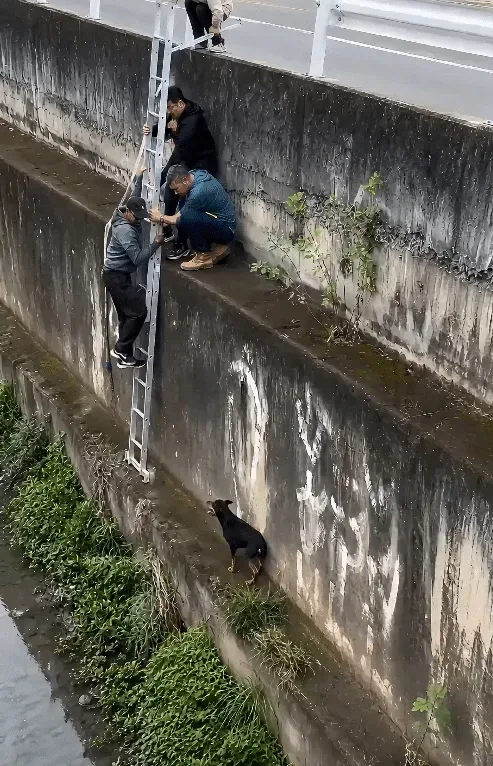
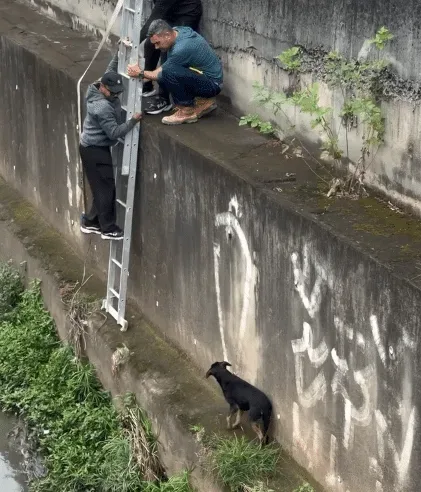
At the bottom of a deep concrete canal, a black dog was walking in circles. He completed one lap of the narrow strip of ground, paused, and started another.
The walls around him were smooth and steep, far too tall for any dog to scale. According to the account of the rescue, nothing held him in place. He was not tied up, and he showed no obvious injury. The canal itself was the problem.
A person walking along the top could easily have missed him. On this occasion, three men did not.
Pacing the Only Ground He Had
The dog seemed to be looking for a way out. He moved along the base of the canal and turned his head toward the walls, as if hoping to find a gap, a slope, or any rise in the cement that might lead upward. There was nothing like that. Concrete rose on every side, and the height made jumping out impossible.
From above, the canal was easy to pass by. One glance in another direction and the dog would have stayed out of sight. But the three men looked over the edge, and it was clear to them that he could not climb out alone. Nothing in the account suggests they hesitated about stopping.
Video: Three Strangers Lower a Ladder Into a Concrete Canal to Reach a Trapped Dog
Working Out the Descent
The men did not simply jump into something risky. They settled on a plan first. Someone found a long aluminum ladder, and they lowered it slowly down the wall until it touched the canal floor near the dog. It became the one connection between the trapped animal and the ground above.
One of the men agreed to climb down. The ladder was tall, the walls were steep, and there was little room for a misstep, so every rung called for care. Below him, the dog stayed calm and watched the man approach.
A Dog Who Did Not Run
When the rescuer reached the bottom, the dog stayed where he was. He did not bark, back away, or struggle. He simply waited.
Speaking softly, the man picked him up. The small black dog rested against his chest, quiet and still. It is tempting to call that trust, and his calm certainly made the handoff easier. What the account actually shows is more modest: he allowed himself to be carried without resistance.
The Climb Back Up
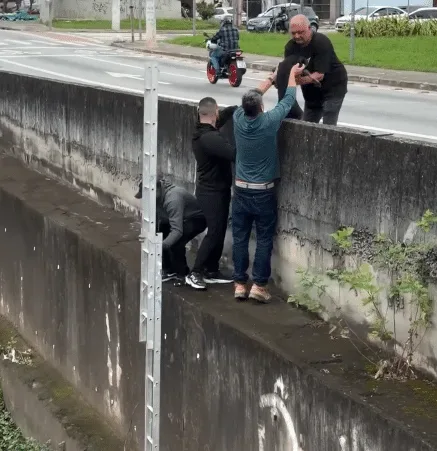
Getting out was the hardest part, and it took more than one person. With the dog held securely, the rescuer started up the ladder. A second man leaned over the edge of the canal to guide him and keep him steady.
Their pace was slow and deliberate. One step, then another, with help always within reach. At last, the man and the dog reached solid ground.
No special equipment or training made this possible. The rescue worked because three strangers shared the job, each doing his own part.
Safe, but Still Watchful
Even on level ground, the dog stayed in the rescuer’s arms for a little while. His eyes still looked uncertain, a sign that the fear of being shut in did not disappear the instant he left the canal.
Still, the danger was over. The tall concrete walls were behind him, and he was out in open air with room to move.
What the Account Leaves Unsaid
The story ends at the top of the canal. It does not say whether the dog had an owner, where he went afterward, or whether anyone later gave him a home. Those answers are unknown, and it is better not to guess.
What the account does record is a complete rescue: a trapped dog, a plan, a ladder, and a safe return to open ground.
Why Three Men and One Ladder Were Enough
It was a modest event on paper. Three men, one ladder, and one dog. No one in the account appears to have wanted praise or attention. They saw an animal in need, worked out a safe way to reach him, and carried it through patiently.
The dog had no visible injury, and no one describes him crying out. He was simply stuck, and it took people willing to look down to realize it.
Because those three stopped long enough to build a way up, the black dog left the canal in a rescuer’s arms and reached open ground.