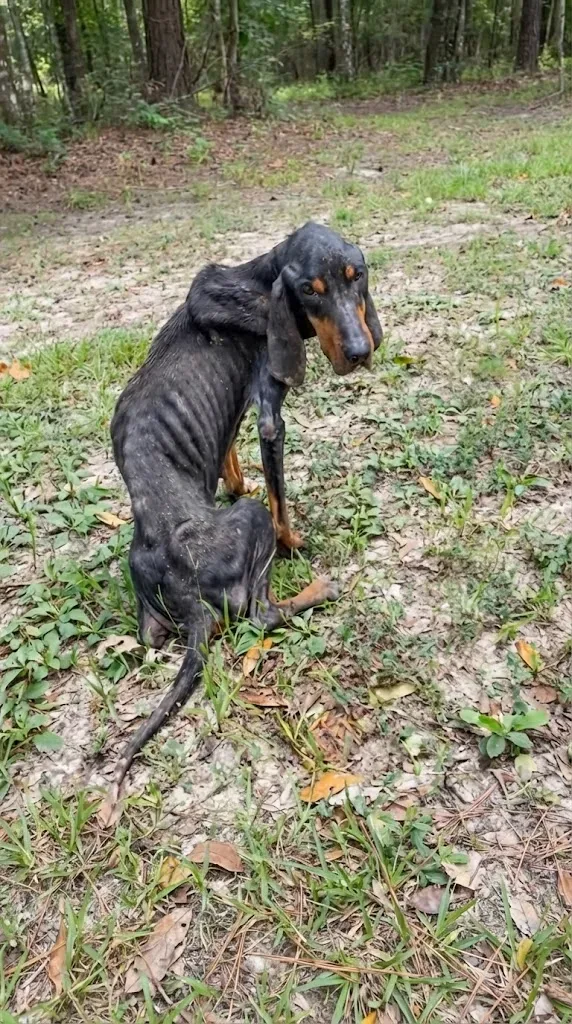
The road was quiet and far from the nearest homes. The dog lying beside it was easy to miss, and she was so still against the dusty ground that she hardly looked alive.
Her name was Nora. She was painfully thin, her legs trembled when she tried to move, and each breath seemed to take effort. Nothing dramatic had drawn attention to her. There was only an empty stretch of road and a dog who looked as though her strength had run out.
Then rescuers stepped closer, and Nora lifted her head. It was a small movement, and a person could easily have missed it. But it told them she was still there.
A Dog Easy to Miss at the Edge of the Road
No one could say how long Nora had been alone. Her body suggested it had been a hard stretch. Her ribs showed clearly beneath her skin. She was severely dehydrated, and long-term hunger combined with an ongoing digestive illness had worn her down to almost nothing.
She was not wandering along the roadside. Every unsteady step and shallow breath looked like work just to keep going.
Frightened or neglected dogs often hide, bolt or turn defensive when strangers come near. Nora did none of those things. She stayed where she was and watched the rescuers closely. She showed no aggression and made no attempt to get away. She seemed exhausted, and perhaps willing to let these people try to help.
When a rescuer reached out, she allowed the touch. A warm blanket was wrapped around her thin frame, and she was lifted gently into the vehicle. She felt almost weightless. On the drive she barely moved, as if saving whatever energy she had. The mood stayed calm rather than frantic, but everyone understood she needed a veterinary team without delay.
Video: Nora Is Found Beside the Road and Begins Her Slow Recovery
Why Every Spoonful Had to Be Measured
At the veterinary clinic, the medical team quickly saw how dangerous Nora’s condition was. After so long without proper nourishment, her body could not safely take in large amounts of food or water. Too much, too soon, could overwhelm a system that was already weak.
So treatment moved slowly. Controlled fluids began to restore her hydration. Tiny meals were given by syringe, with small portions of nutrition spread across the day. The goal was not to end her hunger in one sitting. It was to help her body start working again.
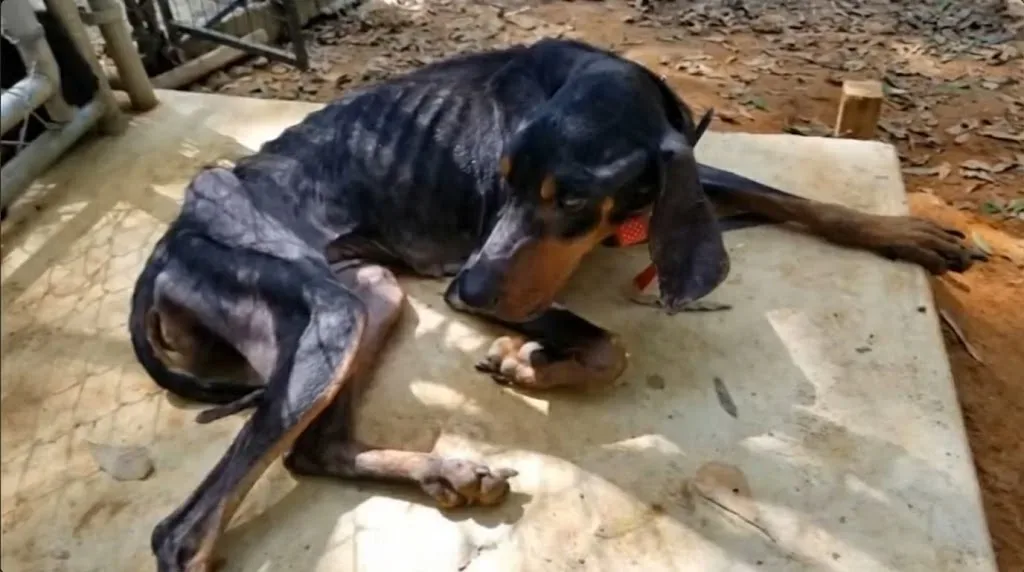
For the first several days, Nora lay almost motionless on soft blankets and rarely raised her head. Food placed nearby was not ignored for lack of interest. She simply did not have the strength to eat without help.
Caregivers stayed close. They watched her breathing, checked her temperature and noted every small response. There was hope, but there was also uncertainty, because no one could promise that her exhausted body would be strong enough.
The Afternoon She Raised Her Head
Then, one afternoon, Nora lifted her head from the blanket. It lasted only a moment, but the caregivers noticed at once.
A few hours later she accepted several careful sips of water. Soon her eyes began to follow the people moving around her room. To an outsider these details might have seemed trivial. To the people caring for her, they were proof that she was responding.
The days that followed brought progress in the same small increments. Her breathing grew steadier. She rested for longer stretches. At each meal she managed a few more bites than before. Her body was still dangerously fragile, but something had shifted.
Nobody celebrated loudly. The caregivers simply kept at it, with a little more reason to believe it was working.
A Small Coat and a Predictable Day
Nora’s weakened body had trouble holding on to heat, so caregivers often dressed her in a small coat. Food was there to nourish her from the inside, while the coat helped her keep the little energy she had.
Her days were built from simple, repeatable things. Meals arrived at regular times. Fresh water stayed within reach. Her bedding was kept soft and dry, and gentle hands checked on her without startling her.
A routine can mean a great deal to an animal who may never have had one. As the sequence repeated, Nora appeared to settle into it. The people who came to her room brought warmth and food, and they stayed through the harder moments. Whatever she had experienced before, her responses suggested she was beginning to link them with comfort.
By this point, recovery was no longer only a matter of fluids and calories. Her behavior was starting to change too.
The First Bath
One of the most meaningful moments came with Nora’s first bath. Dirt had collected across her coat, and her skin needed careful cleaning. Rescuers half expected the warm water to frighten her.
Instead, she stayed still. Then, slowly, she leaned into the hands washing her. She did not struggle or look for a way out. She accepted the care.
For the team, the bath was about more than getting clean. It hinted that she was starting to trust them. Dogs who have lived through uncertainty rarely understand right away that they are safe. They learn it through repetition. A hand touches without hurting. A voice stays calm. A meal arrives again. A bed is still there the next morning.
Nora seemed to be learning that lesson one day at a time, and the bath was among the clearest signs that it was taking hold.
From Watching the Room to Walking Through It
As her body gained strength, Nora began paying attention to the shelter around her. At first she only watched. She followed caregivers with her eyes and listened when familiar voices came into the room. She noticed other rescue dogs resting nearby.
Before long she was taking short walks around the shelter. The distances were small, her legs still tired quickly, and she often paused to rest. But each outing carried her a little further from the helpless dog who had been lying beside the road.
She began inspecting unfamiliar spaces with quiet curiosity, and even the toys scattered nearby caught her interest. The world was no longer something she only had to endure. It was becoming something she wanted to explore.
A Careful Friendship With the Puppies
The shelter’s puppies became an unexpected part of Nora’s recovery. At first she watched them from a distance. Their energy was nothing like hers. They ran, played and greeted everything with excitement, while Nora stayed cautious.
Then one day she moved closer. She walked alongside them and let them greet her. Eventually she rested calmly while they gathered nearby.
Caregivers saw a gentler side of her appear, one that hardship seemed to have pushed into silence. She was patient with the puppies and more relaxed in their company.
For the rescuers, that change mattered. Nora was no longer spending all her energy on survival. She had enough strength to notice others, and enough comfort to accept companionship.
Four Weeks, Measured in Small Changes
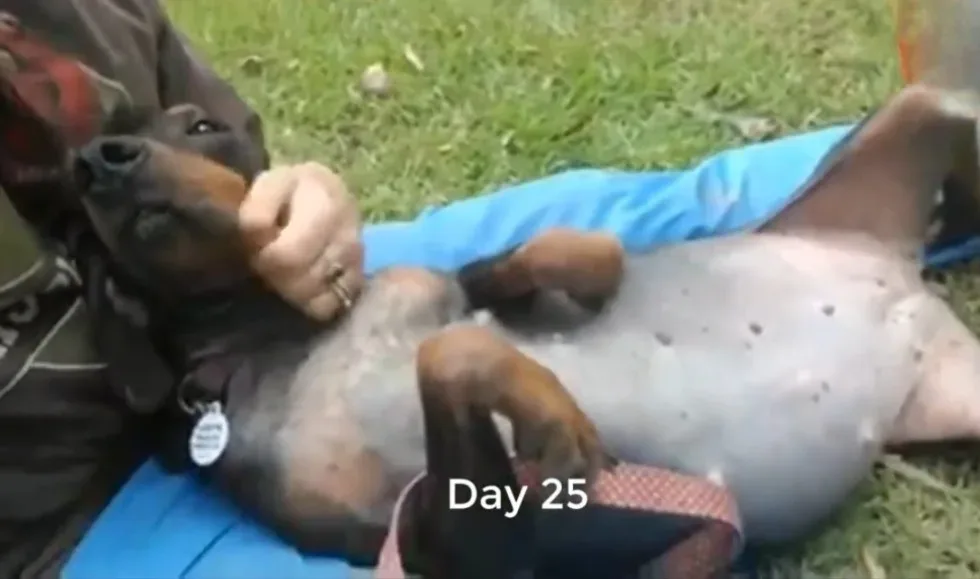
Nora’s transformation did not happen overnight. It came in stages. Around the tenth day, her energy improved noticeably. She lifted her head more often and responded eagerly when caregivers came near.
By the third week, her steps were steadier and she could walk farther without stopping. A healthier weight slowly returned to her frame, and her coat began to regain its softness and shine. By the end of the first month, she looked almost unrecognizable next to the fragile dog found beside the road.
Some of the most important changes could not be measured on a scale. Her body relaxed. Her eyes softened. She no longer looked like a dog bracing for something bad. The animal who had once lain nearly motionless in the dirt now greeted familiar people with calm curiosity.
Where Nora’s Story Stands Now
Today, Nora no longer spends her days fighting just to stay alive. She eats peacefully, sleeps deeply and walks with confidence. Sometimes she even runs. The roadside where she was found now belongs to her past, replaced by regular meals, warmth, companionship and people who notice every change in her.
The account does not say where she will live next, and it does not need to for the point to land. Nora’s rescue was not defined by one extraordinary moment. It was built from ordinary acts of care: a blanket around a trembling body, a few drops of water, a tiny meal, a warm coat, a gentle bath and a patient hand that returned every day.
That is often how healing arrives. Not all at once, but in movements so small that only those watching closely can see them. A tired dog lifts her head. A careful sip of water goes down. For Nora, life came back one small step at a time, until she was no longer merely surviving.