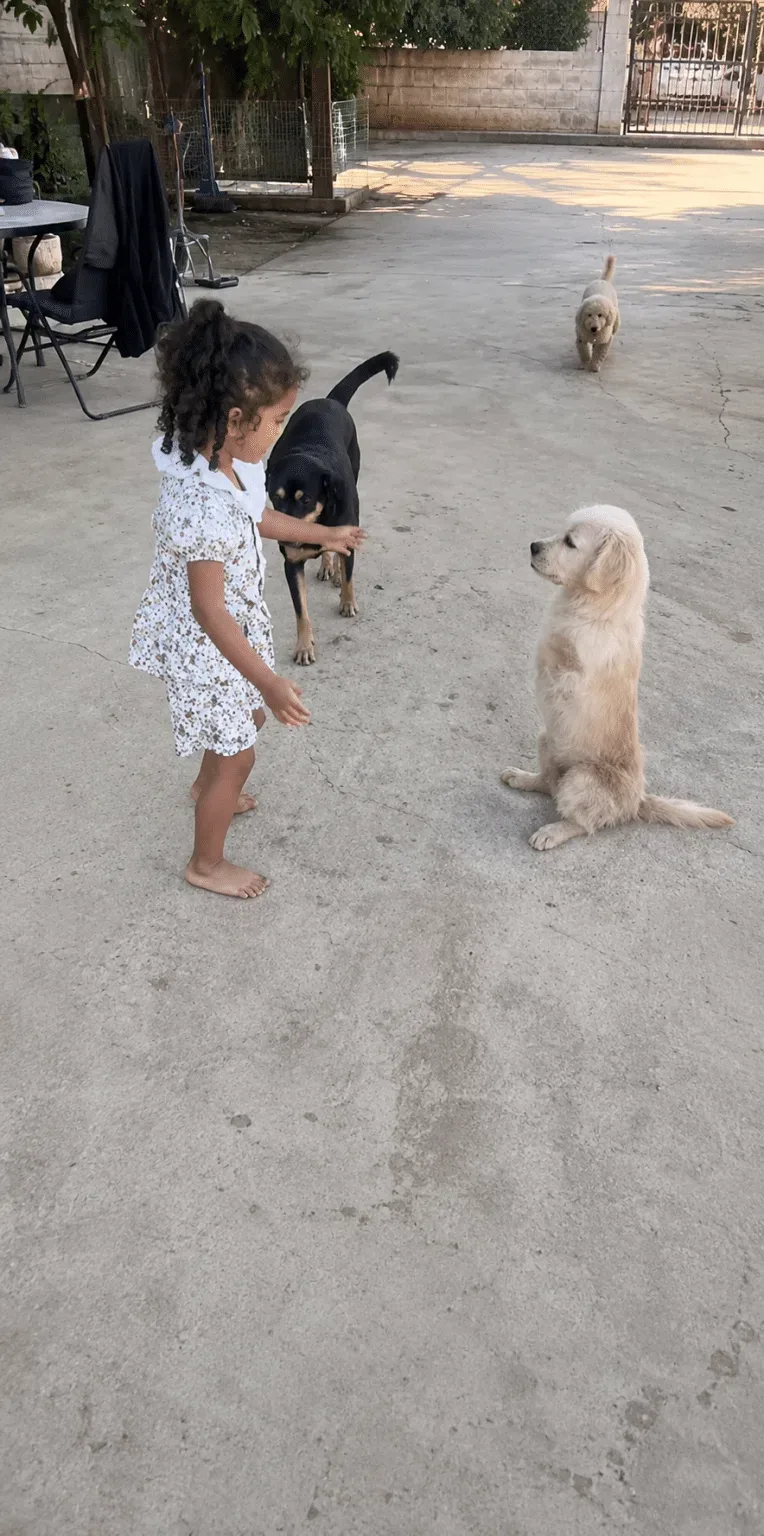
Most viewers register an absence first. The small golden dog in this short video was born without front legs, so every step, every turn and every dash toward a friend depends on the two legs at the back of his body.
Then he moves, and the focus shifts. He lifts his chest, finds his balance and launches forward in quick hops, his tail swinging the whole way. Within seconds the question is no longer how he copes. It is who he is chasing.
The clip is cheerful and brief. It shows him with a young girl and other children, and it never gives his name, his age or where he lives. What it does show is a dog who has settled on his own way of getting around, and people who leave room for him in their games.
Two Legs, a Lot of Bounce
Movement that most dogs never think about takes real coordination for him. Standing is a balancing act. Changing direction means shifting his weight at exactly the right moment. A bumpy patch of ground can be a bigger obstacle than a smooth floor.
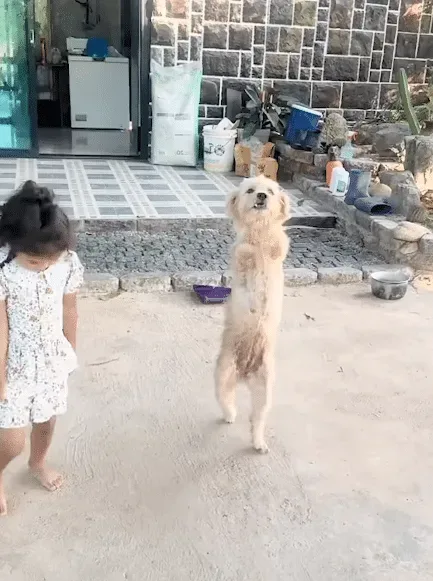
In the footage, he has clearly worked out a method. He raises his upper body, plants himself on his hind legs and travels in bouncing hops. His tail shows his excitement, while the rest of him keeps making small corrections to stay upright.
Now and then he pauses to steady himself. Then he goes again.
The way he moves is unusual, but it does not look hesitant. He seems at ease in his own body and comfortable in the places he knows. When children are playing nearby, he does not wait for someone to carry him over. He heads for the action under his own power.
Video: Two-Legged Golden Dog Hops Alongside the Children He Loves
Matching the Pace of a Young Girl
His confidence is easiest to see when the young girl is near. She plays outside, and he hops along just behind her, keeping up in the way he has learned. When she turns, he turns. When she stops, he stays within reach and watches for what comes next.
What makes the scene so likable is how ordinary it feels. She does not appear to be thinking about the fact that he has only two legs. She does not keep her distance, and she does not handle him as though he might break.
She laughs, calls him along and includes him.
He answers with plain enthusiasm. His tail speeds up, and he keeps angling his body toward her as they play. There is very little space between the two of them, and that says more about their bond than any explanation could. In these moments he does not come across as a lesson or a curiosity. He is simply her playmate.
The Effort Behind the Fun
None of this is effortless. His hind legs carry his whole body weight, and the muscles that keep him balanced have to work differently from those of a dog on four legs.
Even so, regular activity seems to have made him more capable. Each hop uses the parts of his body he relies on most, and each turn is another chance to practice repositioning himself. Familiar surroundings probably help as well, since he can move with less caution on ground he knows. That last point is an inference, not something the video states.
Play gives him a reason to keep moving without turning every step into a training exercise. He trails the children, explores the yard and reacts to voices and activity as if something interesting might be waiting around the next corner.
At times he stops or lowers himself to rest. That takes nothing away from what he can do. Adapting to a physical limitation does not mean pretending it causes no difficulty. It means finding safe, workable ways to live with it, and he appears to have found his.
Riding Upright in a Pickup Bed
One segment of the video shows the little dog riding with the children in the bed of a pickup truck. He stands on his hind legs, facing the moving air, with his ears and fur stirring in the breeze. His posture is alert, and his tail keeps going as he takes in the view.
The moment shows how much he wants to be included. He does not seem content to watch family outings from a distance. He wants to go where the people he trusts go and see what they see.
A note of caution belongs here, though. Any dog in a vehicle needs secure restraint and close supervision, and a dog balancing on two legs could be especially vulnerable to a sudden stop or an uneven surface. The scene should not be read as a model for how to transport a dog.
What stands out is not the truck but the dog’s evident curiosity. He looks outward with interest, yet he stays near the companions who have welcomed him into their lives.
What the Footage Leaves Unanswered
It helps to be clear about what the video does not tell us. It gives no name for the dog, no age and no location. It does not explain how he came to live with the children, and it does not describe any veterinary care he has received.
It also does not say whether he uses a wheelchair, a harness or any other assistive device. Those questions stay open, and there is no honest way to fill them in from a short clip.
What the footage can support is smaller but still meaningful. This dog is allowed to move. He is surrounded by children who play with him, and he seems energetic and engaged in the moments the camera captured.
Everyday Needs in an Uncommon Body
Although he moves in an uncommon way, many of his needs are the same as any other pet’s. He needs affection, mental stimulation, and chances to play, explore and rest.
He also needs care shaped around his body. In general, dogs who rely mostly on their hind legs can put extra strain on their hips, joints and spine. Veterinarians commonly point to a few things that can help dogs like him:
- Comfortable, non-slip surfaces to rest and move on
- Sensible limits on how long and how hard they play
- Regular veterinary checkups, especially as they age
- Mobility support when an individual dog needs it
None of that is described in the video, so it should be read as general background rather than a report on this dog’s routine. The broader point still applies: a joyful dog is not the same as a dog who needs no attention to his physical well-being.
Protection Without Taking Away Freedom
Some dogs with missing limbs benefit from custom carts or other devices. Others move on their own for short stretches and get help when they need to cover longer distances. The right approach depends on the individual animal, and a veterinarian is usually the best guide.
Whatever the answer is for this dog, the clip suggests a balance worth noticing. He is not being kept still for the sake of safety, and he is not being pushed to prove anything. He gets to join in.
His happiness does not mean his condition has no effect on him. It more likely reflects the people around him building a daily life where he can take part in a way that is safe and that matters to him.
How the Children See Him
The young girl offers one of the clearest examples of acceptance in the video. Children tend to respond to animals very directly. They notice whether a dog wants to play, whether he follows them and whether he likes being close. They often care less about comparing him with a picture of what a dog is supposed to look like.
She invites him into her world without asking him to move the conventional way. He hops. She runs nearby. Together they make whatever small adjustments the game requires, and those adjustments never become the center of attention.
That kind of inclusion can matter a great deal for animals born with disabilities. They may need help, but they also need chances to make their own choices. They need protection, but they should not be shut out of play and exploration by default.
More Than a Missing Pair of Legs
A physical difference can easily become the only thing people remember about an animal. A few moments of watching this dog suggest there is more to see.
He is curious. He enjoys attention. He wants to stay near the children, and he grows visibly excited when play begins. He seems determined to reach whatever has caught his eye.
His missing front legs explain how he moves. They do not explain who he is.
It would be easy to call him inspiring simply because he gets by on two legs, but that is not really the heart of the video. What stands out is the ordinary life he gets to enjoy: company instead of isolation, freedom to move instead of being held back, and play instead of being treated only as something fragile. His family seems to understand that he needs both care and room to be the lively young dog he appears to be.

What Stays With You After the Clip Ends
The little golden dog did not choose the body he was born with. He cannot run on four legs, rest his front paws in someone’s lap or cross every surface without difficulty.
Yet his days hold much more than those limits. He has a girl who plays beside him, children who keep him in the group, outdoor space to explore and a home where he is welcome rather than treated as a burden.
His story does not prove that love makes every physical challenge disappear. It shows what becomes possible when care, adaptation and acceptance work together. With the right support, an animal born differently can still form close bonds, show excitement and share in the everyday pleasures of family life.
The video leaves his name, his age and the details of his care unanswered. What it makes plain is how he behaves when he is happy. You can see it in the speed of his tail, in the way he follows the children and in how eagerly he lifts himself up and heads toward whatever comes next.
Most viewers notice his missing legs first. Those who keep watching tend to notice something else: a lively little dog who has found his own way of moving, and people who make sure he does not have to face the world alone.