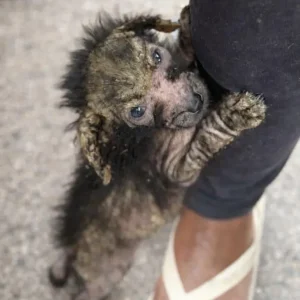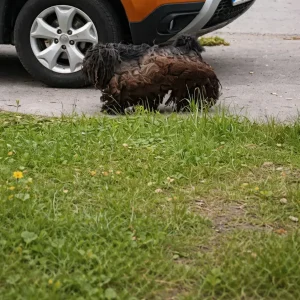
There was no dog in sight. There was only a dark, heavy mass of fur that shifted slightly whenever something inside it tried to move.
That something was Sprout. His face, his legs and the outline of his body had all disappeared under compacted mats, and even standing up or changing position looked like hard labor. The people who met him could not say what breed he was. They could only see that he needed help, and that freeing him would take far more than a routine grooming visit.
What followed was a carefully planned medical procedure, weeks of recovery in a foster home, and the gradual return of a dog who had been there all along.
A Coat That Had Turned Into a Shell
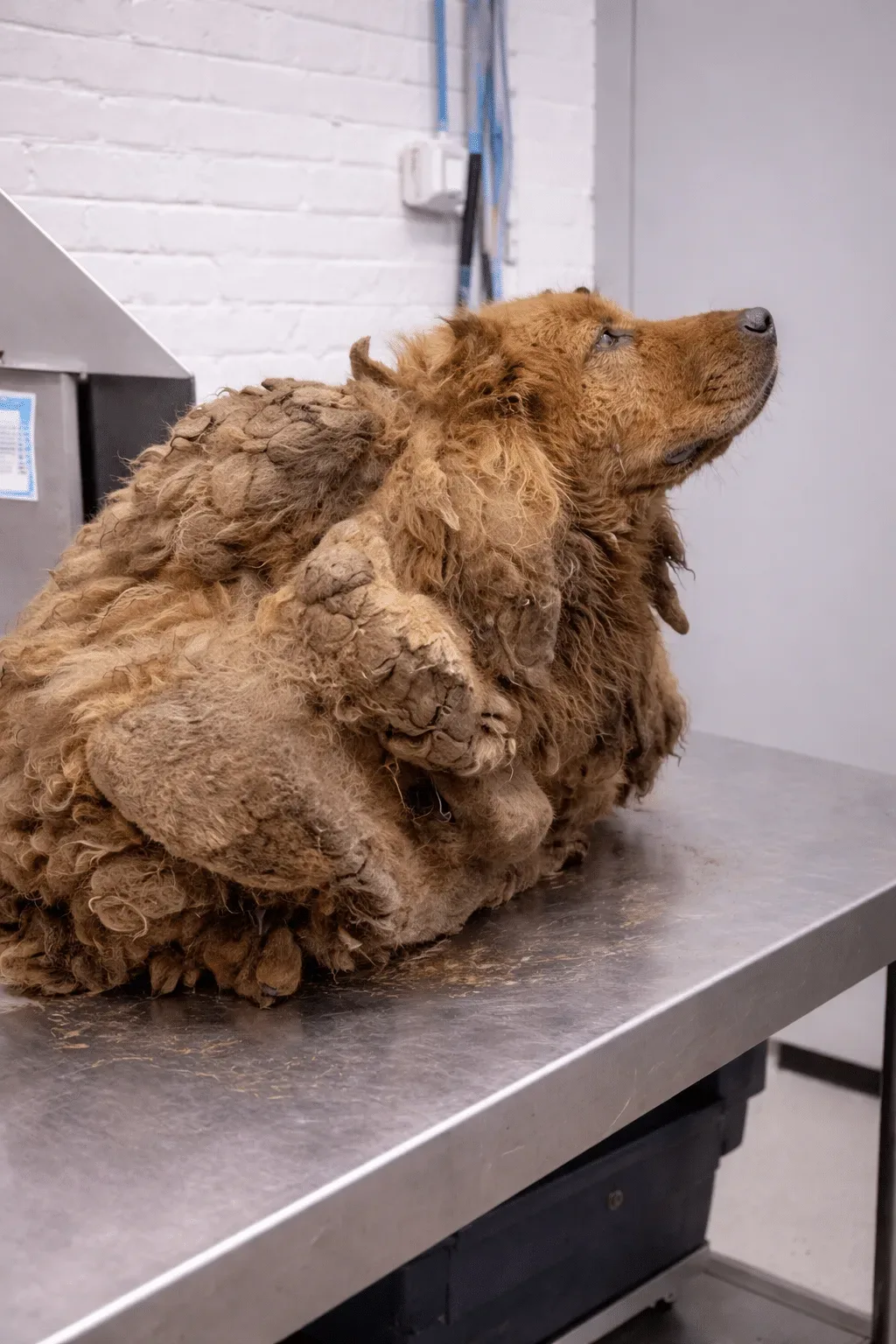
According to the rescue account, Sprout’s coat was not simply long or untidy. It had pressed together into thick layers filled with dirt and covered almost his entire body. Large sections had fused into a heavy shell that swung and dragged whenever he took a step.
The usual landmarks of a dog were gone. His legs were hard to pick out. His face was nearly hidden. Nobody could trace the line of his back or chest by eye.
Ordinary movement looked restricted. When he walked, the coat came with him. When he tried to lie down, dense sections folded beneath his body. The weight was more than an inconvenience. It also kept rescuers from examining his skin or learning what other problems might be underneath.
No one could confirm how long Sprout had lived this way. Mats on this scale build up slowly when a dog goes without the grooming his coat requires, but the source gives no timeline.
Video: Sprout Under the Heavy Coat, and the Moment His Face Begins to Show
From Official Intervention to a Rescue Group’s Care
Chicago Animal Care and Control stepped in and brought Sprout to safety. He was then transferred to a rescue organization, One Tail at a Time. The account does not explain how he was first found or who noticed him. It says only that authorities intervened and moved him out of the situation.
The handoff mattered because the fur was not the only unknown. No one could yet say what shape Sprout’s body was in, and the coat itself blocked any answer. The rescue group had to find a way to remove the mats without causing more harm.
The goal was twofold: lift the burden he was carrying, and find out what that burden had been hiding.
Why the Clippers Had to Wait for Sedation
Sprout’s condition was too severe for an ordinary grooming table. The mats sat tight against his body, and the team could not clearly tell where the fur ended and his skin began. Trying to cut the coat away while he was awake risked unnecessary stress and an accidental injury.
Veterinarians decided sedation was the safest route. Under medical supervision, Sprout was prepared for a procedure that would combine grooming with a full check of the body beneath the coat.
That pairing was deliberate. Irritation, wounds or tender spots could be concealed under the mats, so each cut had to be planned. The team used professional tools to open the outer layers first, then worked gradually closer to his skin.
A Dog Emerges, One Section at a Time
The work started slowly. One piece of compacted fur came away, then another. Large clumps were set beside the table as the team moved across his legs, chest, belly, back and face.
It took hours. From a distance, the coat had looked like a single enormous mass. Up close, it was a tangle of layers, dirt and debris that had built up over time.
Then, bit by bit, the dog appeared. A paw came into view. Next the outline of a leg. Eventually the team uncovered his face and could finally see the animal they had been working for.
Nothing about the process could be hurried. The point was not a neat haircut. It was a body that could at last be seen, examined and treated.
Thirty-Two Pounds Lighter, With Work Still Ahead
When the procedure ended, roughly 32 pounds of matted fur, about 14.5 kilograms, had reportedly been removed. The pile beside him was huge. It is close to the weight of a medium-sized dog, and Sprout had been carrying it on top of himself.
Without the mats, he looked dramatically smaller. His natural shape was visible again, his legs were no longer wrapped in heavy cords of fur, and his face was no longer buried.
For the first time, the team could examine his skin properly. Areas that had been trapped under the coat showed irritation and infection. His body was weak, and the condition he had been living in could not be fixed by grooming alone.
Still, the most immediate load was gone. He no longer had to haul that weight each time he stood, and the dense coat no longer tugged at his skin when he shifted. He could begin recovering as a dog, instead of staying locked inside something he could never have removed himself.
The Quiet Minutes After Waking
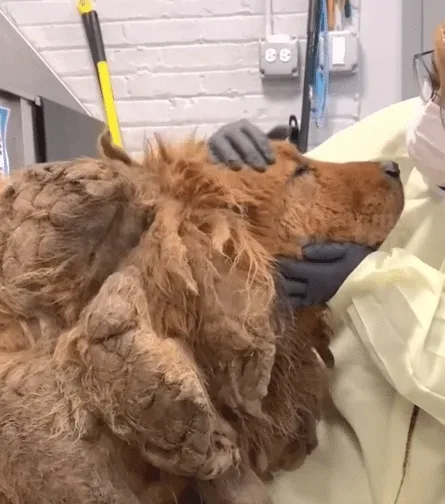
As the sedation wore off, caregivers watched Sprout closely. His first movements were small. He lifted his head, and without the mats around his neck, the motion seemed easier than it had been before the procedure.
He looked around the room with warm, attentive eyes that no one had been able to see when he arrived.
The change was striking, but Sprout was not suddenly well. His skin still needed treatment. His strength had to be rebuilt. And after years of carrying a restrictive coat, if that is what it had been, he would need time to learn how to move without it. The source does not say how long the mats had been forming, so that part remains unknown.
Nobody expected him to stand up and run. The team supported him while the medication faded and kept him warm as his body recovered from the long procedure. His first attempts to shift position were cautious. Air could now reach skin that had been covered for a long time, and his legs could move without dense fur resisting them. For the moment, raising his head and staying alert were enough.
A Slower Kind of Healing in Elisa’s Home
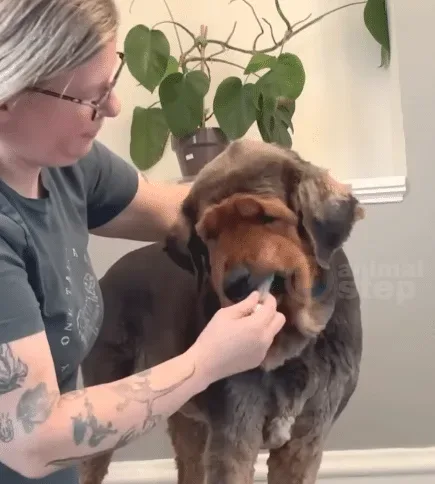
Once Sprout was stable enough to leave intensive medical care, he moved in with a foster caregiver named Elisa. What he needed there was simple: quiet rooms, soft bedding, regular meals, and time to regain strength without being overwhelmed.
At first he moved carefully. His muscles had worked for so long against constant resistance that they could not behave as though nothing had happened. Elisa let him set the pace. There was no pressure to tour the whole house or to interact all day. Sprout had a comfortable spot from which to watch his surroundings and decide when he was ready to come closer.
Treatment for his skin infections continued. His nutrition was monitored, and caregivers kept an eye on his movement, appetite and energy for signs that his body was responding.
Small improvements followed. He stood for longer stretches. His steps became steadier. He showed more interest in what was happening around him.
Friends, Fresh Air and a Run Across the Yard
As Sprout grew more comfortable, his personality began to show. He responded when Elisa walked into the room. His tail moved when familiar people approached. Instead of staying in one resting place, he followed the activity around the home and explored new spaces with growing confidence.
None of it happened overnight. One day he walked a little farther. Another day he stayed close while someone gently touched him. Then he started seeking attention instead of merely accepting it.
He also met other dogs. The introductions were supervised and allowed to unfold calmly. He watched his new companions, learned their routines, and slowly began sharing space with them. Before long he was walking beside another dog, investigating the yard and resting near his new friends.
The yard offered the clearest picture of how far he had come. His early steps had been careful and measured. Later he crossed the open space with more confidence, walking farther, then faster, and eventually running. The dog who once struggled under 32 pounds of matted fur was moving across the grass with nothing dragging him backward.
These moments may look ordinary, but they mark a real change. Sprout was no longer spending all his energy carrying the weight around him, and that left room for curiosity, companionship and play. His body was still rebuilding, and his medical recovery needed continued attention. Yet the freedom in his movement was hard to miss. He could choose where to go, follow another dog, or approach Elisa simply because he wanted company.
What Changed, and What Is Still Unfolding
Sprout’s rescue depended on many hands. Chicago Animal Care and Control removed him from the situation in which he was found. One Tail at a Time took responsibility for his treatment and recovery. Veterinarians sedated him so the coat could come off without further harm. Groomers spent hours freeing his body. And Elisa gave him a foster home where progress could continue once the most dramatic part was over.
It helps to remember what the coat had done beyond changing his appearance. It limited his movement, hid his skin from examination, and covered irritation and infection that came to light only once it was gone. That is why the procedure was medical rather than cosmetic, and why veterinarians were involved.
The pile of fur made for an unforgettable before-and-after image, but the recovery that mattered came afterward: medication, regular meals, clean bedding, short walks, gentle introductions to other dogs, and calm days when nothing frightening happened. The coat came off in a matter of hours. Rebuilding his strength and confidence took much longer, and no one set a deadline for him.
When Sprout was found, he was almost impossible to recognize. His eyes could not be seen, his legs were buried, and even his breed was a mystery. Yet the dog was there the whole time. A gentle expression appeared once the fur around his face was gone. His interest in people showed once he had the strength to watch them. His joy became visible when he ran across the yard.
According to the account, his body is now lighter, his skin is healing, and his days include comfort, companionship and open space to explore. What comes next for him is not described, and his medical recovery is ongoing. What is clear is that the people around him kept working past the surface and stayed while his body recovered, and they found a dog still ready to embrace life.