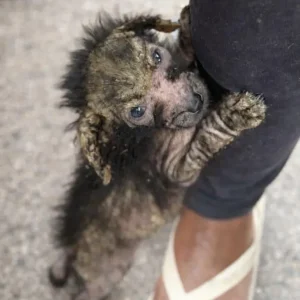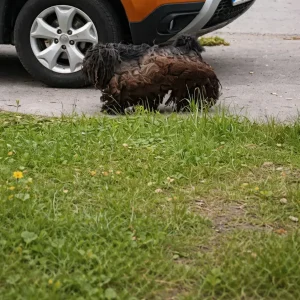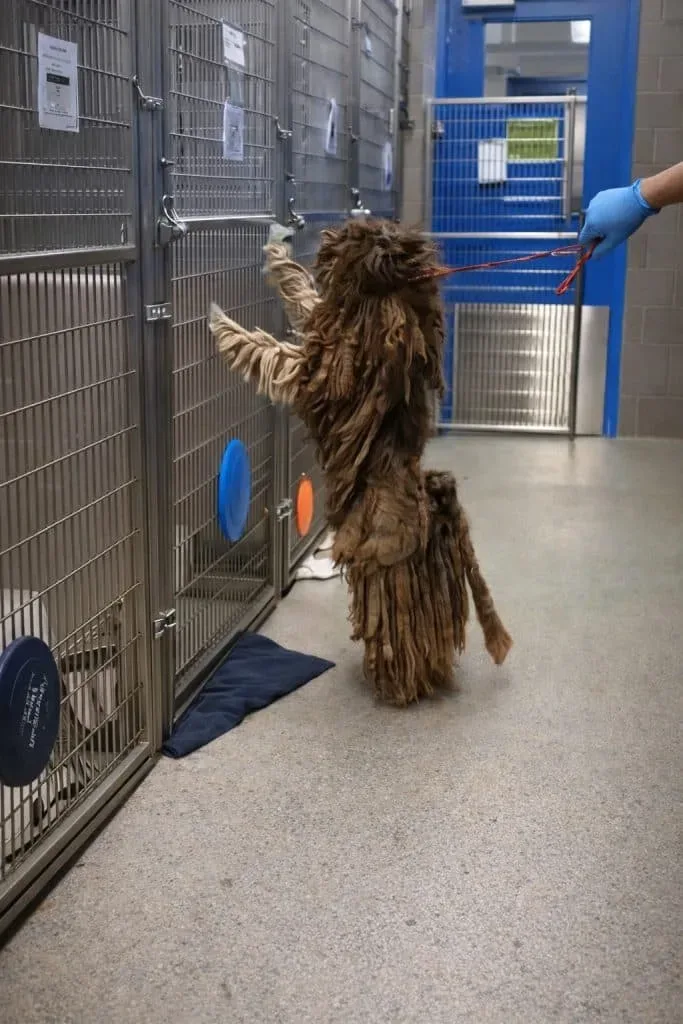
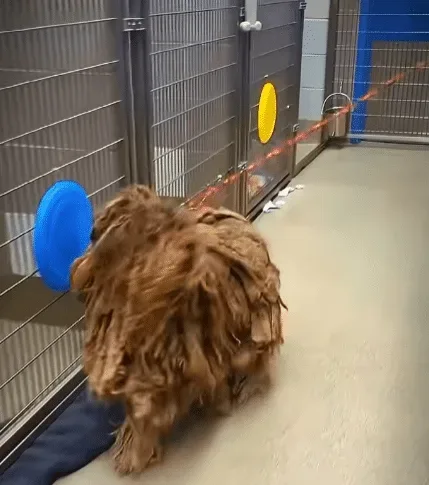
At first glance, the animal in front of the rescuers looked more like a heap of knotted fabric than a dog. Mats had pulled tight across nearly his whole body, forming heavy clumps that tugged at his skin and limited how freely he could move.
He was also shaking. When people came close, his eyes tracked their hands, and his body went rigid whenever someone reached toward him.
Everyone involved understood that the coat had to come off. What they could not know was whether anything else lay beneath it. This would not be a routine grooming appointment.
When Fur Becomes a Burden
A dog’s coat is supposed to protect him. In cases of severe matting, it can do the opposite.
That appeared to be the situation here. His fur had twisted together so tightly that large sections moved almost as a single solid layer. Each time he shifted position, the coat dragged against his skin instead of sliding over it. Even ordinary movement looked uncomfortable.
His fear was a second obstacle. The trembling did not ease while he watched the people around him, and his muscles tightened as hands approached. A coat that dense could not simply be brushed out, and a frightened dog could not be expected to tolerate a long, hands-on process without some help.
Video: Rescuers Work Through Severely Matted Fur and Find Something Hidden Beneath It
A Check-Up Before the Clippers
The team did not start cutting right away. Rushing would only have made a stressful day harder for the dog.
Veterinary staff examined him first, making sure he was stable enough for what lay ahead. Only then did the rescuers settle on a plan. Because the matting was so severe, they decided that mild sedation would allow them to work more safely. It would also reduce the stress of having clippers move close to skin that was already sensitive.
That choice shaped everything that followed. With the dog calmer, the team could approach the job in small steps rather than struggling against his fear. They began slowly and worked on one section at a time.
Clump by Clump, a Much Smaller Dog
The first mats came away in thick pieces, and more followed. The rescuers kept the clippers close enough to cut through the tangles, yet stayed careful around the skin underneath.
There was a practical reason for the slow pace. Dense mats can conceal irritation, wounds, debris, or other problems that cannot be seen from outside. Before moving on, the team needed to understand what each section had been covering.
As the fur fell away, the dog himself gradually came into view, and he turned out to be far smaller than his enormous coat had suggested. His frame looked delicate. Without the clumps, the shape of his legs and body was clearly visible.
The transformation was striking, but the work was never about appearance. Every clump removed meant less weight pulling on his skin, less restriction around his body, and less knotted fur getting in the way of his movement.
Then, partway through, the team uncovered something that nobody had been able to see when he arrived.
The Hook Inside the Mats
Lodged within the dense matting was a fishing hook.
Until the coat was carefully taken apart, it had been completely hidden. The rescuers could not say how long it had been there or how it ended up caught in his fur, and those questions remain unanswered. What the discovery made clear was how much can stay invisible under severe matting. A sharp object had been resting against a dog whose coat was already pulling tightly across his body.
The surprise did not change the way the team worked. They removed the hook without causing any additional injury, then kept checking the surrounding area.
To anyone looking from the outside, there had been only tangled fur. Underneath was a hazard that could not have been recognized without patiently working through those layers. The find made the team even more deliberate. Each section had to be inspected, and each pass of the clippers had to allow for whatever else might be concealed.
Eventually, the last heavy mats came off. The little dog was no longer buried inside the coat that had covered him.
A Warm Bath and Quiet Hands
With the clipping finished, the next step was far gentler: a warm bath.
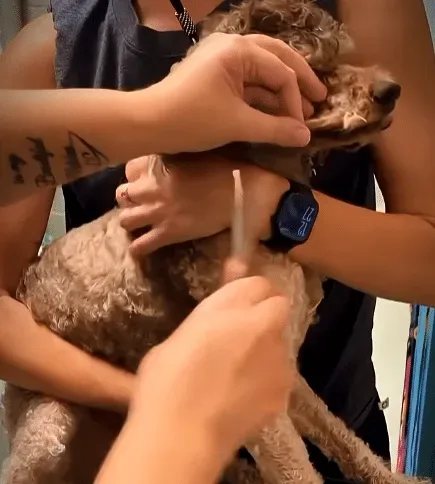
The dog was lowered carefully into the water and washed. Dirt that the coat had held against him could finally be rinsed away. His skin was now accessible, and caregivers could handle him without constantly pulling on knotted fur.
He was still wary. At times his body tensed, and he kept his attention on the people nearby. The rescuers answered with slow movements and soft voices, supporting his small frame as they washed him.
Nothing about this stage needed to be dramatic. For a dog who had arrived frightened of human touch, steady and calm handling was the most useful thing the team could give him.
Afterward, he was gently dried, and the full difference became plain. The oversized, tangled coat was gone, and so was the fishing hook. In front of the caregivers stood a very small dog who looked almost unrecognizable compared with the animal who first came into the rescue center.
Trust Takes Longer Than a Haircut
The physical change was immediate. Without the mats, he could move without heavy clumps dragging across his body. His face was visible, his legs were free, and his whole frame looked lighter.
His behavior was a different matter. A haircut can be completed in a single session, but trust cannot. The rescuers did not assume he would feel at ease with people just because the grooming was over.
They kept the same patient approach afterward. They gave him space and let him observe the room. When he seemed unsure, they did not push affection on him.
Gradually, his reactions began to shift:
- The trembling became less constant.
- He spent more time looking around the room instead of reacting to every movement.
- Familiar caregivers could stay near him without triggering the same level of tension.
These were small changes, but for a frightened dog they carried real weight. A quiet meal, a comfortable bed, and a person who approached slowly instead of reaching suddenly each gave him another peaceful experience to build on.
What Was Hidden, and What Still Needed Time
When the rescuers first met him, nearly everything about the little dog was covered up. His body was buried under the coat, the hook was caught inside the mats, and even his personality was hard to read through the constant trembling.
Taking off the fur solved only the first problem. What came next depended on something much less visible: time.
Caregivers let him recover at his own pace. He did not have to seek out affection right away, and he did not have to become a different dog overnight. He simply needed the chance to learn that the day on the grooming table would not define every interaction that came after it.
The change that followed was not a sudden shift in character. Once the physical burden was gone, he had room to rest, watch, and respond differently, and that made the dog beneath the mats easier to see day by day.
Where the Story Stops
The fishing hook may have been the most startling thing inside that coat, but it was not the most important discovery. Under all those tangled layers was a frightened little dog who needed careful treatment, patience, and enough time to feel safe again.
At the start of the day, human hands made his body tense. By the end of the grooming, those same hands had lifted away the coat that restricted him, found and removed the hidden hook, and cleaned his skin so that he could begin recovering without that weight.
The account does not say where he went afterward or how his recovery ultimately turned out, so his story is best left at the point it actually reaches. The last mat had been cut away, and the little dog finally had space to start over.