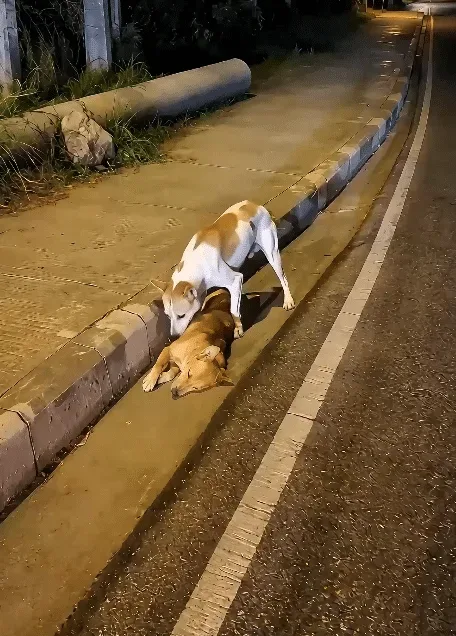
Traffic had thinned and the night was getting darker, but one dog was still on the shoulder of the road. He lay close to the companion he had spent his days with on the street. Now and then he lowered his head toward his friend and let out a soft cry. He seemed to be waiting for a movement that never came.
The rescuers who arrived could see that a leash and a firm grip would not work here. This dog was homeless, but that was only part of the problem. He needed time, and he needed a kind way to be separated from the friend beside him.
What helped him in the end was a small plush bear and a great deal of patience.
A Vigil Beside the Pavement
By the time help reached him, the dog had settled into a watch. He stayed pressed close to his companion’s body. He did not leave even as the cars grew fewer.
His response to strangers said a lot. When the rescuers stepped closer, he grew uneasy and positioned himself between them and his friend. Nothing in the account suggests aggression. He looked frightened, and the fear seemed to come less from worry about himself than from the prospect of being pulled away from the one companion who had stayed with him through street life.
His eyes kept going back to the roadside. Everything around him carried on, but he did not appear ready to carry on with it.
The account does not explain how the two dogs ended up on that road, or what happened to his friend. What it does make clear is the bond. One dog stayed, and he kept staying.
Video: A Homeless Dog Stays Beside His Friend on the Road as Rescuers Approach
Letting Him Decide
The rescuers changed their approach. They slowed their movements and kept their voices low. They did not reach for him. They let him watch them and see that nobody intended to add to his troubles.
That patience counted for a lot. A rushed grab could easily have made his distress worse. By waiting, the team gave him room to form his own impression of these new people.
In time, exhaustion began to outweigh his wariness. With steady encouragement, he let them guide him away from the road. He left the spot physically, but the sadness in his face went with him.
There was nothing triumphant about it. It was a quiet, careful moment. He was out of immediate danger, although the harder work still lay ahead.
Safe, but Still Watching the Door
At the rescue center, the dog finally had what the street had not given him: a warm bed, regular meals, clean water and gentle people close by.
His body was safe. His spirit appeared to be lagging behind.
He paid no attention to the toys placed near him. He spent long stretches lying quietly in his bed. Whenever footsteps came near, he lifted his head and looked toward the doorway, as if hoping someone familiar would come through. Then he lowered his head again.
The volunteers understood what this meant. Shelter and food could answer only part of his need. He had lost the companion who may have helped him get through each uncertain day, and no one could explain to him why that friend was gone.
What they could give was time. Caregivers sat nearby without pushing him to respond. They spoke softly, offered a touch when he would accept one, and let him get through the difficult days at his own speed.
Still, something seemed to be missing.
A Lock of Fur and a Plush Bear
Before saying a final goodbye to the dog’s companion, the rescue team saved a small lock of fur. They put it in a soft cloth pouch and fastened the pouch carefully inside a plush teddy bear.
To anyone glancing at it, the bear would have looked like any other toy. Inside, though, was a familiar scent connected to the life the grieving dog had known before he came to the shelter.
The volunteers had no way of knowing how he would react. He might ignore the bear, as he had ignored the other toys. The scent might mean nothing to him at all.
They placed it gently near his bed and stepped back.

The Moment He Reached for It
The dog raised his head and looked at the unfamiliar object. Then he leaned in and sniffed. Once, and then again.
Something in his posture began to shift. He kept investigating the bear, and the tension he had carried since the roadside seemed to loosen. His withdrawn body softened. He lowered himself beside the toy.
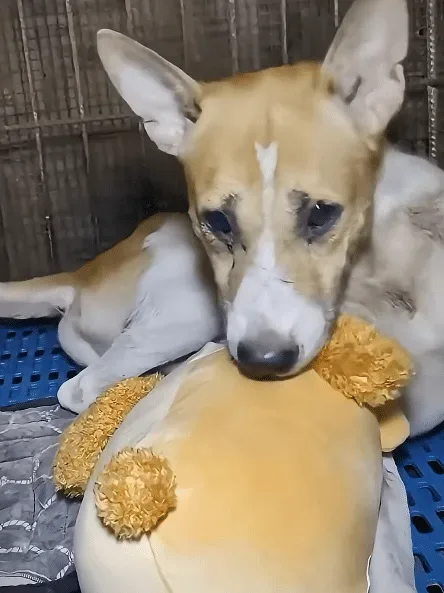
Slowly, he wrapped his paws around it and drew it against his chest.
He did not bark or grow excited. He just held it. For the volunteers watching from a distance, that stillness was more affecting than any burst of energy would have been. He rested his head near the bear and closed his eyes.
No toy could stand in for the friend he had lost, and nothing could return the life the two had shared. Even so, the familiar scent appeared to give him something he had lacked since leaving the road: comfort, and a sense of recognition. The room stayed quiet, and the caregivers let him stay just as he was for as long as he needed.
Small Signs of a Dog Coming Back
Recovery did not happen in one afternoon. The dog still had quiet days, and at times he stayed with the bear instead of engaging with the people around him. Nobody tried to take it from him. It remained beside his bed, and it went with him whenever he moved to a different resting spot.
Gradually, small changes appeared. His tail moved when familiar caregivers walked in. He showed interest in short walks. He began to accept affection rather than turning away from it.
The space beyond his bed no longer seemed to hold only the threat of more loss. It also held gentle voices, safe places to explore and people who came back every day.
The bear stayed close through all of it. Sometimes he slept with it between his paws. Other times it lay next to him while he watched the activity around the shelter.
A New Home, With the Bear Along
Eventually, a family heard about the loyal dog and the hard goodbye he had been through. They did not expect him to leave his past behind. What they offered was patience, security and plenty of time to get comfortable in a new home.
When he was adopted, the teddy bear went along. It sat near his bed during the first unfamiliar nights. As he learned new routines and got used to new voices, the small toy remained a link to everything that had come before.
Little by little, the once-withdrawn dog settled into family life. Walks became something to look forward to. He welcomed gentle attention, and his tail wagged more freely.
The dog who had stood alone beside a road now had people looking out for him, a warm place to sleep and meals waiting each day. He also had a family prepared to stay with him through every stage of healing.
Comfort Without Forgetting
The bear could not erase the dog’s loss. It could not replace his friend or explain why they had been separated. What it did was let him keep something familiar nearby as a new chapter began.
Animals may grieve differently than people do, but attachment shows in the way they wait and stay near the companions who matter to them. This dog’s loyalty was plain to see beside the road. His sadness showed in the silence that followed at the shelter. And his recovery became visible each time he let someone new into his life.
The rescuers never asked him to forget. They gave him time, respected the bond he had lost and, through one thoughtful gift, offered comfort in a place where medicine could not reach.
According to the account, the teddy bear still stays near him today. It is not a sign of a life stuck in sorrow, but a quiet reminder of love carried forward. He once refused to leave his best friend alone on the roadside. Now he has a family making him the same promise: to stay, to care, and not to walk away when he needs them.