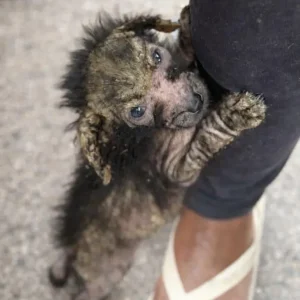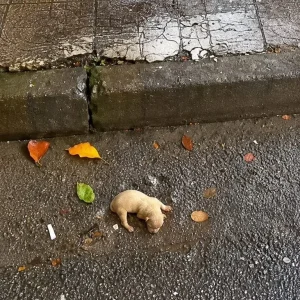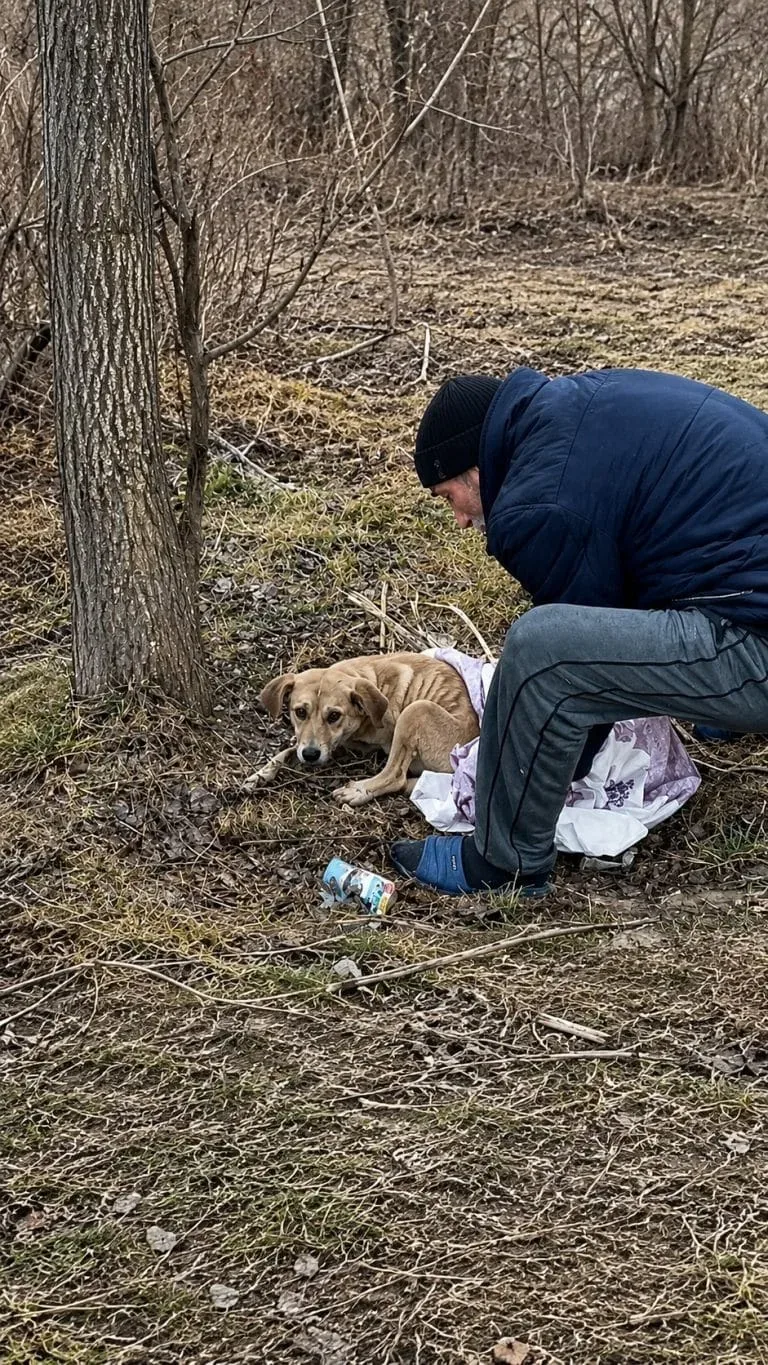
Cars kept passing on a cold winter day, and none of the noise reached the small ginger dog lying at the edge of the pavement. She was curled tightly against the frozen ground, trembling.
Her breathing was shallow. She could hardly lift her head. Rescuers who stopped understood quickly that this was not an ordinary stray waiting out a hard season. Something was badly wrong, and she could not help herself.
An emergency examination, a difficult operation and months of patient rehabilitation followed. This is the story of Ryzhaya, and of the slow work that put her back on her feet.
A Dog Too Weak to Run
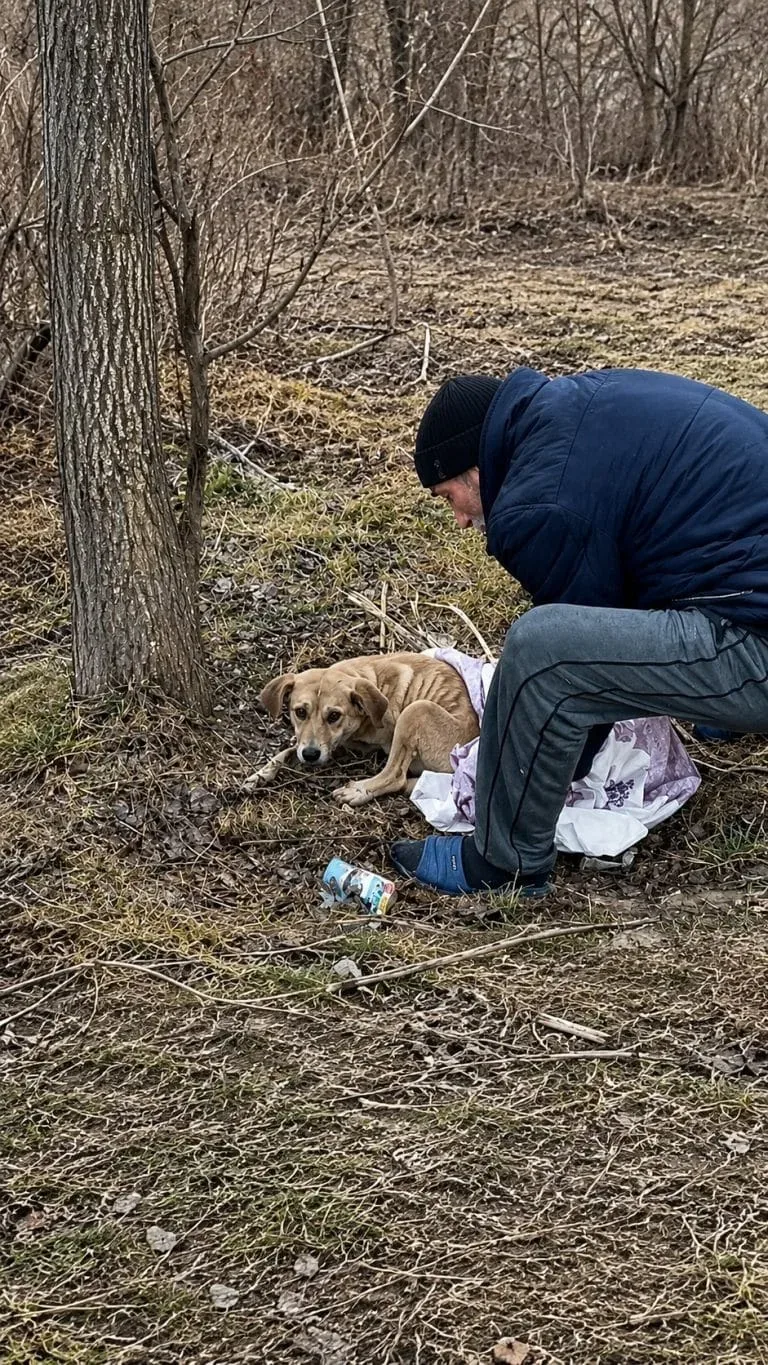
The rescuers came toward her slowly, careful not to startle her. They needn’t have worried. She made no attempt to flee, because she was unable to. Her body stayed curled against the ground while the wind moved through her coat.
They wrapped her in a warm blanket. According to the account, it was the first protection from the cold she had been given that day. She did not resist when they lifted her.
They called her Ryzhaya, a Russian word meaning “ginger,” after the color of her coat. It was a gentle name for a harsh scene: frozen pavement, a body that would not respond, and the uncertain hope that help had come in time.
One question hung over everyone standing around her. Why could a dog this small not get up? The answer would come only at a veterinary hospital.
Video: Ryzhaya Found Shivering Beside the Road, and the Long Fight to Walk Again
The Diagnosis Behind the Stillness
At the hospital, doctors began assessing her condition, and the findings were serious. She had suffered severe trauma, including injuries consistent with gunshot wounds. Her spine was also fractured.
That explained why she could not stand or support the back half of her body. She was completely paralyzed.
The source does not say how or when the injuries happened, and it does not name anyone responsible. What it does make clear is the combination she faced: a broken spine and paralysis, in a dog already weakened by lying in the cold.
For the veterinary team, routine treatment would not be enough. If Ryzhaya was ever going to move again, she needed specialized care and urgent surgery.
Sent to Stavropol for Surgery
She was transferred to Stavropol, where doctors prepared for the operation. The decision to send her elsewhere for specialized treatment shows how seriously her injury was taken.
There was little room for easy optimism. Her body was fragile, and the procedure carried real risk. Without it, though, she might never walk again.
Ryzhaya came through the surgery. Given what her small body had already endured, that alone was a significant step. Still, nobody expected an instant miracle. The operation had dealt with the injury, but healing, and any movement that might come with it, lay ahead.
Quiet Days With a Healing Spine
Her spine needed time. During the period when she could not move, the muscles in her legs had weakened, and her body would have to slowly relearn motions that once came naturally.
The days after the operation were calm and tightly managed. Ryzhaya rested in a protective collar. Caregivers monitored her closely and shifted her body gently, so that no needless pressure fell on the healing spine.
Early on, progress was hard to see. She stayed mostly still while people helped her eat, rest and stay comfortable. They watched for the smallest responses: a flicker in one leg, a change in posture, a brief attempt to shift her weight.
There were no dramatic turns in this stretch, only small signs that gave the team a reason to keep going.
Rehabilitation at Her Own Pace
Once she was stable enough, rehabilitation became part of Ryzhaya’s daily routine. Caregivers supported her body and guided her legs through controlled movements. The aim was to keep her flexible, rebuild strength and encourage her nervous system to respond again.
Some sessions were hard. She tired quickly, and on some days improvement was almost invisible. The team did not hurry her. They followed her pace and encouraged every attempt she made.
In recovery like this, small things count. A slight reaction counted. A short effort to push upward counted. So did a few seconds of steadier balance, which suggested her body was still trying.
Those caring for her knew that healing from a spinal injury can be slow and uncertain. Ryzhaya kept taking part in the work, session after session.
When Her Legs Began to Respond
Gradually, something shifted. Her legs showed faint signs of strength, and with support she tried to raise her body. At first she could hold herself up only for a moment before she needed to rest.
Then she tried again, and the next attempt lasted a little longer. Her movements were unsteady, but each one suggested that the link between her brain and her body was starting to return.
Caregivers stayed close without doing everything for her. Ryzhaya needed help, but she also needed room to find out what her legs could do.
Then, one day, she rose and stood on her own.
Her legs shook and her posture was far from perfect. Even so, the dog who had lain helpless beside a frozen road was holding up her own weight. For the people watching, those few seconds meant a great deal.
Learning to Take Steps
Standing was a major milestone, and walking was the next challenge. Ryzhaya began with slow, careful movements. Each step took concentration as she worked on balance and on coordinating her recovering legs.
At first she covered only a short distance, and her steps were uneven. She stopped often. But she was moving forward.
As rehabilitation continued, the hesitant movements grew steadier. She walked farther and leaned less on the hands that supported her.
The change was not only physical. Caregivers noticed that the fear in her eyes slowly faded. She responded when they called her and showed interest in her surroundings. She accepted affection more freely and approached therapy with growing confidence. Treatment was no longer simply something done to her; she was taking part in it.
Outdoors, Far From the Roadside
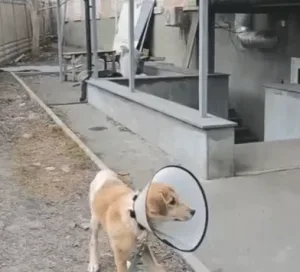
As her strength returned, Ryzhaya began to walk outside. The dog who could not lift herself from frozen ground now crossed open space on her own legs.
She was still careful, and her recovery remained a work in progress. The account does not describe a final outcome, such as a permanent home. It says only that she was walking, and that each step took her farther from the place where she was found.
Those walks also reflected the effort of many people: the rescuers who noticed her in the cold, the veterinary team that operated, and the caregivers who repeated the same gentle exercises day after day. And there was Ryzhaya herself, who kept trying even when progress came slowly.
What the Small Steps Add Up To
Ryzhaya’s recovery did not happen overnight. It was built from specific, ordinary-looking moments. A blanket around a trembling body. A hard surgery completed. A leg that responded. A few seconds of standing, then one uncertain step and another.
Together they gave a paralyzed dog a chance to walk again, something that seemed unlikely on the day she was found.
Her story suggests that resilience is not always dramatic. Sometimes it looks like a frightened dog trying to rise. Sometimes it looks like caregivers repeating the same exercise without knowing when progress will come.
Ryzhaya was found freezing, injured and unable to move. Today she walks, carefully and on her own.