Soñador was never hidden. He was up on a rooftop in Gustavo A. Madero, a district of Mexico City, where anyone on the street below could in theory have noticed him. Year after year, though, he stayed where he was.
The rescue account says the elderly dog had been living there for more than ten years. His coat had turned into a heavy, matted mass, and his health problems had gone untreated. Neighbors knew about him, and reports were made. Help still took a very long time to arrive.
When a team finally got to him, the matted coat was only the most visible part of the problem. The days that followed brought a slow descent from the roof, hours of careful grooming, a veterinary exam with some sobering results, and the first signs of an easier life.
More Than Ten Years Without a Roof Over Him
The rooftop was not a short-term refuge. According to the rescue account, it was where this dog lived for over a decade, in an open space above the neighborhood while daily life went on beneath him.
Sun, rain and cold reached him directly. Nothing in the account points to regular grooming or veterinary visits, which an aging dog needs, and it mentions no clean bedding or gentle handling in his routine either.
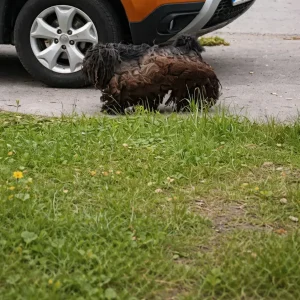
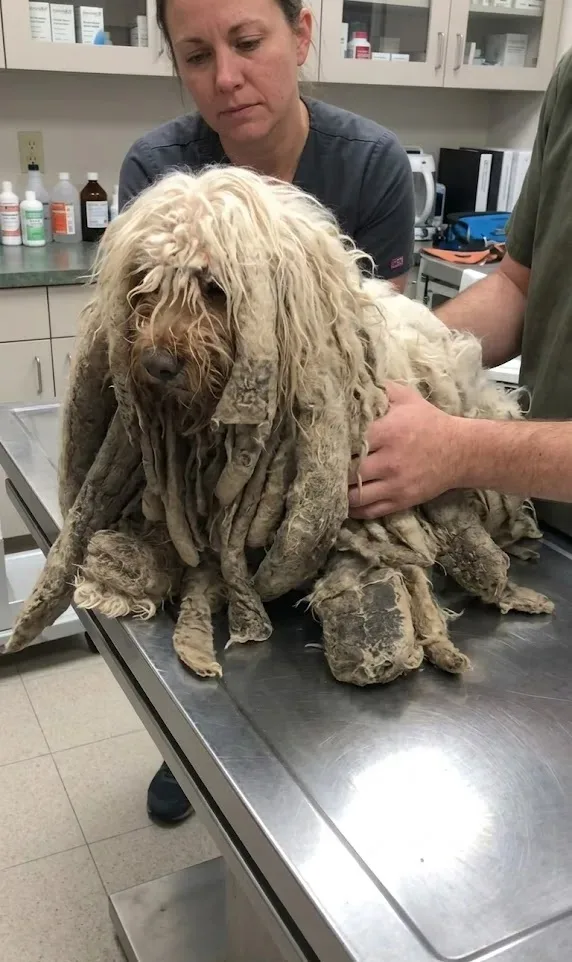
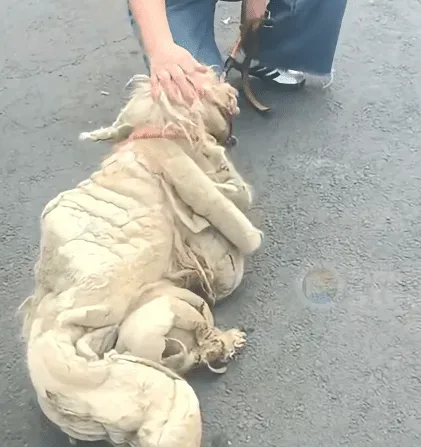
His coat made the neglect easy to see. Over time the fur grew longer and heavier, then knotted with dirt and debris into dense mats. They covered much of his body, restricted his movement and disguised his real shape. By the end, the team would take about 12 kilograms (roughly 26 pounds) of fur off him. For an elderly dog with untreated health issues, that was an exhausting amount to carry.
Neighbors reportedly voiced worry about him, and reports were made. Even so, no one reached him quickly. He remained a dog who could be seen but not easily helped, and the team who arrived at last were dealing with an animal whose adult life may have been spent almost entirely in confinement.
Video: Soñador’s Rooftop Rescue in Mexico City After More Than Ten Years
Strangers Arrive, and the Old Dog Stays Calm
Getting onto the roof solved only part of the problem. Approaching Soñador safely was another matter. He was old and uncomfortable, and strangers had suddenly appeared in the one place he knew. Nobody could say in advance how he would behave.
He did not lash out. The account says he watched the rescuers closely and allowed them to come near, a mild reaction that surprised the people who had climbed up to him.
That calm set the tone for everything that followed. The team had no reason to hurry him or ask him to walk on his own. They worked slowly, supported his weight and got ready to move him off the roof.
What he understood during those minutes is unknown, and the account is careful not to guess. It simply reports what the rescuers observed: a matted, aging, weakened dog who held steady while unfamiliar hands reached for him. Because he did not struggle, they were able to handle him safely.
Leaving the Roof, Watching Through a Curtain of Fur
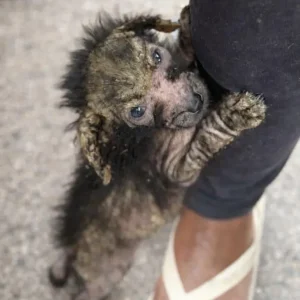
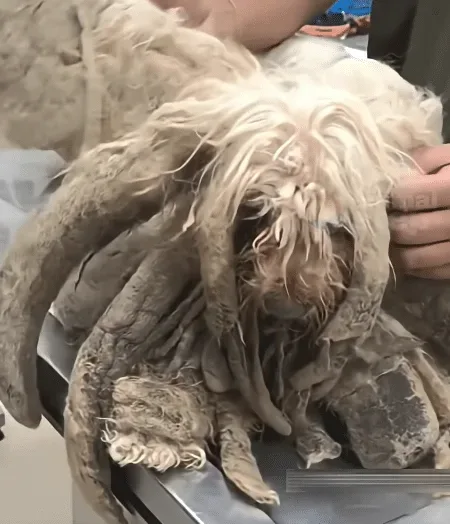
Once the team lifted him, the toll of the coat became plain. Sections of his legs were buried under the mats, and he could barely move. His face was nearly covered by tangled fur, with only narrow openings near his eyes.
Through those openings, he kept his gaze on the people carrying him.
The move took him away from the only place he had lived for more than a decade, although that place had given him almost no protection. The account does not say how he felt about leaving, and it would be wrong to fill that gap with speculation. It records that the rescuers stayed gentle, did not push him to move on his own, and met no aggression from him.
Being brought down ended his constant exposure to the weather. It did not take away the weight of the fur or reveal what his body was dealing with underneath. Those tasks belonged to the clinic, where the team had professional tools and enough time to work without rushing.
Clippers, Not Combs: Freeing Him One Section at a Time
Brushing was never a realistic option. The mats were too thick and too firmly fixed to his body, and pulling at them could have hurt him or injured the skin below.
So the groomers brought in professional tools and took the coat off in stages. They opened a small gap first, then moved outward in sections, stopping often to check where matted hair ended and skin began. Some mats came off as solid slabs. Others had to be loosened gradually so the clippers could slide underneath without harm.
The work was slow, and Soñador cooperated through it. He looked tired, and sometimes he needed support to stay comfortable, but he let the team continue.
As the fur came away, the dog beneath turned out to be much smaller than the rescuers had anticipated. His legs appeared first, followed by the shape of his chest and back. The hair covering his face was removed last, uncovering features that had been concealed for a very long time.
In total, about 12 kilograms of fur were reportedly cut from him. The result went well beyond a new look. A burden that had affected nearly every movement was gone, and the veterinarians could finally see what they were treating.
The Health Problems Hidden Beneath the Mats
With his body exposed, the veterinary team carried out a proper examination. It showed that the coat had masked several conditions at once.
Soñador was deaf. Serious mouth infections had reportedly begun to affect the area near his sinuses, and the untreated dental disease needed careful attention. Eating may have been painful for him. His skin was inflamed and diseased in places, a likely consequence of years beneath dirty, compacted fur. The veterinarians also found a heart murmur.
Because of his age and weakened condition, every decision about his care had to account for his overall health. Years of unmet needs could not be reversed within a few days.
Stabilizing an Elderly Dog
The first priority was to steady Soñador and ease his discomfort. The team cleaned and treated his skin and began evaluating the infections. His diet was adjusted so he could build strength gradually, without placing too much strain on a fragile system.
He was also given a warm, quiet place to rest. After so long on a hard, open surface, even that basic change set his new circumstances apart from everything described in his years on the roof.
New Routines: Soft Bedding, Gentle Meals, Visible Hands
At the rescue center, Soñador was introduced to a soft bed. He approached cautiously, stepped onto it, shifted his weight and finally lay down. Rain, harsh sun and cold no longer reached him there.
Regular meals followed. Since his mouth was in poor condition, caregivers served food in a way he could manage comfortably and watched to be sure he was not struggling to eat. Clean water stayed nearby, and his medication was given on schedule.
The same people looked after him each day. Because he could not hear them, they adapted. They approached where he could see them and avoided sudden touches that might startle a deaf dog. They kept their movements unhurried, backed off when he wanted space, and stayed close when he leaned toward them.
Repeated daily, that predictable pattern began to shape a life that looked nothing like the years on the roof.
Small Steps, a Moving Tail and a Gentle Nature
With the mats gone, Soñador had to get used to his own body again. His first steps were careful. He was old, out of condition and still adjusting to a new place, and losing the coat did not instantly restore strength that had faded over many years. Caregivers let him go only as far as he could handle, so he walked short distances, paused and went on.
Meals and treatment gradually improved his posture, and he looked steadier on his feet. His interest in his surroundings grew. He started following people with his eyes and moving toward the caregivers he knew. Then his tail began to wag.
It was a small gesture, but it appeared more often as the routine became familiar. Brief moments of playfulness came later. For an older dog, that might mean a curious step toward an object, a light movement of the paws, or a flash of interest in a nearby person or animal. Such behavior suggested he had some energy left for more than getting through the day.
His temperament impressed the team as much as his physical change. After years alone, he accepted contact from people with unexpected gentleness. He let caregivers hold and examine him, rested near them, and, once he seemed to understand what was happening, appeared to enjoy calm affection.
What he remembered of the roof, and how he made sense of the sudden change, cannot be known. What could be seen was that he did not consistently pull away from kindness, he responded to gentle touch, and over time he chose more and more often to stay near the people caring for him.
The Name He Was Given, and What Still Lies Ahead
The removal of the coat did not end Soñador’s medical needs. He is still an elderly dog with deafness, a heart murmur, dental disease and skin that needs continued treatment, and his recovery depends on ongoing veterinary care. The account does not describe a permanent home. It leaves him at the rescue center, still under treatment.
His days, though, now look very different. He sleeps somewhere clean and eats at dependable times. He no longer drags 12 kilograms of matted fur around, and he rests under cover instead of lying on top of a building in the open. People also watch the details of his progress: how he walks, how well he eats, whether his skin is healing and when he needs reassurance.
The rescuers called him Soñador, the Spanish word for “dreamer.” They could not know what went through his mind during the years above Gustavo A. Madero, and the name does not say he spent them imagining rescue. It looks instead at what became possible after he was brought down: treatment for ignored illnesses, a body no longer buried under its own coat, and a daily life organized around care.
Nothing can give back the decade he spent on that roof. Still, relief that arrives late counts for the animal receiving it. A pain-free mouth, clean skin, a soft place to lie down and a full bowl matter to an old dog who went without them for so long.
For years, Soñador could be spotted from the street and little else happened. Now attentive people are close enough to notice his appetite, his steps and the state of his skin, and to give him the attention he needed long ago.