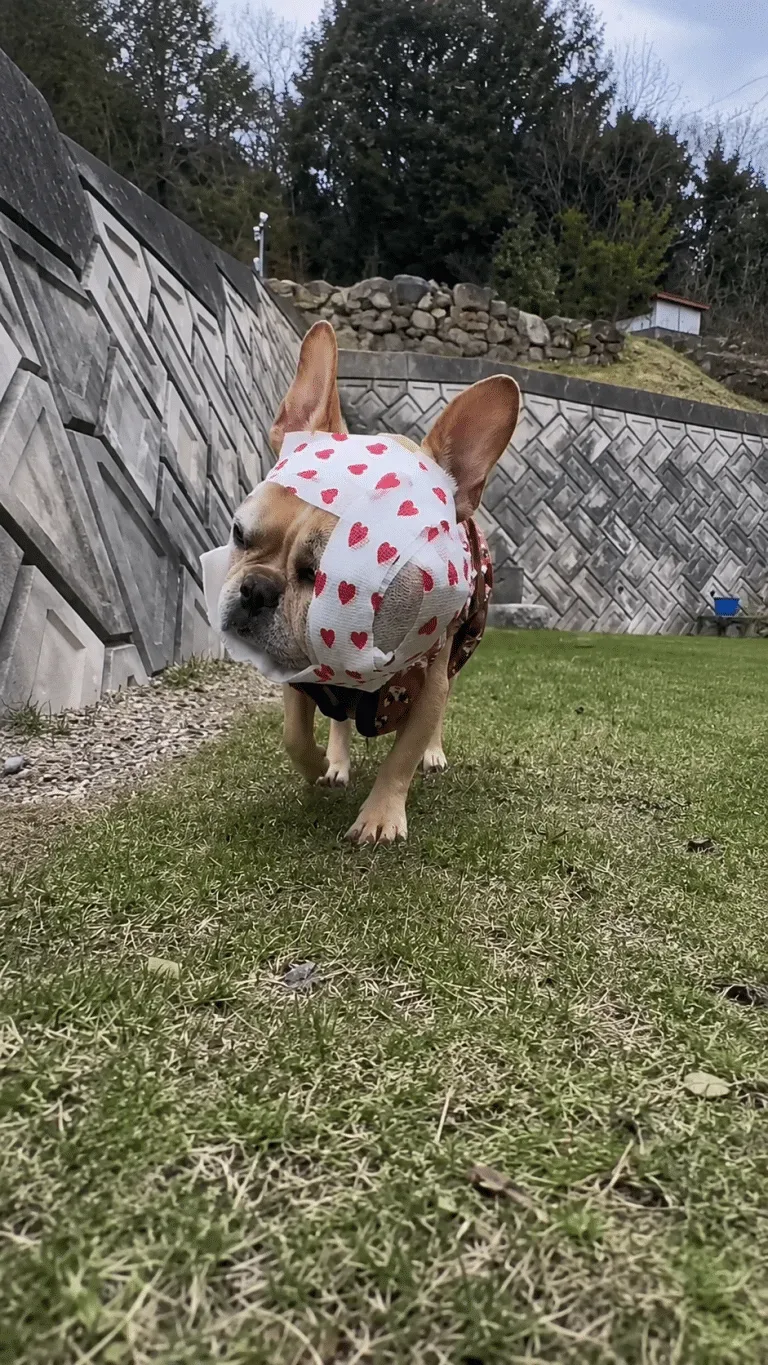
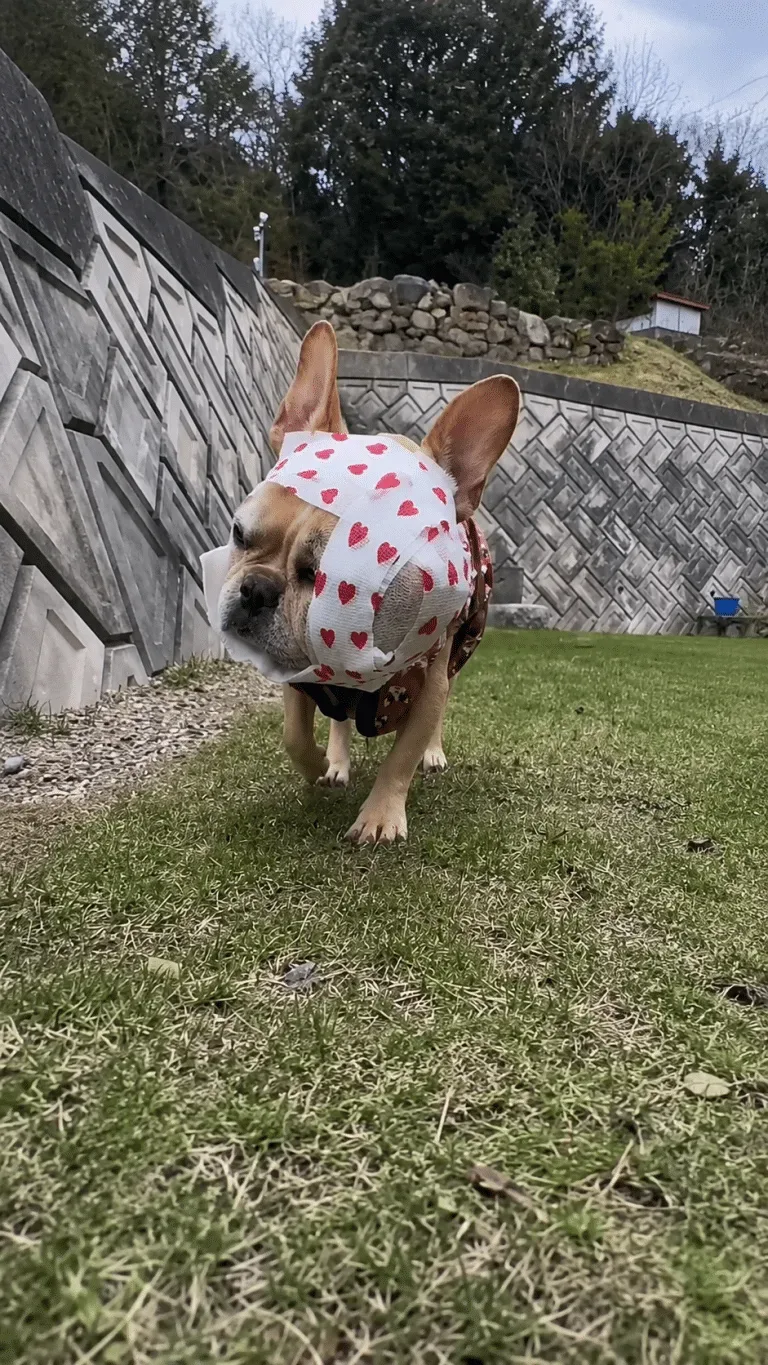
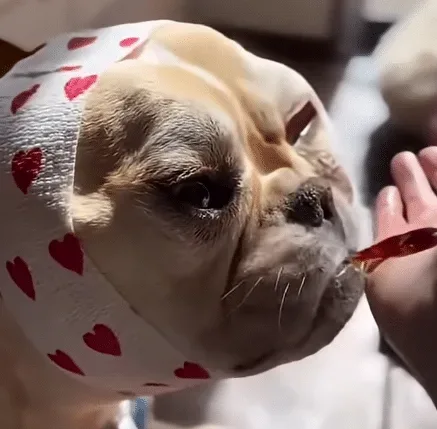
A bandage printed with tiny red hearts was wrapped around Lucy’s head, covering part of her face and ears. A caregiver set the French Bulldog down on the grass, and she did not stand still and wait to be lifted again. She lowered her nose, caught a scent and followed it a few steps.
Her body looked tired, and she moved slowly. Even so, she kept looking for the next smell worth checking.
The video of this moment is not a story of triumph. It shows a dog in the middle of treatment, with more care ahead. According to the message shared with the footage, the surgery planned for her had not yet been funded. That unfinished quality is why this short walk is worth a closer look.
What the Video Shows, and What It Leaves Out
The footage does not explain Lucy’s medical history. Viewers can see that she has received some treatment and that part of her head needs protection. The accompanying message adds that further care, including surgery, is still to come. It does not say what happened to her, what the operation involves or when it might take place.
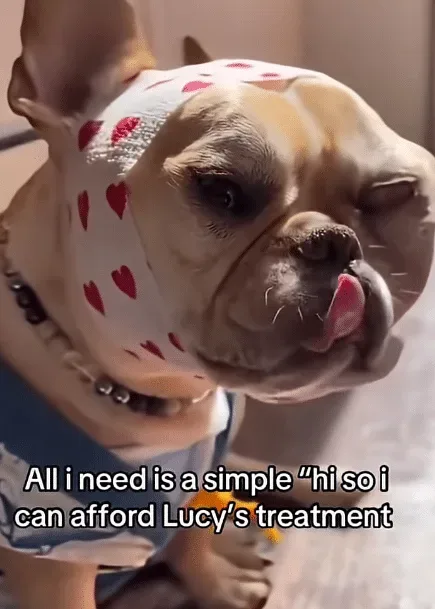
The bandage is hard to miss. It frames her face and sits over her ears, and the heart pattern gives a soft look to something that is plainly medical. Underneath is a small dog trying to get through an ordinary outdoor moment while her recovery is still incomplete.
Because the wrap covers part of her face and ears, it may change how she takes in her surroundings. The video does not say so, and no one watching can be sure. It would, however, fit with how deliberate her movements look, as though each step needs a little thought before she commits to it.
Video: Bandaged French Bulldog Keeps Exploring the Grass While Waiting for Surgery
Letting Lucy Set the Pace
Once she was on the lawn, a caregiver stayed close and let her decide how far to go. No one asked her to run, and no one coaxed her into performing for the camera. She went as far as seemed comfortable and no farther.
Her steps were measured. Now and then she stopped, as if weighing whether she had enough energy for the next stretch. The ground looked uneven, which made the careful pace seem sensible.
There is a particular patience in the scene. The person beside her did not treat the walk as a chance to show off progress or to ask for more. A few steps across the yard, followed by a few more, appeared to be enough for the day.
It is also worth noting what the footage does not claim. It does not say Lucy was getting stronger by the hour, and it does not describe the outing as part of a formal rehabilitation plan. It shows a tired dog outdoors with someone watching over her, and it leaves it at that.
A Nose Still Full of Questions
Whatever Lucy was dealing with, her interest in the outdoors had not gone away. She pointed her nose toward the grass and paused near unfamiliar smells. She looked around before choosing where to go next.
These are everyday dog behaviors, but they carry extra weight in the setting of treatment. An animal in care may spend long hours resting, taking medication or traveling to appointments. A slow circuit of a yard offers something different: fresh air, new scents and a little room to roam.
Nothing in the video suggests her attention was anywhere but on what lay right in front of her. A patch of grass. A smell worth investigating. Another spot a few steps away.
It would be tempting to read her sniffing as proof that she felt no pain or worry. The footage cannot establish that, and it is more honest not to try. What it does show is a dog whose medical troubles had not erased her curiosity. She was bandaged and tired, yet still taking part in the world around her.
The Brown Jacket and the Person Beside Her
Lucy also wore a soft brown jacket decorated with drawings of dogs. It added to her gentle appearance, and it may have served a practical purpose too.
The video does not explain the jacket, so what follows is a general observation rather than a fact about Lucy. Small dogs recovering from medical care can have trouble staying warm, particularly if activity has been limited. A comfortable layer can make a short time outside easier.
Clothing used during recovery has to fit properly. It should not rub against a wound, restrict breathing or interfere with movement, and it needs to stay clean and dry. Those decisions belong to the veterinary team and caregivers, not to viewers at home. In the footage, the jacket did not seem to stop Lucy from walking or sniffing.
Taken together, the details form a small circle of support. The bandage protected the treated area. The jacket seemed to keep her comfortable. And the caregiver nearby meant she was not facing the outing alone.
None of it replaced the surgery she reportedly still needed. But it made the waiting gentler, and it showed that care can be made of ordinary things as well as operating rooms.
An Operation Waiting on Funding
The message that came with the video said the money for Lucy’s upcoming surgery had not yet been secured. That detail changes how the footage should be understood. She was not being shown at the end of a finished recovery. She was waiting for an important stage of treatment to begin.
For rescue groups, complex medical care can bring real financial pressure. Examinations, imaging, medication, surgery, aftercare and rehabilitation can all be part of getting an animal to stability, and the bills do not disappear because the animal has already been brought to safety. In many cases, the rescue itself is only the first step.
The post did not name the procedure Lucy needed, what it would cost or when it might happen. Anyone moved to help should confirm those details directly with the organization responsible for her care before giving.
What the footage did make clear is that her medical journey was unfinished. The people around her could offer warmth, supervision and affection in the meantime. The next chapter, though, depended on access to proper veterinary treatment.
The Quiet Middle of Recovery
Recovery stories are often told through dramatic before-and-after pictures. A sick animal arrives, treatment begins, and months later the same dog is racing across a field.
Lucy’s video belongs to a quieter stage. It has no completed transformation and no announcement that her medical concerns were resolved. Instead, it shows the part of recovery that is easy to overlook: the stretch between treatment and surgery, a protected area under a bandage, a few steps taken outdoors.
In general terms, progress during a period like this can be modest. It might mean walking a little farther before tiring, eating comfortably or tolerating bandage changes calmly. Nothing in the footage says whether Lucy reached any of those milestones. They are examples of how small gains can look, not claims about her case.
Caregivers in this position cannot rush the process. They watch for signs of fatigue, limit activity when needed and balance gentle movement against rest. Lucy’s part was simpler. She moved when she could, explored what interested her and paused when she needed to.
One walk did not prove she had recovered. It showed only that she was still moving forward, and for people following her story, that was meaningful enough.
A Patient, and Still a Dog
Medical equipment can easily become the defining feature of a rescue animal’s story. People notice the cone, the stitches, the wheelchair, the shaved patch of fur or, in Lucy’s case, the large bandage around her head.
Those details matter because they show how serious an animal’s needs are. But they do not show the whole animal.
Lucy was also a French Bulldog who wanted to smell the grass, who noticed what moved around her, and who made her way across a yard in a warm jacket beside a caregiver.
Her condition shaped what she could do. It did not erase her personality, and that distinction matters whenever a story involves injury or illness. She did not have to be presented only as a symbol of suffering. She was a patient, yes, but she was also a dog with preferences and reactions of her own, and she deserved care that recognized both.
Where Things Stood When the Footage Ended
The closing moments offered no neat conclusion. Lucy was still bandaged. The planned surgery had not taken place. Her long-term outcome was unknown. She kept walking slowly through the grass in her brown jacket while someone watched nearby.
That uncertainty made the story feel honest. Not every rescue reaches its happiest chapter before the video is shared. Sometimes viewers meet an animal in the middle of the journey: after treatment has begun but before surgery, after safety but before complete healing, after someone decides to help but before the necessary resources have been found.
Lucy was living in that space. Her future depended on medical decisions, daily care and the people willing to support her.
Even without a confirmed ending, the video offered one reason for hope. She had not withdrawn from the world around her. She was still curious about where the next scent might lead, still placing one paw in front of the other while her recovery continued at its own pace.
The tiny red hearts on her bandage, whether chosen by design or by chance, echoed what surrounded her: care, attention and people hoping she would get the treatment she needs. Her journey was not finished. But on a quiet day outside, Lucy showed that a hard chapter can hold more than pain. It can also hold a warm jacket, the smell of grass and one more careful step toward whatever comes next.