From the sidewalk, the iron gate looked like the border of any neglected property. The dog standing behind it told a different story.
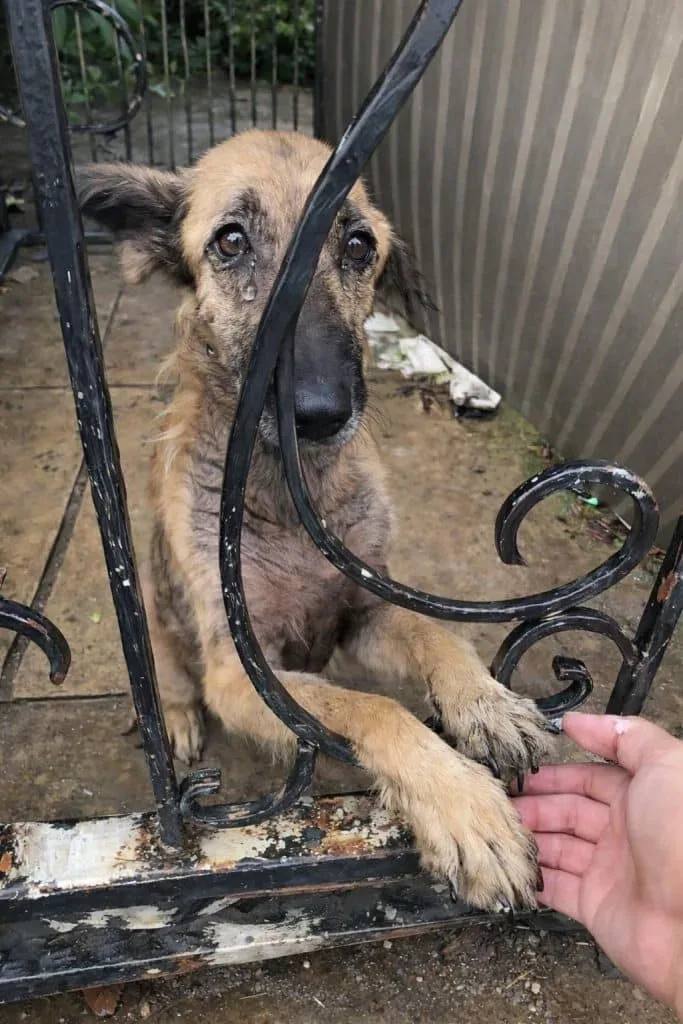
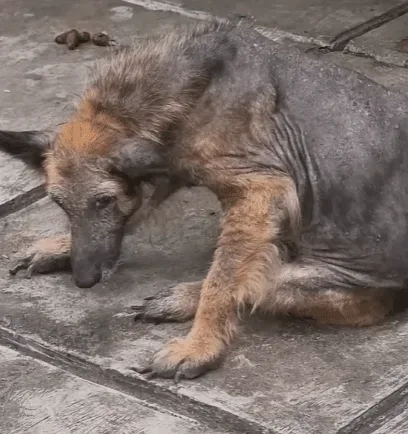
She was a German Shepherd with a thin, uneven coat and bare patches where fur should have grown. Her skin looked raw and irritated. Trash and debris were scattered across the yard, and the house behind her appeared to be empty.
A young man stopped at the gate. She didn’t bark, and she didn’t back away. She stood and watched him, and then her tail moved in a small, careful wag that was easy to miss. He noticed it. That gesture would bring him back again and again, and eventually it would lead the dog now called Melda out through that gate.
A Message About a Dog Left Behind an Empty-Looking House
The story began with a message, not a meeting. Someone concerned about the German Shepherd had passed along a report describing a dog kept behind a locked gate at what seemed to be an abandoned property. The young man who received it didn’t want to rely on secondhand details. He went to see for himself.
What he saw confirmed the worry. The dog was painfully thin, and large areas of her coat were missing, leaving irritated skin exposed across much of her body. Discarded objects and rubbish covered the yard. He saw no soft bedding and no clear place where she could lie down comfortably.
Someone may have left her food from time to time, but nothing he observed suggested the steady care her condition called for. The house looked empty, yet she remained confined to the property, apparently alone.
As he stepped closer, she studied him. Her body stayed cautious, but she showed no sign of aggression. Then the tail moved again. He couldn’t know what she remembered about people or what she expected from him. He could only say that she was willing to stay near the gate and look at him. For him, that was reason enough to linger a little longer.
Video: The German Shepherd Behind the Locked Gate
Food, Water and Time: Earning Trust From the Wrong Side of the Bars
Some readers might expect the next step to be a quick climb over the fence. It wasn’t that simple. Who owned the dog and the property still had to be sorted out, and entering a locked space without permission could have brought legal trouble and real risk for both the man and the animal. So he started with what he could do from where he stood.
He brought food. He brought fresh water. And he brought time, which may have been the most unusual of the three gifts.
On each visit he approached the gate calmly and let the dog look him over before he came any closer. At first she stayed guarded. She accepted what he offered but kept her distance. He didn’t reach through the bars or push her to be affectionate. He set the food down, waited, and left when it was time to go.
Then he returned. Little by little, the dog seemed to recognize the sound of his arrival. She came toward the gate sooner than before, and her tail wagged more openly. For an animal living in an uncertain situation, a routine may count for more than one dramatic gesture. A single meal offers short-term relief. A person who keeps showing up starts to make the world a bit more predictable.
He also tried to learn about her past. Neighbors reportedly remembered other dogs living on the property with her at one time, but those dogs were gone, and she was by herself. He couldn’t confirm every detail of her history. What he could see was her present: she was isolated, her health appeared to be slipping, and occasional meals could not fix what was showing on her body.
Why Kindness Through a Gate Could Only Go So Far
The visits made the dog calmer around him, but they also made one thing clear. Help delivered through a gate had limits.
Her skin plainly needed a veterinarian’s attention. Her eyes looked irritated, and her ears seemed to need treatment too. Even with food arriving, she stayed underweight. The yard was no place to recover, since dirt and debris could aggravate skin trouble, and if her condition suddenly worsened, no one would be there to notice.
The young man came to see that keeping her alive behind the gate was not the same as helping her heal. She needed to leave.
Permission, Planning and the Moment the Gate Swung Open
Making that happen took patience. He worked to get the necessary permission and to make sure she could be taken out safely. That mattered for more than legal reasons. A German Shepherd who has lived in one confined space may be frightened by unfamiliar vehicles, equipment or strangers, and even a change for the better can feel overwhelming if everything happens at once.
When the day arrived, the gate was opened.
The dog paused near the entrance. For a long time, that iron barrier had marked the edge of the only space she was known to have. Beyond it lay unfamiliar sounds, new people and open ground.
The young man stayed close but didn’t pull her forward. He let the moment be hers. After a pause, she stepped through.
Her body was weak, and her movements were careful. Even so, the gate was now behind her, and nothing in the way she walked suggested she wanted to turn back toward the empty house.
What the Veterinary Exam Revealed
At the clinic, the veterinary team could finally examine her properly. The missing coat turned out to be only part of the picture. Her skin was inflamed and needed ongoing treatment. Her eyes looked irritated, and her ears showed signs of long-running discomfort or infection. She was also underweight, which suggested her nutritional needs had not been met on a steady basis.
None of it could be fixed in one visit, so the team put together a gradual plan:
- Medicated baths to clean and soothe her skin.
- Treatment for her eyes and ears based on what the exam showed.
- Nutritious meals introduced to help her regain weight safely.
- Close monitoring of her progress from day to day.
Her comfort mattered as much as her chart. A clinic is full of strange sounds, with doors opening and closing, other animals nearby, and unfamiliar people touching areas of her body that may have hurt. The caregivers kept their handling gentle and predictable. They gave her time to observe, spoke in calm voices and, whenever possible, kept familiar caregivers close during treatment.
She didn’t have to prove that she trusted everyone right away. She only needed to feel safe enough to begin healing.
Forty Days of Slow Repair
The first signs of progress were small. Her appetite grew more reliable. She could stand for longer stretches without looking so worn out. The redness on her skin slowly began to fade. Each medicated bath removed dirt, and it also let the team keep watch over skin that had once been hidden under damaged fur.
Then tiny patches of new coat appeared. At first they were easy to overlook, a thin layer over one area of skin and then another beside it. Week after week, the difference became harder to ignore. Regular meals gave back some of her weight and strength, and her frame began to fill out.
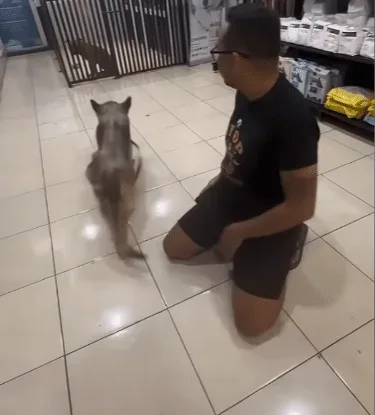
The dog who had stood behind the gate with a narrow body and a dull coat now moved with more confidence. By about the fortieth day, the change was striking. Fur was returning across much of her body, her skin looked calmer, and her eyes seemed brighter. She even carried herself differently.
The treatment had not erased every effect of what she had been through, and she might still need further veterinary care. But the discomfort that had defined her arrival no longer ruled every hour. Her body finally had what it needed to recover.
A Watchful Dog Begins to Show Her Personality
Some of the most meaningful changes couldn’t be measured in new fur. When the rescuer first met her, the German Shepherd had been watchful and restrained. She had no way of knowing whether the people who came to the gate would help or simply disappear.
After weeks of steady care, her behavior began to soften. She showed more curiosity about her surroundings and approached familiar people more readily. Her tail wagged without the old hesitation. Instead of standing apart and tracking every movement, she started to join in the activity around her. She accepted affection and explored her space. At times she even showed a playful side that no one could have glimpsed from the far side of the gate.
Her rescuers didn’t claim that every frightening memory had vanished. Recovery doesn’t delete an animal’s past. It gives her new experiences to set beside it: a hand that treated her without causing needless pain, a bowl refilled every day, a person who left the room and then came back, and a clean place to sleep without staying alert to every noise outside.
Through repeated moments like these, she seemed to be learning that her circumstances had changed. She no longer had to save all her energy just to get through the day, and that left room for her personality to appear.
A Name of Her Own and a Place Among Other Rescued Dogs
Once she had reached an important point in her recovery, Melda, as she came to be called, left the clinic. She wasn’t going back to the locked property. Instead she arrived at a safer place where other rescued dogs were already living.
The introductions were handled calmly. After so much time alone, a crowd of other animals could have been too much, so the caregivers let her watch and approach at her own pace. The other dogs seemed curious but peaceful. They sniffed, moved nearby, and gradually accepted her presence.
The new setting offered something the abandoned yard could not: company. She was no longer the only living presence beside an empty house. Dogs rested close by, people arrived with food and care, and life went on around her without leaving her isolated.
Her name gave her rescuers a way to talk about her as an individual instead of only as the dog behind the gate. She was no longer defined by the place where she had been found. She had preferences and needs of her own, and a future that could keep unfolding well beyond the return of her coat.
What One Small Wag Can and Cannot Tell Us
That first tail movement carried a lot of weight for the young man. It would be tempting to call it proof that Melda never lost hope, or that she understood from the start that he would get her out. No one can know that. A wagging tail can express interest, uncertainty, nervousness or cautious friendliness.
What mattered was how he answered it. He didn’t treat the gesture as permission to rush at her. He treated it as an opening. He came back with food, gave her time, worked through the steps needed to remove her safely, and stayed involved while veterinary professionals dealt with problems that feeding alone could not solve.
The rescue didn’t come from one magical moment at the gate. It came from follow-through. Noticing suffering matters, and coming back matters even more.
Her story is also a reminder that animals can go unnoticed even where people live nearby. A locked gate makes it easy to assume that whatever lies behind it is someone else’s concern. An empty-looking property may still hold an animal, and a dog can receive just enough occasional food to stay alive while serious medical problems go untreated.
Anyone worried about an animal in a similar situation should avoid trespassing or confronting an owner in ways that could create further danger. A safer path is to document conditions from a legal public spot and contact local animal control, law enforcement or an established rescue organization. Useful details include:
- How long the animal seems to be left alone.
- Whether clean water and proper shelter are visible.
- Signs of injury, extreme weight loss or untreated skin disease.
- Weather conditions that could create immediate danger.
Prompt reports give professionals a better chance to step in before an animal’s condition becomes more severe. Melda lasted long enough for someone to notice her. Other animals may not have that much time.
Not long ago, her whole life was contained within one neglected yard. Forty days after her rescue, she no longer looked like the dog standing among debris behind a rusted gate. Her coat was coming back, her body was stronger, and she was being treated, meeting other dogs and learning the routines of a safer place.
The first time the young man saw her, Melda offered one cautious movement of her tail. He chose to notice it, and then he chose to keep coming back. The gate has opened now, and her treatment has begun.