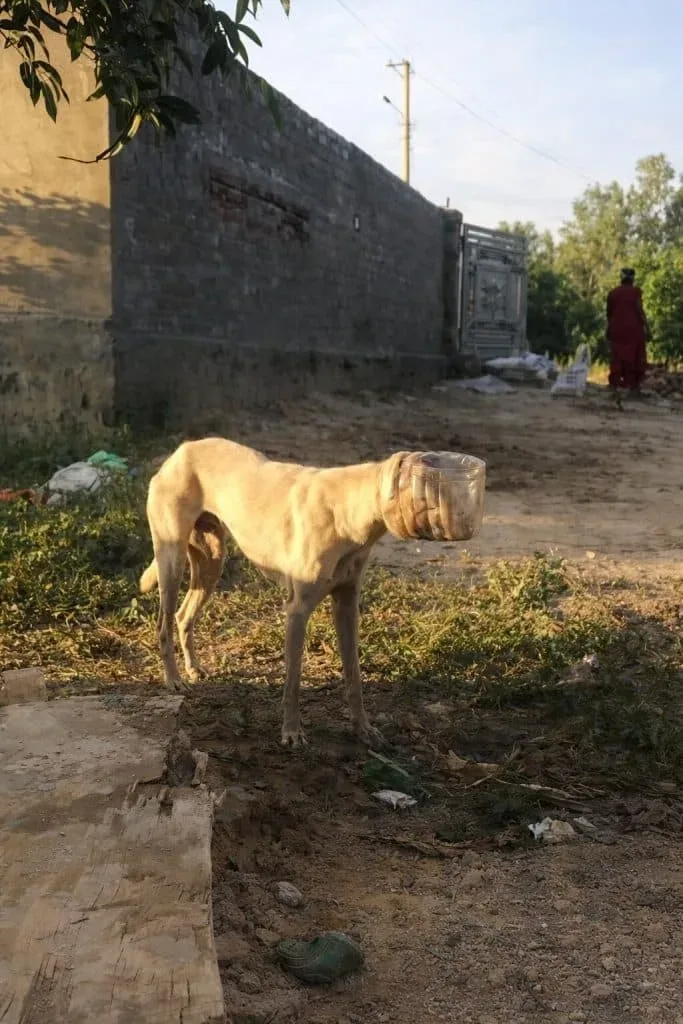
From a distance, the problem was easy to misread. A thin dog was moving along the edge of a road, and his head looked wrong. Where a muzzle and eyes should have been, there was a clear plastic jar.
The container fit tightly around his head. He could not lower his mouth to eat or drink, and his steps were unsteady. His body looked worn down.
No one could say how long he had been like this. What the people nearby could see was that he was losing strength, and that a road is a dangerous place to walk when you cannot see clearly.
A Thin Dog, a Clear Jar, and a Busy Roadside
He might have passed for any stray dog drifting along a shoulder. It was his gait that made a person look twice. He moved hesitantly, like an animal testing the ground before trusting it, and the jar made clear this was no ordinary stroll.
He could still walk, but he had little control over where he went. With his head sealed inside plastic, he faced a list of risks that grew with every step. He could drift toward traffic. He could stumble into a ditch. He could wander somewhere no one would think to look, or keep going until exhaustion made him stop.
The account does not say how long the jar had been on him. It could have been a few hours or considerably longer. His thin frame and shaky movements suggested that time was short.
When the rescuers arrived, they grasped the urgency at once. They also grasped that hurrying could make things worse. How they approached him would matter as much as how quickly they got there.
Video: A Stray Dog With a Plastic Jar on His Head Is Calmly Helped by Rescuers
What Life Looks Like From Inside a Jar
Light could pass through the clear plastic, but the container bent and clouded whatever lay beyond it. Shapes would have been blurred, distances hard to judge, and the ground ahead uncertain.
Sound was a different matter. Cars went by. Footsteps came close. Voices carried from places he could not identify. He could hear the world around him, but as far as anyone could tell, he had no easy way to work out which direction led away from danger.
The jar also took away the most basic things a hungry, thirsty dog does without thinking. He could not drop his nose to the ground and he could not drink. Even if air kept reaching him, an animal that cannot eat or drink weakens quickly.
That is part of why his situation was so easy to overlook. There was no loud struggle, only a dog walking in a strange, tentative way and slowly running out of energy.
Rescuers Who Slowed Down Before They Stepped In
The team faced a real dilemma. The dog could not see them coming clearly. A sudden grab might send him into a panic, push him toward the road, or make him hurt himself against the hard plastic.
So they changed their pace. Voices dropped and steps shortened. Before anyone tried to take the jar off, they had to let the dog sense that nobody was chasing him.
One rescuer guided him toward a patch of softer ground. Another stayed near enough to keep him from heading for traffic, but far enough back that he would not feel boxed in.
No one lunged. No one raised a voice. Nobody tugged at the jar. The people simply gave the dog time to register that they were there and that they meant no harm.
Steadying a Frightened Body
His breathing stayed quick, and his body was tense. Any unfamiliar touch could have set off another desperate attempt to flee.
Once he was in a safer spot, one rescuer gently secured his body. The goal was not to hold him any more than necessary. It was to keep him from injuring himself while the container came off.
Force was out of the question. The jar sat snugly around his neck, and his ears were folded up inside it. Yanking at it carelessly could have caused pain or damaged the sensitive areas beneath the plastic.
One hand stayed near the dog’s body. The other rested on the jar. For a moment, everyone held still.
The dog kept breathing fast, but he did not fight. Why he stayed calm is impossible to know. Exhaustion may have been a factor, and the steady, unhurried handling may have helped too.
The First Try Showed Why Pulling Wouldn’t Work
The first attempt made the problem plain. The jar would not simply slide off. Its narrow opening had caught around the dog’s head, and the way his ears were folded made removal harder still.
Pulling harder risked harm, so the rescuer stopped. That pause shaped everything that followed. Rather than treating the dog’s fear as something to push through, the team built their method around it.
A Little Oil and a Lot of Patience
A small amount of oil was carefully applied around the trapped area. The idea was to reduce friction between the plastic and the dog’s neck, so the container could move without scraping or dragging at his skin.
It was a modest fix, but it demanded control. The dog had to stay calm. His ears had to be protected. And the jar had to be angled just so, letting its narrow edge pass over his head without pressing on his throat.
No sharp tools were brought near the frightened animal, and there was no hurried pulling. There were only steady hands and a careful plan, with the dog given as much time as he needed.
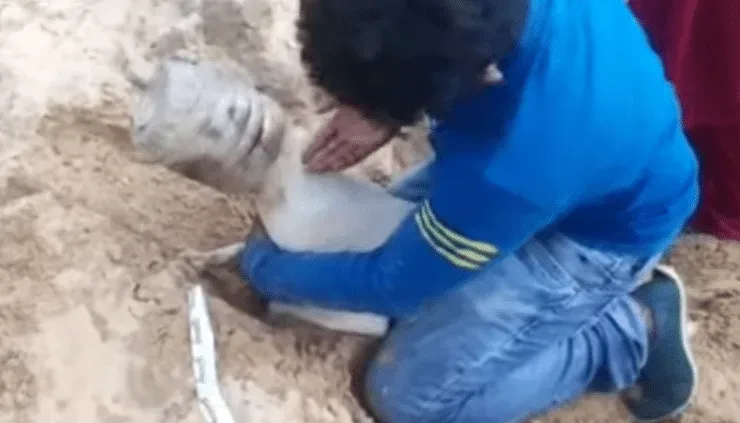
Inch by Inch, the Jar Let Go
The rescuer worked in small increments. He shifted the container slightly, then paused. He checked where the dog’s ears sat, then tried again.
At first the jar barely moved. Then it shifted a little more. Each small change brought the dog closer to being free.
Gradually the container began to slide forward. The rescuer shielded the folded ears as the narrow edge passed over them, keeping every motion slow so the plastic would not catch or cause needless discomfort.
Then, after one last adjustment, the jar came off.
A Clear View, a Shake, and a Run
The dog’s face was uncovered for the first time in an unknown number of hours, or perhaps days. He lifted his head and blinked.
Fresh air moved across his muzzle. He could see the ground beneath his paws and look at the people beside him without plastic bending the view.
For several seconds he stood completely still, and the rescuers did not crowd him. They let him take in the space that had suddenly opened up.
Then he shook himself from head to tail, as if trying to rid himself of the whole ordeal. The rescuers released their hold, and he stood on his own. Nothing covered his face, and nothing kept him from lowering his head.
His first moves were cautious. He looked around, adjusting to the light, the movement, and the openness. His body was still tired. But now the choice of direction was his. He took one step, then another.
A few careful steps turned into a quicker walk, and soon the dog was running. The jar stayed behind on the ground.
There was no celebration by the roadside. The rescuers simply watched him go. The account does not say where he went next or whether he found a home. What it does show is that he left under his own power, able to see where he was headed.
How Everyday Litter Becomes a Trap
No one can say for certain how the dog ended up in the jar, but one explanation is easy to imagine. The plastic may once have held food. Even after it was thrown away, it might have kept a scent that drew a hungry dog to investigate. He may have pushed his head inside to reach what was left and then found he could not back out. That is speculation, not something the account establishes.
What looks like harmless trash can become a serious hazard. Stray animals often check out discarded containers because food is hard to find, and they cannot understand the danger of a narrow opening or deep plastic walls.
Once a head is stuck, panic can make matters worse. An animal may run blindly, collide with objects, wander into traffic, or grow too exhausted to keep looking for help. A trapped container can also prevent it from eating or drinking.
Often there is no cry to draw attention. There may be only a dog walking strangely, a head held at an odd angle, and a body slowly losing strength.
This dog was helped because someone noticed that his movements were not normal, and a rescue team arrived before exhaustion overtook him. Those who came also understood the difference between acting fast and rushing. They moved quickly to reach him, then slowed down once they were beside him.
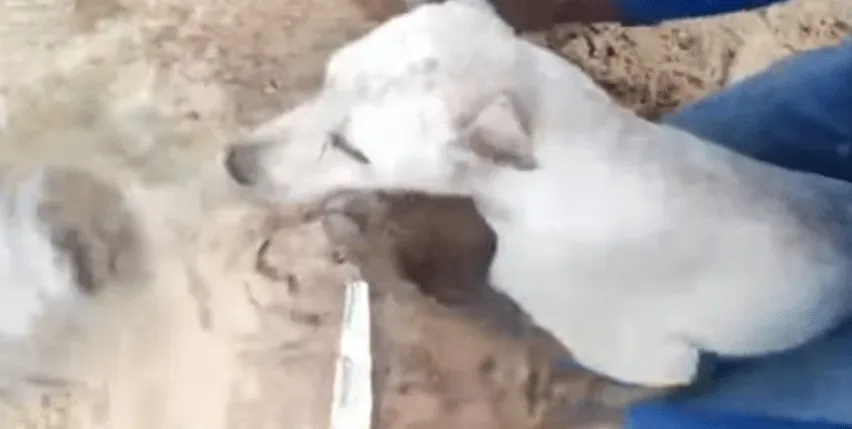
Help That Didn’t Need to Be Loud
This was not a story of long hospital stays or months of rehabilitation. The account describes no complicated operation and no crowd around a treatment table. It describes a thin dog beside a road, a plastic jar around his head, and a few people willing to come near him with care.
Even so, the rescue mattered. The dog did not need anyone to plan the rest of his life. He needed help with the danger directly in front of him.
The rescuers steadied his body and protected his ears and neck. When force failed, they turned to oil, and they kept at it slowly until the plastic finally came away. Then they stepped back, giving him room to stand, look around, and leave when he was ready.
When he was first spotted, his whole world had shrunk to the cloudy walls of a jar. He could not see where he was going and could not reach what his body needed. All he could do was keep walking.
Someone noticed. And when the jar finally came off, he raised his head to a world that was open again.