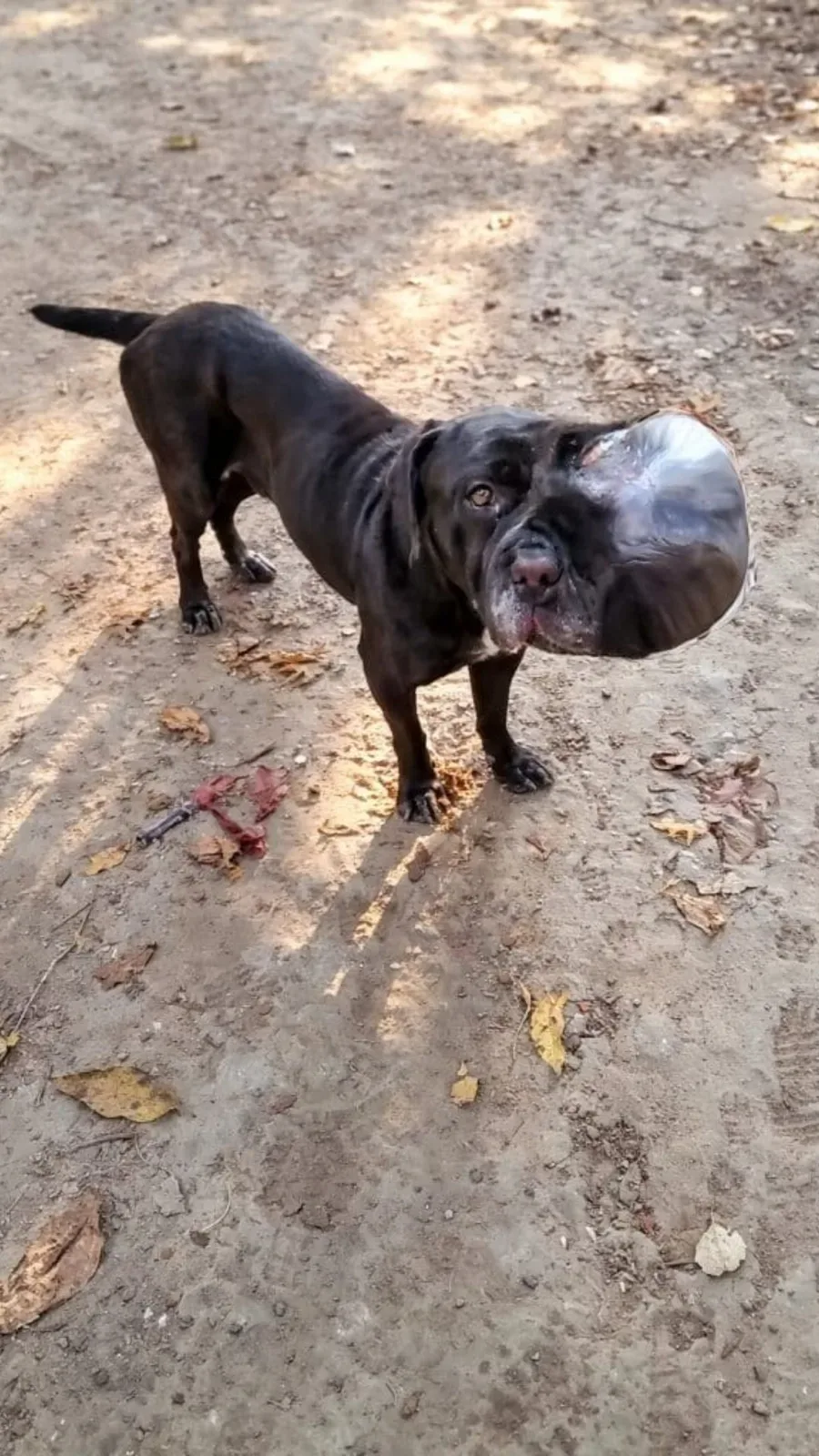
The big dog walked a few steps, then stopped. Slowly, Bubbles lowered her head until the growth on the side of her face touched the ground. She stayed that way, letting the earth carry a weight her neck could no longer hold.
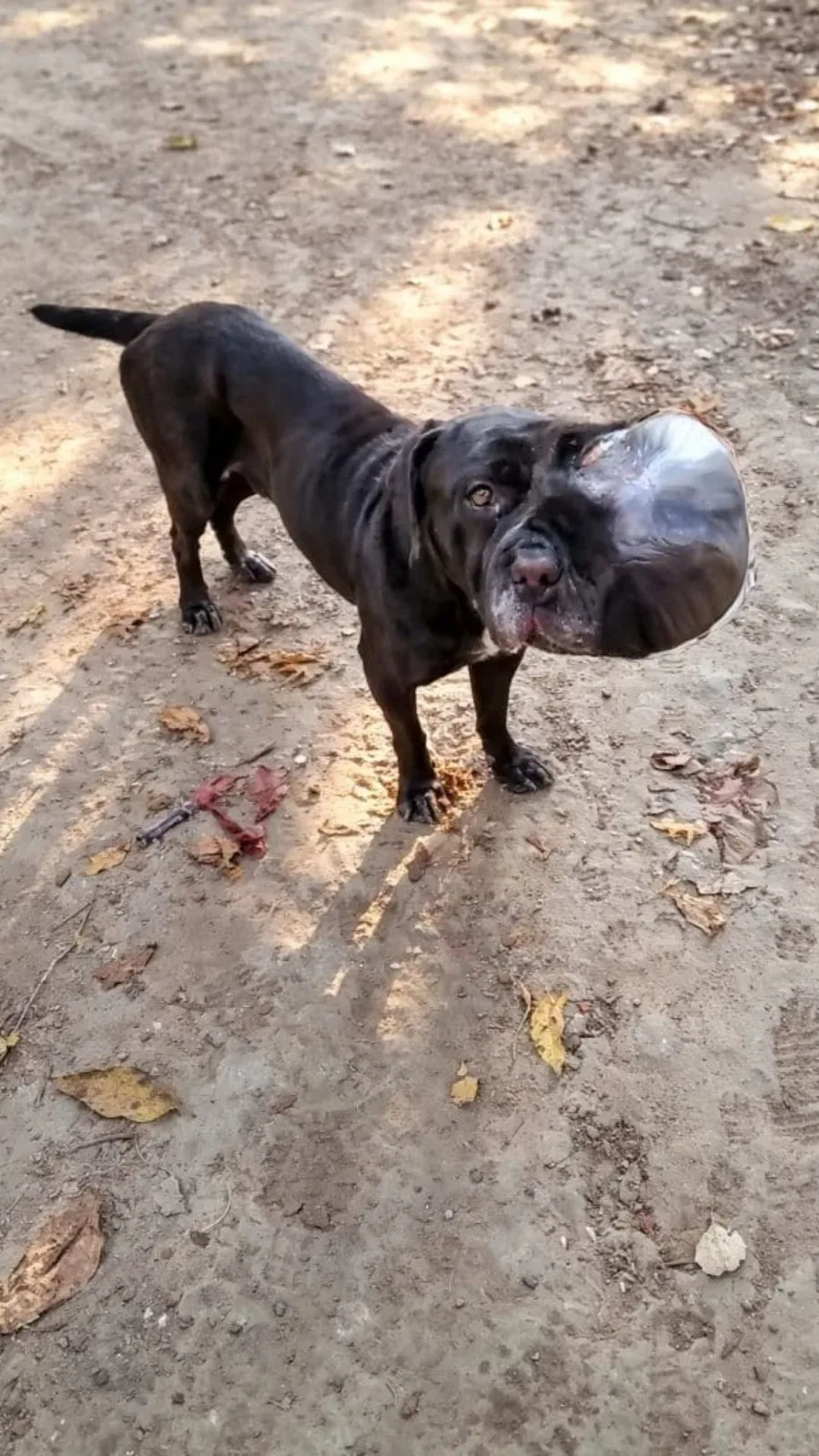
The mass covered one of her eyes and dragged her head downward. Nobody knew how she had ended up on that road or how long she had been there alone. What mattered was that one passerby looked at her and understood that she could not go on without help.
That decision started a journey of many months for the Neapolitan Mastiff. It led through a Baltimore shelter, a team of surgeons, a second round of treatment and, finally, a household in North Carolina.
A Slow Walk and a Heavy Head
Bubbles was large, and she was easy to notice from a distance. It was her way of moving that made people look twice.
The growth on her face threw off her balance and made it hard to hold her head up. It stretched across one eye, which limited what she could see on that side. She walked slowly, and each time she paused she tended to set the swelling on the ground, giving her neck a short break.
That habit says a lot about how she lived. Resting was not simple for her. She had to work it out around the mass, one stop at a time.
When a person came close, she did not react with aggression. She let the passerby near enough to help, and she was brought to the Baltimore Animal Rescue and Care Shelter, known as BARCS.
The rescue account does not say where she came from or who, if anyone, had looked after her before. It shows only a dog in plain difficulty who accepted a helping hand.
Video: A Mastiff Rests Her Head on the Road, and Surgeons Prepare to Help
Arriving at BARCS
Shelter staff had taken in animals with serious medical needs before, but Bubbles needed attention quickly.
She looked underweight, and the size and position of the growth complicated even basic routines. Eating, drinking, walking and lying down all had to be managed around it. Even getting comfortable took some planning.
The team noticed something else that had nothing to do with her condition. When people spoke gently to her, her tail gave a small, quiet wag.
It was a modest signal, but it suggested that Bubbles still welcomed company. Her condition was severe, yet her interest in the people around her had not gone away.
That mix shaped what came next. Instead of treating her as a case to manage for a few days, the people caring for her began looking for a way to deal with the growth itself. Answering that question would take more than a shelter could provide on its own.
Specialists Study a Difficult Case
BARCS sent Bubbles to an emergency veterinary hospital, where specialists could examine the mass more closely.
Their first job was to learn how deeply it was attached to the tissue around it and whether it could be removed safely at all.
Its location made that harder. The growth covered a broad area of her face and sat near structures that needed careful protection. The surgeons were also concerned about the chance of heavy blood loss during an operation.
This would not be routine surgery. Bubbles first had to be stabilized and monitored. Her medical team then planned how to remove as much of the growth as possible while protecting her airway and supporting her recovery.
Through the exams, she stayed gentle with the people handling her. She accepted careful touch, responded to soft voices and kept looking for attention from the caregivers nearby, even though she carried a load that affected nearly every movement.
According to the rescue account, weeks of preparation passed before the team was ready. Nothing was guaranteed. But without treatment, the growth would keep limiting her comfort and quality of life, and the surgeons felt she deserved the chance.
Surgery Day
When the day came, the team prepared for a long and complicated procedure. Bubbles was put under anesthesia, and the surgeons began the slow work of separating the large mass from her face.
Each stage had been planned around the risk of bleeding and the delicate structures near the affected area. The work called for steady concentration and precise control.
Outside the operating room, the people who had grown attached to her waited. They had watched her lower the growth to the floor when she tired. They had seen how she adapted the way she ate and drank, and they knew how much of her daily life it had shaped.
Eventually the medical team brought the news everyone wanted. Bubbles had come through, and the enormous growth was gone. She would still need close monitoring, but the weight that had pulled her head toward the ground was no longer part of her body.
As she woke and began to adjust, the difference showed in small movements. She could hold her head differently. She could settle onto bedding without having to position the mass beside her. Caregivers could see more of her expression than they had in a long time.
The operation had not created a different dog. It had taken away the burden that had defined her rescue.
Regaining Weight and Ease
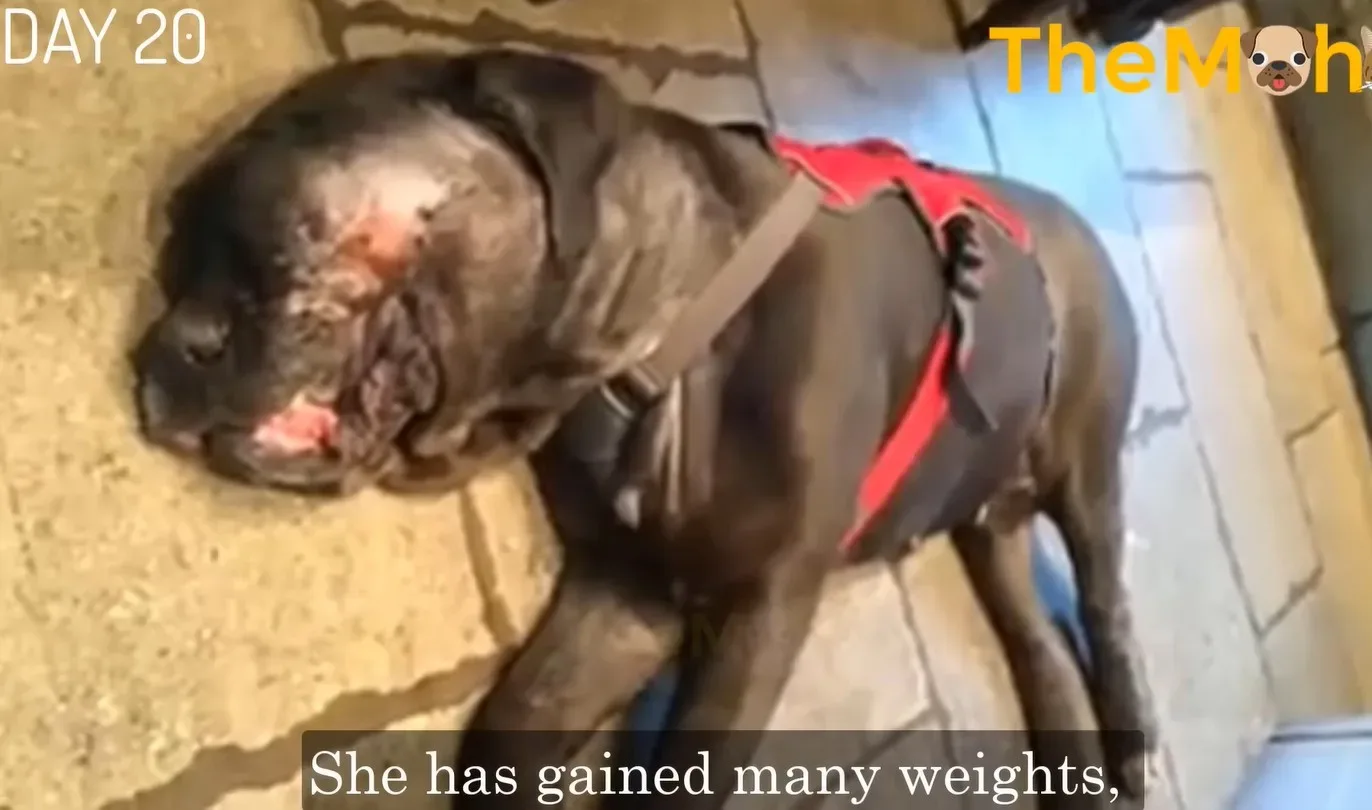
A major operation calls for a long recovery. Bubbles needed rest, medication and regular checkups while the surgical area healed, and her caregivers worked to rebuild the strength she had lost.
Her appetite gradually improved. According to those involved in her care, she eventually gained nearly 14 pounds, a sign of a dog who could eat more comfortably and rely on steady meals.
Drinking from an ordinary bowl got easier too. Before surgery, the growth had affected the position of her head and face. Afterward, she could reach food and water without constantly working around it.
To an outsider, those changes might seem small. For Bubbles, they meant a degree of independence she had not had on the road.
She also showed more interest in her surroundings. She enjoyed affection from caregivers, sought out sunny spots and rested where she could feel the warmth. When she had the energy, she crossed the grass with growing enthusiasm.
Her personality did not appear overnight. The same gentle dog had been there from the beginning. Now that moving through the day cost her less effort, she simply had more room to show it.
An Unexpected Second Treatment
Just as Bubbles seemed to be leaving the hardest stretch behind, her veterinarians identified another medical concern that needed specialized care.
According to the rescue account, she received radiation therapy and then spent roughly one month in a controlled isolation period. The account does not describe the concern in any more detail.
The extra treatment opened another demanding chapter. Bubbles needed medication, monitoring and a routine built around her medical needs, and contact and activity had to be handled carefully while she was isolated.
For a social dog who liked being near people, those limits could have been hard. Her caregivers worked to keep her comfortable and connected while following the necessary precautions.
Bubbles kept cooperating. She took her medication and rested when her body needed it. Whenever circumstances allowed, she enjoyed the things that had begun to fill her new life: attention, sunlight and time outdoors.
No one could promise that every stage would be easy. What her team could offer was close tracking of her progress and decisions made around her well-being, a long way from the dog who had wandered an empty road by herself.
A House in North Carolina, and a Blind Dog Named Gus
In time, Bubbles was ready for a life beyond the hospital and the rescue facility. A family in North Carolina heard about her and decided to welcome her into their home.
They knew she came with a complicated medical history and might need continued monitoring and follow-up care. They did not see those needs as a reason to look away. What they saw was a gentle dog who wanted companionship.
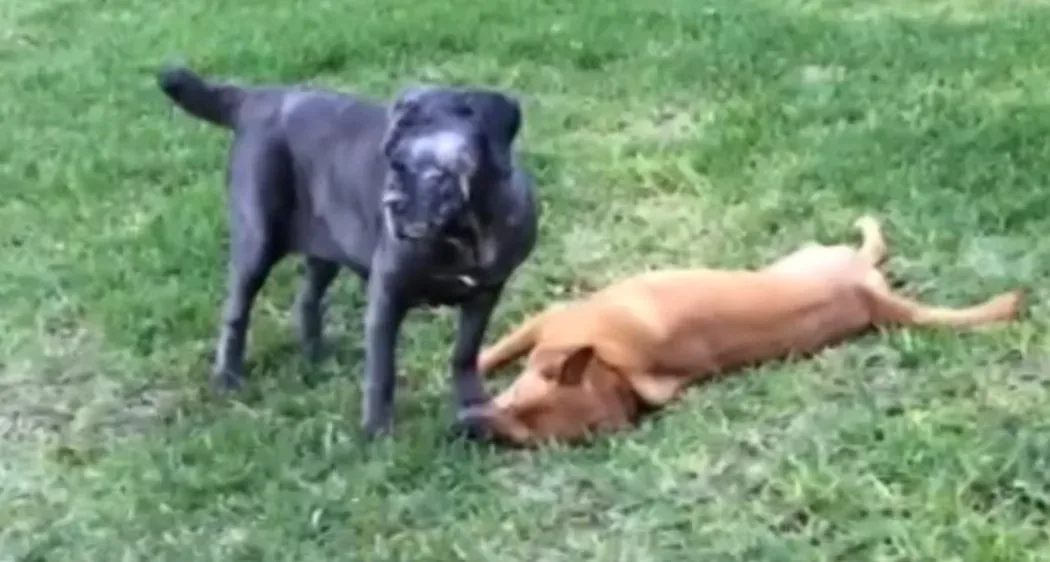
When she arrived, she met another rescue dog, a blind dog named Gus. Gus finds his way through scent, sound and the familiarity of a steady routine. He could not see the changes surgery had made to Bubbles’ face, but he grew comfortable with her quickly.
The two began spending time together. They rested side by side and moved through the house as companions. During the final stages of Bubbles’ treatment, Gus stayed nearby, a quiet presence from a dog who lives with a difference of his own.
Their bond did not need to be dramatic. It showed in ordinary moments: sharing a resting place, following one another through familiar rooms, settling close enough to know the other was there.
After months of procedures and unfamiliar settings, Bubbles finally had something lasting. She had a home.
Many Hands Behind One Dog’s Change
By the latest account, Bubbles is no longer the tired dog lowering a heavy growth onto the roadside. She lives with a family that knows her history and values the affectionate nature that stayed visible through every stage of treatment.
She has comfortable places to sleep, grass to cross at her own pace, people who keep an eye on her health and welcome her attention, and a canine companion who stays close without needing to see what she went through.
Her change did not come from one person or one moment. A passerby stopped on a quiet road. BARCS took responsibility for a dog with complex medical needs. Veterinary specialists spent weeks planning a risky operation. Caregivers saw her through recovery, further treatment and isolation. Then a family chose to carry on once the urgent rescue was over.
Her story does not claim that kindness guarantees every outcome. It does show what kindness can open up: a chance at treatment, some comfort, and the discovery of how much warmth a dog still has when pain no longer steers every step.
On that road, Bubbles had to put her face on the ground whenever she needed to rest. Now she can lie down next to Gus, in a home she did not have to find on her own.