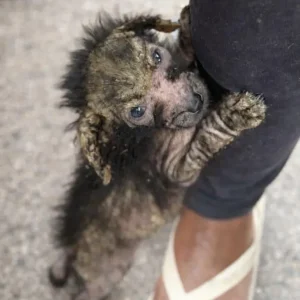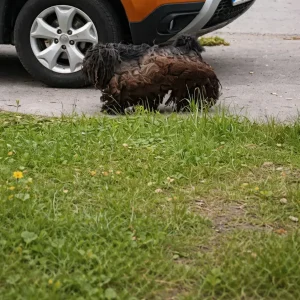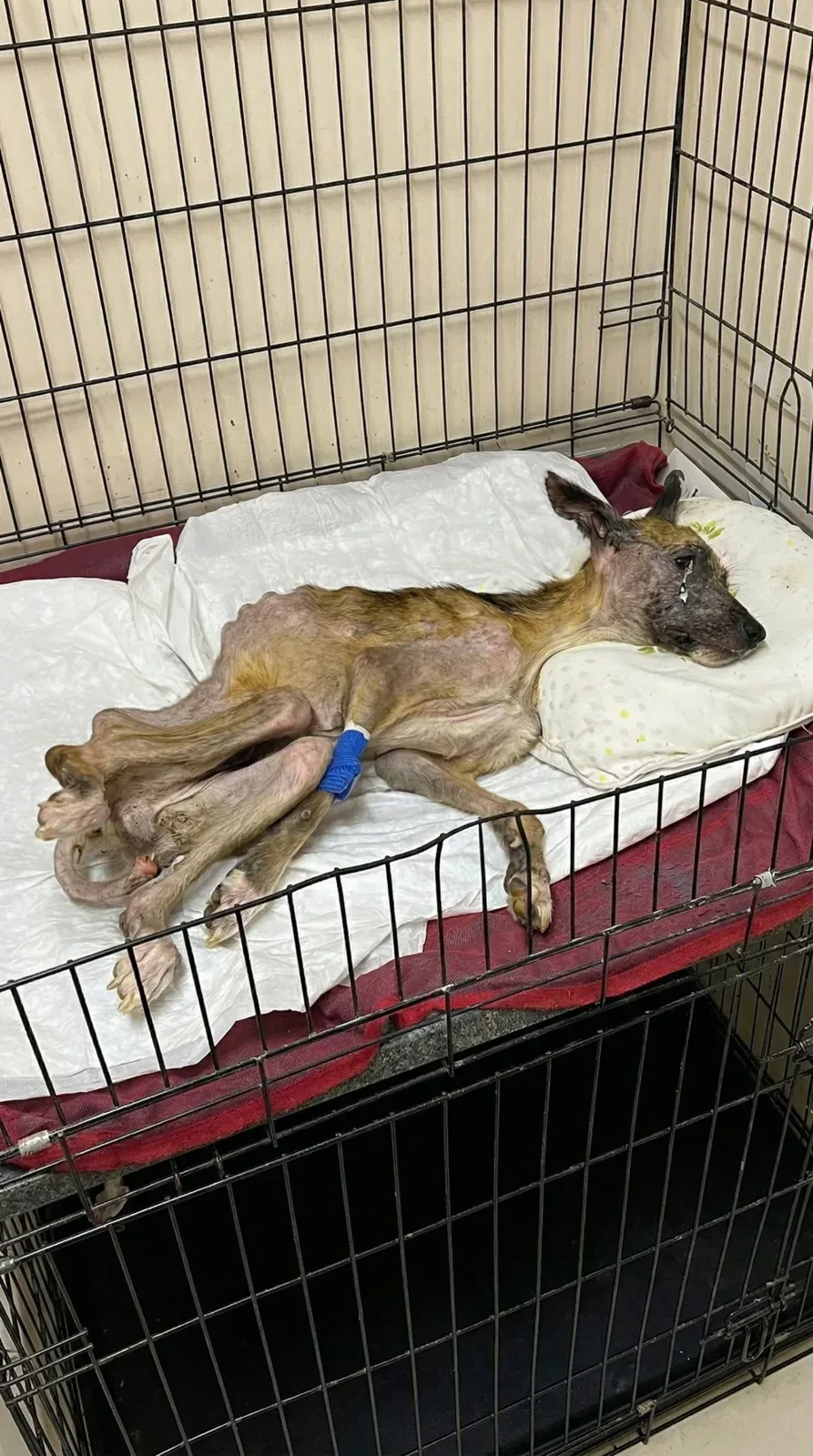
Dairn came to the shelter looking tired in ways that were hard to miss. She was thin and frail, her eyes were weary, and scars marked parts of her body.
According to the account of her rescue, she had lived much of her life in a small, dirty cage with very little proper care. Her rescuer expected a long road back, the kind that asks for patience more than anything else.
Nobody expected the next part. Once the test results arrived, the question was no longer how long her recovery would take. It was how much time she might have left.
Test Results That Changed the Question
The veterinary examinations showed that Dairn’s problems went far beyond weakness. She had severe neurological damage. Her brain was affected, and her spinal cord had suffered serious trauma. The account does not say what caused the injuries. It says only that the damage was real and extensive.
Until then, the hopeful assumption had been a familiar one. With food, rest and time, a neglected dog might slowly regain strength and movement. The findings undercut that idea. The veterinary team warned that routine treatment could not simply undo what had happened.
The doctors then raised a painful possibility. If her condition continued to worsen, euthanasia might be the most humane choice.
It was a hard conversation for the person caring for her. Only days earlier, the goal had been recovery. Now the medical team was talking about saying goodbye.
Video: Dairn’s Journey From a Hospital Warning to Life at Home
Days in the Hospital, Without a Breakthrough
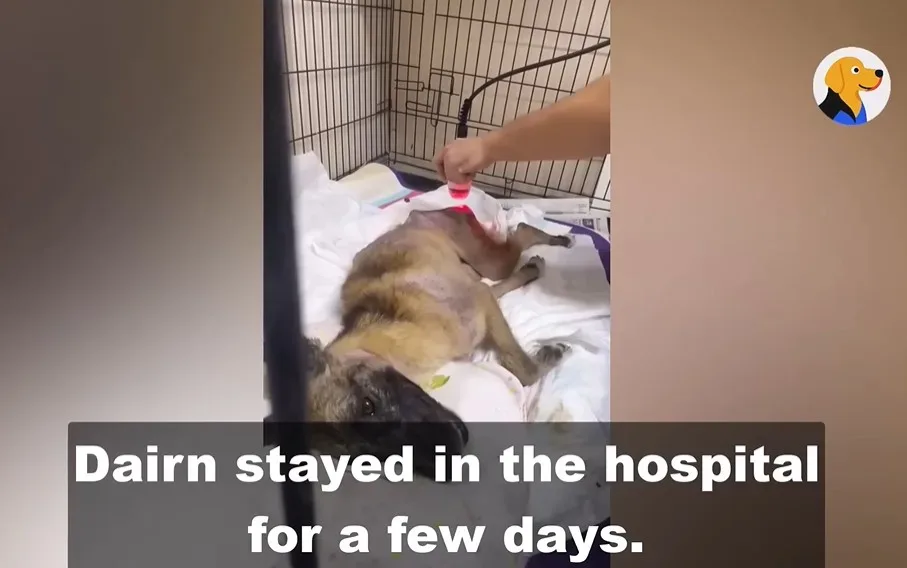
Dairn stayed at the hospital so the team could keep monitoring her. Her caregiver came every day with soft food and spent time sitting beside her.
No one can say how much Dairn understood of what was happening around her. What the account does make clear is that she was not alone through those days. The same familiar person kept coming back.
The visits did not change the medical picture, though. Her condition did not improve. In the end, the doctors explained that they had reached the limit of what they could offer. No further treatment was expected to reverse the neurological and spinal damage.
Their advice was simple and difficult to hear: take Dairn home, keep her comfortable, and be prepared for the possibility that her life was close to its end.
Sent Home to Rest, Not to Recover
That advice shifted the goal from treatment to comfort. The question was no longer what medicine could still fix. It was where Dairn could rest most peacefully.
She was wrapped carefully and carried out of the hospital. If her remaining time was going to be short, it would be spent somewhere quieter than a clinic.
At home, her caregiver began with a warm bath. It was a gentle task, but not an easy one. Dairn could not move her legs, and she could not lift her head in the usual way. Her body needed full support from start to finish.
Afterward she was kept warm and comfortable. The days ahead were not built around ambitious rehabilitation, and no one expected her to suddenly stand. The plan was smaller and more immediate: make her comfortable and see what each day brought.
The First Days at Home
Her care came down to a handful of basic tasks. Feed her. Keep her clean. Change her position. Stay close.
Her caregiver slept very little during that stretch, watching for any sign that she was getting worse. The account does not say exactly how many days passed this way, but it makes clear how closely she was watched.
For a while, nothing seemed to change. Then, quietly, something did. Dairn’s breathing became steadier, and her condition stopped declining.
It was not a dramatic recovery, and it did not look like one. There was no sudden movement and no sign that the damage had reversed. But the dog who had been sent home for comfort care was still there, and she was no longer slipping.
A Follow-Up Visit Nobody Predicted
When Dairn went back to the hospital for a follow-up evaluation, she was not the patient the veterinary team had braced to see.
She was still severely disabled. The neurological damage remained, and she still could not walk. But she had stabilized. Instead of continuing to decline, her body was holding steady.
That mattered. The original prognosis had been extremely poor, and Dairn had now moved past the expectation that she would have only a very short time left.
It did not mean she was cured. Nothing in the examination suggested the spinal damage had disappeared. What had changed was the conversation itself. It was no longer only about preparing for the end.
A new question had taken its place: how could Dairn live as comfortably and independently as possible with the body she had?
Learning to Get Around on Wheels
The long-term outlook was still hard. Dairn was not expected to regain normal use of her legs, and her mobility would be limited permanently.
Limited mobility, however, did not have to mean a life spent in one spot. Her caregiver looked for another solution and arranged a custom wheelchair for her.
The device supports Dairn’s body and gives her a way to move without depending entirely on her damaged legs. Using it took practice, and her caregiver worked with her regularly as she adjusted.
No one claims the wheelchair fixed what was wrong. Its value is more practical than that. It gives her a way to travel beyond wherever someone happens to set her down, and for a dog once expected to have almost no future, that is a meaningful change.
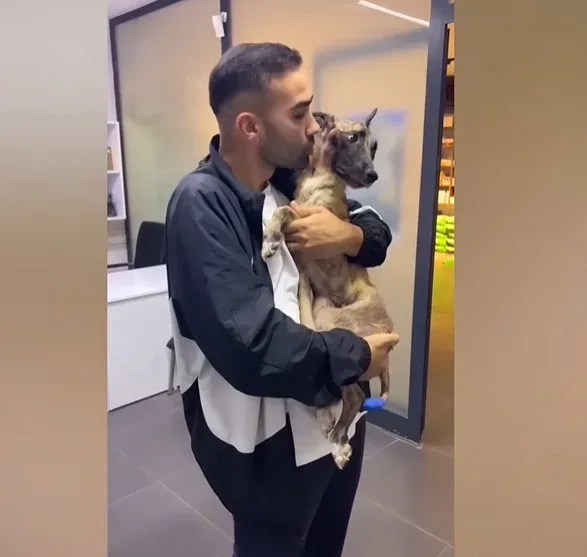
Where Dairn’s Story Stands Today
Dairn still lives with serious neurological and spinal damage. She still cannot walk normally, and her life takes more support than that of many other dogs.
But she is alive. She lives with the person who took her home when veterinarians believed there might be very little time left. She has a custom wheelchair, daily care, and a household arranged around what her body can and cannot do.
It is worth being precise about why her story stands out. Medicine did not reverse the damage, and Dairn did not erase her diagnosis. What changed was more grounded: her condition leveled off at a time when everyone expected it to keep worsening.
That steadiness gave her caregiver room to think about something other than goodbye. Comfort turned into routine, and routine turned into daily life. Eventually, daily life included wheels.
When Dairn left the hospital, the expectation was that she might be going home for the last time. Instead, home became where the next stage of her life began. Rescue does not always restore what was lost. Sometimes it builds a way forward around what cannot be repaired.