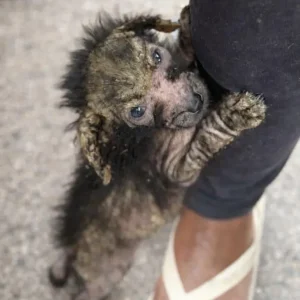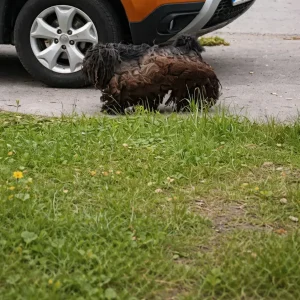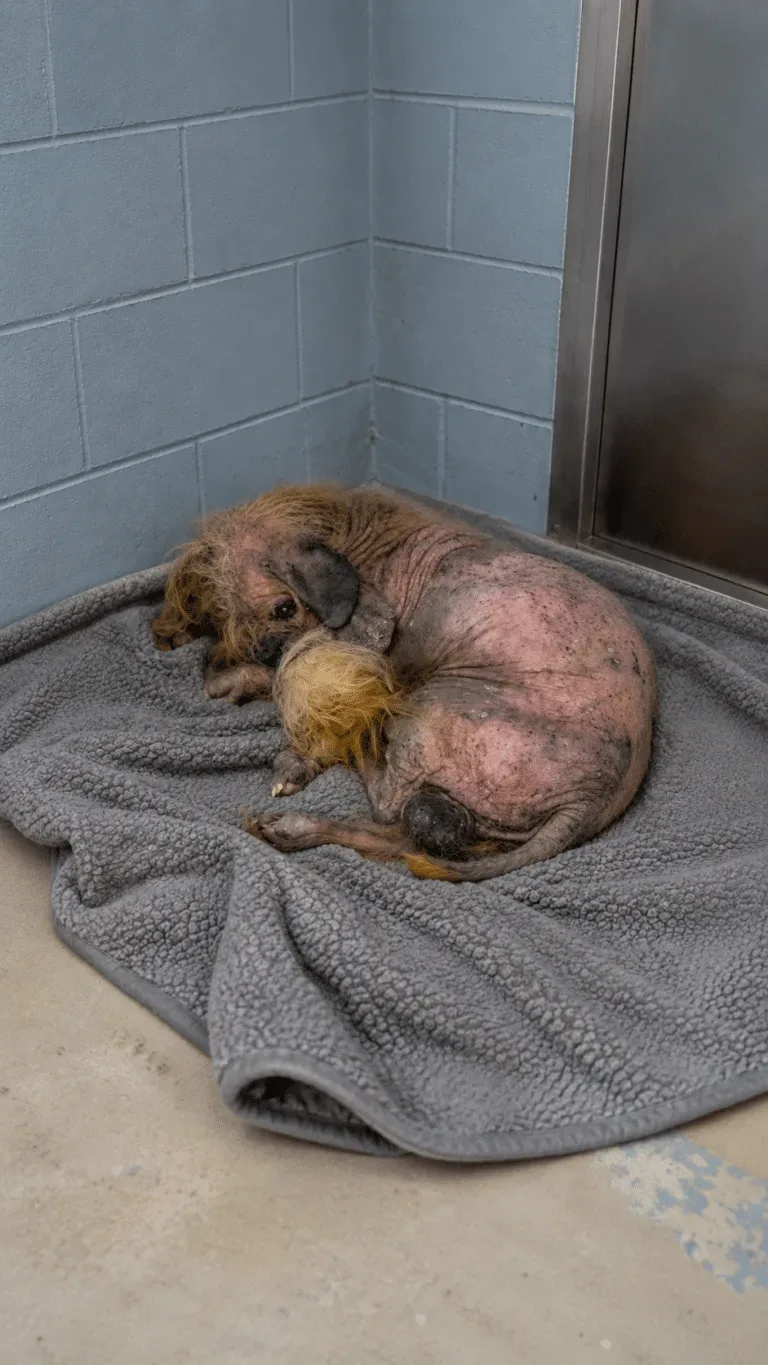
A few steps. That was usually all Freddy could manage before his legs folded under him.
The small dog had almost no fur left. The skin showing through looked inflamed, one of his eyes had been badly damaged, and his teeth reflected years without proper care. Yet the people who met him were most concerned about how he moved. His body was stiff, and the ground never seemed steady beneath him.
A foster volunteer named Caitie opened her home to him. She did not expect a quick turnaround. Her plan was to treat his recovery as a series of small pieces, and to count every one of them.
What Caitie Saw When Freddy Crossed the Floor
Freddy arrived showing clear signs of long-term neglect. With so little hair, his body had almost no cover, and his sensitive skin meant that even handling him required care.
His walking told its own story. He kept his posture tense and moved slowly. Sometimes he set off across a short stretch of floor and lowered himself down before reaching the far side. Other times his balance gave out entirely and he fell.
Caitie read it as a dog who wanted to get somewhere while his body refused to cooperate. She did not ask him to behave like a healthy dog on day one. She made a quiet place for him to rest, watched how he moved, and arranged the veterinary visits that could explain what lay beneath the damage anyone could see.
Those visits made one thing plain: this was more than general weakness. Something serious was affecting his spine.
Video: Freddy Struggles To Walk In Foster Care, Then His Personality Starts To Show
The Diagnosis Behind the Unsteady Steps
The veterinary examinations pointed to severe spinal disc compression. Put simply, pressure around his spine was making movement uncomfortable and unstable.
That finding explained the stiffness Caitie had noticed, and it explained why his legs could fail after only a handful of steps. What had looked like ordinary frailty turned out to have a specific medical cause.
It also changed how the coming weeks had to be handled. Freddy could not just be encouraged to walk more. Pushing him too hard might add strain to a body already under stress, so every activity had to be chosen with his spine in mind.
For a foster caregiver, an answer like this cuts two ways. It gave the treatment a direction. It also made clear that the road ahead would be slow.
A Care Plan With Many Moving Parts
His spine was only one item on a long list. His irritated skin needed treatment, and infections had to be brought under control. His damaged eye and worn teeth called for professional evaluation as well.
None of these needs could be allowed to slide while another was being addressed, and no single procedure could undo everything his body had been through. His care relied instead on a combination of medication, injections, antibiotics, supportive care, and carefully controlled physical rehabilitation.
Even with all of that in place, nothing was guaranteed. Veterinary treatment could give Freddy a chance, but it could not promise how far he would get.
That uncertainty shaped how Caitie approached each day. She was not working toward one dramatic moment of recovery. She was putting together a routine from many modest pieces and trusting that they would add up.
Why Caitie Let Freddy Set the Pace
Freddy had probably lived with discomfort for a long time, and limited movement had left his muscles weak. Asking too much of him too soon could have caused more strain.
Caitie understood this early on. Rather than push toward a goal she could not be sure he would reach, she decided his recovery would follow his body’s own pace.
Some days might bring visible progress. Others might bring nothing but rest. She chose to treat both as part of healing instead of keeping a scorecard of wins and losses.
That approach asked plenty of her. Patience in foster care is not passive. It means watching closely, noticing small differences, and adjusting the plan whenever his body showed it had reached its limit for the day.
Standing a Little Longer, Day After Day
Caring for Freddy soon became part of Caitie’s daily rhythm. Medication had to be given on schedule. His skin needed regular attention. Physical therapy was introduced gradually, with exercises designed to help his legs regain strength without putting needless pressure on his spine.
The movements were small. Caitie supported his body while encouraging him to shift his weight, helped him practice standing, and guided him through short attempts at walking.
Some days Freddy managed several steps. On others his legs slipped before he had gone far. A morning when he looked stronger might be followed by a day when he seemed tired again, so his progress never ran in a straight line.
Caitie did not treat a hard day as a failure. She changed the exercises, let him rest, and tried again when he was ready.
The victories that counted were modest: standing a few seconds longer, reaching his bowl without falling, crossing part of the room before he needed a hand. To a stranger they might have seemed ordinary. To someone who had seen Freddy at the beginning, they showed that he was still responding.
The First Patches of Fur
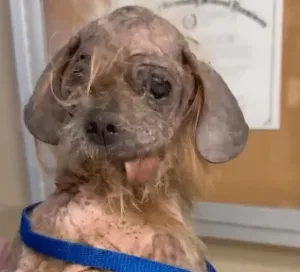
While Freddy worked on his mobility, his appearance began to change too. Small patches of fur showed up across his back. Later, more began growing near his tail and across areas that had once been almost completely bare.
The change was gradual. There was no morning when he woke up with a full coat. His skin needed time to heal before hair could return, and some areas recovered more slowly than others.
Still, he looked healthier from one week to the next. Soft brown-and-gray fur began covering skin that had once been irritated, giving him the scruffy look that became part of his charm.
His face grew more expressive as well. He paid closer attention when Caitie came into the room and showed more interest in food, movement, and whatever was going on around him.
The dog who had seemed absorbed in getting through each painful step was becoming curious about the world. His recovery could no longer be measured only in medical terms. A personality was starting to show.
The Day Walking Turned Into Running
As his legs gained strength, the way Freddy moved changed noticeably. His cautious steps became steadier. He could stay upright longer and cross the house with less help. He still needed to be watched, but stiffness and discomfort no longer seemed to control every motion.
Then he ran.
It began as a short burst, a few excited steps across a room. Before long, those bursts grew into the full-speed laps often called zoomies. Freddy dashed through the house with an enthusiasm that would have seemed out of reach during his first days in foster care.
He explored, played, and sought attention from the people around him, and he seemed eager to be part of whatever they were doing. Caitie finally got to meet the dog who had been hidden behind illness and exhaustion: playful, affectionate, and curious.
He did not move perfectly every moment, and his medical history still mattered. But the dog who once collapsed after a short attempt at walking now had the strength to race toward the people he trusted.
A Neighbor’s Decision
One of Caitie’s neighbors got to know Freddy while he was staying in her home. She saw more than the cheerful dog he eventually became. She also understood the work that had brought him there: the medications, the demanding exercises, the uncertain days, and the patient encouragement.
Over time, her affection turned into a decision. The neighbor chose to adopt Freddy.
For Caitie, fostering had never been about keeping every animal who passed through her door. The aim was to help each dog become healthy and confident enough to join the right permanent family.
Even so, a goodbye could have been hard. Freddy had relied on her during some of the most vulnerable weeks of his life. She had steadied him when he struggled to stand and celebrated when he started moving on his own.
Fortunately, he was not going far. His new home is close enough that Caitie can keep seeing him, so the adoption gave him a permanent family without cutting him off from the person who guided him through recovery.
What Freddy’s Life Looks Like Now
Today, Freddy looks very different from the little dog who first came into foster care. Scruffy fur covers his body. He moves through his home with energy, plays, runs, asks for affection, and lives with a family committed to his continued care.
His past has not disappeared. The effects of spinal compression and long-term neglect required significant treatment, and his health may always need thoughtful attention. Those challenges, though, no longer describe his whole life.
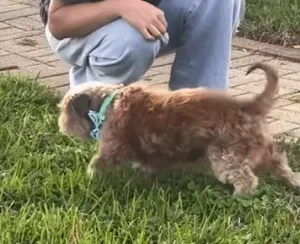
His transformation was not the work of a single miracle. It came from many necessary things done again and again: medication, physical therapy, nutritious meals, rest, encouragement, and care that carried on even when progress was hard to see.
That is what sets Caitie’s approach apart. She did not judge Freddy’s worth by how quickly he healed or whether he could move like other dogs. She cared for him while he was still fragile, stiff, and uncertain, and that patience gave his body time to respond. Damaged skin could heal. Weakened legs could grow stronger. The playful dog beneath the exhaustion had room to appear.
Freddy entered foster care nearly bald and struggling to stay on his feet. He left with a thick, scruffy coat, an energetic personality, and a family of his own, with the woman who helped him get there living close enough to watch him enjoy it.
Once, he needed help to take a few steps. Now he races through his home toward people who are glad to see him coming.