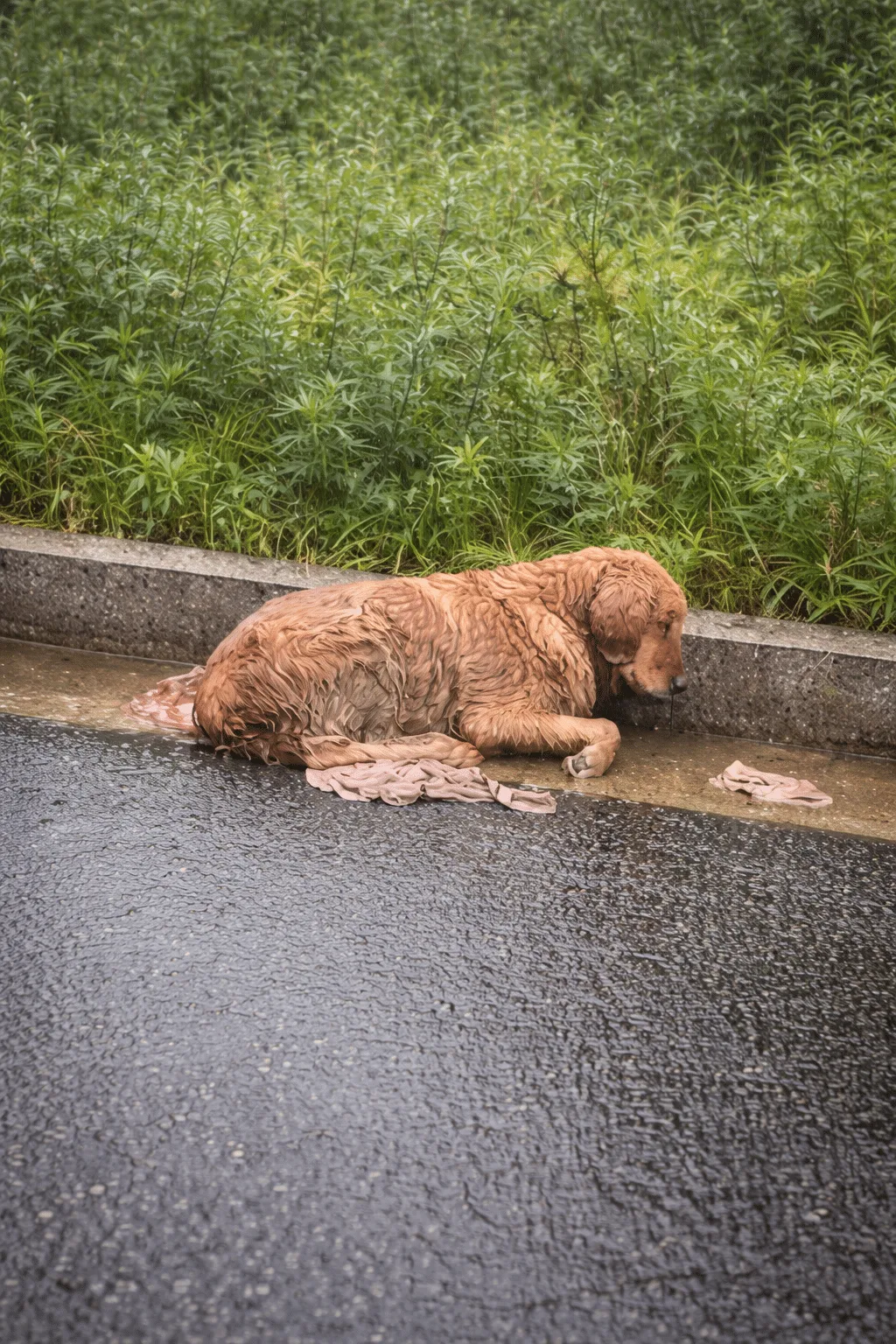
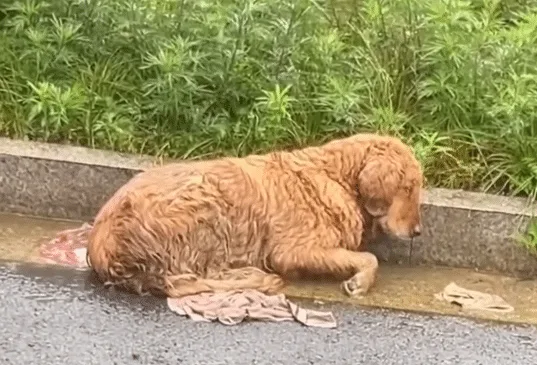
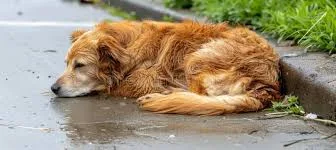
Rain had soaked everything along the road. Muddy water pooled in shallow dips while vehicles kept passing, and in one of those puddles lay a Golden Retriever with barely enough strength to move.
His coat was drenched and his body was painfully thin. Even lifting his head looked like hard work.
A photograph of him reached a local rescue group, and a truck driver who saw the request changed his route. But getting the dog off the roadside was only the first problem. Saving his life would also depend on blood from another dog.
Rain, Mud, and a Dog Too Weak to Stand
No one knew how long the Golden Retriever had been struggling there. By the time someone noticed him, his condition was already alarming. His thick coat hung in wet strands, and mud coated his legs and belly. He moved slowly and seemed unable to stand comfortably.
He did not bark at people walking past, and he did not try to follow them. He stayed where he was.
At one point he found just enough strength to drag himself under a parked vehicle. That gave him some shelter from the rain, but it could not give him warmth or food. It also could do nothing about the illness that was draining him.
When the storm eased, he crawled back into view. He was trembling. His eyes were open, but he seemed barely able to respond to what was happening around him.
A passerby understood that he could not wait. That person took a photograph and sent it to people who might be able to help.
Video: Golden Retriever Found Shivering in a Roadside Puddle Is Rushed Toward Emergency Care
A Photo, a Rescue Group, and a Driver Who Changed Course
The truck driver had never met the dog. He saw the rescue request and decided to go to the location anyway.
When he arrived, the Golden Retriever was still near the road. Up close he looked even more fragile. He was a large dog, but illness had left him severely weakened.
The driver approached carefully and lifted him off the ground. There was no struggle. The dog barely had the energy to react. He was settled inside the truck, away from the wet pavement, and the driver set out for the nearest veterinary hospital.
The dog stayed quiet during the trip, and his breathing appeared labored. He needed warmth, and the man at the wheel could do little except keep driving toward medical help.
The dog was off the roadside, but the real emergency was still ahead. At the hospital, veterinarians soon realized that exposure to the rain was only a small part of what was wrong.
What the Veterinary Exam Uncovered
The veterinary team began examining him right away, and what they found was worse than anyone had expected. Both ears were severely infected. His skin was irritated and damaged, with wounds on his legs and abdomen. Thick discharge affected his eyes. Even sitting upright took considerable effort.
One finding stood out above the rest: his gums were extremely pale. That can signal severe anemia, a condition in which the body lacks enough healthy red blood cells to carry oxygen.
The team started warming him gently. They drew blood samples and watched his breathing and general condition. The lab results confirmed the concern. The Golden Retriever had severe anemia and showed signs of jaundice. He also tested positive for babesiosis, a tick-transmitted disease that can damage red blood cells.
That explained how critical his state had become. His body was struggling to keep up its oxygen supply, and the anemia had reached a dangerous stage. Medication was necessary, but it would not work fast enough to give him the support he needed right then. He needed an emergency blood transfusion.
A Healthy Labrador Turned Out to Be a Match
The team began looking for a suitable donor. Blood could be obtained through the hospital, but the amount he needed would add considerable expense to an already intensive rescue.
A healthy Labrador Retriever was brought in for testing. Before any donation, veterinarians had to confirm that the donor was suitable and that the blood could be given safely, so they ran compatibility tests.
The result was the one everyone had hoped for. The Labrador was a match.
That evening, two bags of donated blood were transfused slowly under veterinary supervision. The staff watched his breathing and checked his temperature. They also stayed alert for any sign of a transfusion reaction.
No one could say right away how he would respond. He was still fighting a serious infection, and his other medical problems had not gone away. The transfusion could not cure babesiosis on its own. What it could do was supply vital red blood cells while medication and supportive care began to work on the underlying illness.
For a dog who had barely been able to move beside the road, that help could make an enormous difference. Another dog had become part of his chance to survive.
The Morning After, He Lifted His Head Alone
The first encouraging signs came the morning after the transfusion. The Golden Retriever seemed more alert, and his breathing looked steadier. Then he did something that would have been nearly impossible when he arrived: he lifted his head without any help.
It was a small movement, but after the state he had been found in, it counted.
Later he tried to stand. His legs shook, and he held his weight for a moment before sinking back down. The staff did not push him. They let him rest. After a while he tried again, and then once more. Each attempt lasted only a few seconds, but the repeated effort showed that some strength was returning.
His condition was still serious. He needed continued treatment for babesiosis, his anemia required monitoring, and the infections in his skin, ears, and eyes were far from gone. Still, the dog who had arrived barely able to sit was now trying to get to his feet.
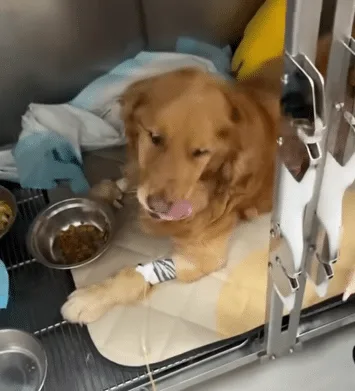
Caregivers then noticed another change. He was starting to show interest in food.
Chicken Breast and a Long List of Treatments
His appetite was limited at first. His body had been through prolonged illness and a medical emergency, and he did not return to normal eating right away. The veterinary team offered suitable meals while treatment went on, and eventually they found a food he clearly preferred: chicken breast.
He accepted it more eagerly than anything else, and meals slowly became part of his daily routine. That nourishment helped support the rebuilding of lost weight and muscle.
Meanwhile, the medical team worked on several fronts at once. Medication targeted the babesiosis. His ear infections were treated, and his damaged skin and wounds were cared for. His eyes were monitored and treated, and his blood levels were tracked as he improved.
No single treatment did all the work. The transfusion had provided essential support during the emergency, but recovery depended on many kinds of care working together: medication, food, warmth, wound treatment, rest, and close observation.
Day by day, the Golden Retriever grew stronger.
A Few Careful Steps in the Sunlight
As his condition stabilized, he spent more time on his feet. Standing was still hard at first. His legs were weak and his muscles had lost strength, so even a short period of movement left him needing a break. Over time, he could stay upright longer.
Then hospital staff helped him take a short walk outside. The first outing was brief. He moved cautiously, placing one paw ahead of the other. Warm sunlight touched the coat that had been soaked by the storm when he was found.
He did not run or try to play. He walked a little, then went back inside to rest. For the people who had seen him struggle even to sit, those few steps meant a great deal.
More short walks followed, each one letting him rebuild strength without overtaxing his recovering body. The distances grew, and his movements became steadier. Eventually he no longer collapsed after every attempt to stand.
Weeks Later, Another Dog Was Showing Through
Over the following weeks, the changes added up. His pale gums regained healthier color. The discharge from his eyes began to clear, and the ear and skin infections responded to treatment. The wounds on his body started to heal.
As his appetite improved, his thin frame began to fill out. His muscles strengthened, and the coat that had once hung in muddy strands looked healthier.
The biggest difference was how he moved. He could stand, walk, and explore. He could go up to familiar caregivers without anyone lifting him. His eyes looked brighter, and his posture became more confident. Hospital staff could finally see more of the dog who had been hidden by illness, and he was becoming increasingly affectionate and responsive.
His recovery also had another part that nobody had planned for. The man who had carried him from the roadside had not forgotten him.
The Driver Who Kept Following His Story
For the truck driver, the rescue could have ended at the hospital door. He had answered the call, driven to the road, lifted the dog into his truck, and delivered him to people who could treat him.
Instead, he kept up with the dog’s progress. He learned about the severe anemia and the babesiosis diagnosis. He heard about the emergency transfusion and the Labrador whose blood had helped keep the Golden Retriever alive. He saw the dog grow stronger and begin standing, walking, and responding to the people caring for him.
Eventually the Golden Retriever improved enough that he no longer needed hospital care. His blood levels had recovered, his infections had been treated, and he could walk confidently on his own. What he needed now was a permanent home.
The truck driver decided he wanted to adopt him.
The Same Truck, a Very Different Ride
The dog had been inside that truck once before. That first trip was an emergency. He was wet, cold, and severely weakened, and the driver took him to the hospital without knowing whether he would survive.
This time the circumstances were completely different. The dog could walk, his health had improved, and no one was rushing him toward emergency treatment. He was beginning a permanent life with the man who had helped rescue him.
The vehicle that had carried him away from the roadside was now taking him home. The man behind the wheel was no longer just someone who had answered a rescue request. He was the dog’s owner.
No More Hiding From the Storm
Later scenes of his recovery look almost impossible beside the first. The dog who once trembled in muddy water was now moving across open ground. His coat looked healthy, his body was stronger, and he had enough energy to play with other dogs. He ran, explored, and greeted his companions. When he got tired, there was a safe place to rest.
The change went beyond his body. His days no longer revolved around fighting a serious illness, and he no longer had to save every bit of his strength. He could spend it on ordinary things like walking, playing, following his owner, and enjoying the outdoors.
His survival came through many separate acts of care. A passerby noticed him and shared a photograph. A rescue group helped spread the word. A truck driver changed his route. Veterinarians found the serious illness hidden beneath his wet coat. A healthy Labrador gave blood when it was needed most. Then came the long work of recovery, and finally an offer of a home.
None of these steps could have replaced the others. The transfusion gave critical support, but the dog still needed treatment for babesiosis and his other problems. The driver got him to safety, but the veterinary team had to help him survive. The Labrador donated blood, but the weakened dog still needed time to regain strength. And once he was well enough to leave, someone still had to take him in.
The truck driver did that too. The dog who once used nearly all his strength to crawl under a parked vehicle and escape the rain can now run with other dogs, surrounded by people who care for him. He has a home and a family.