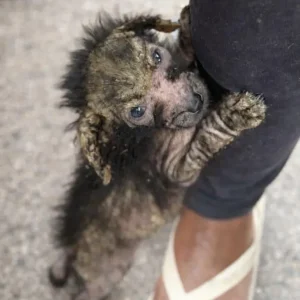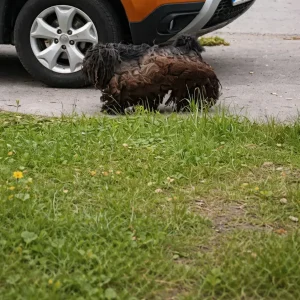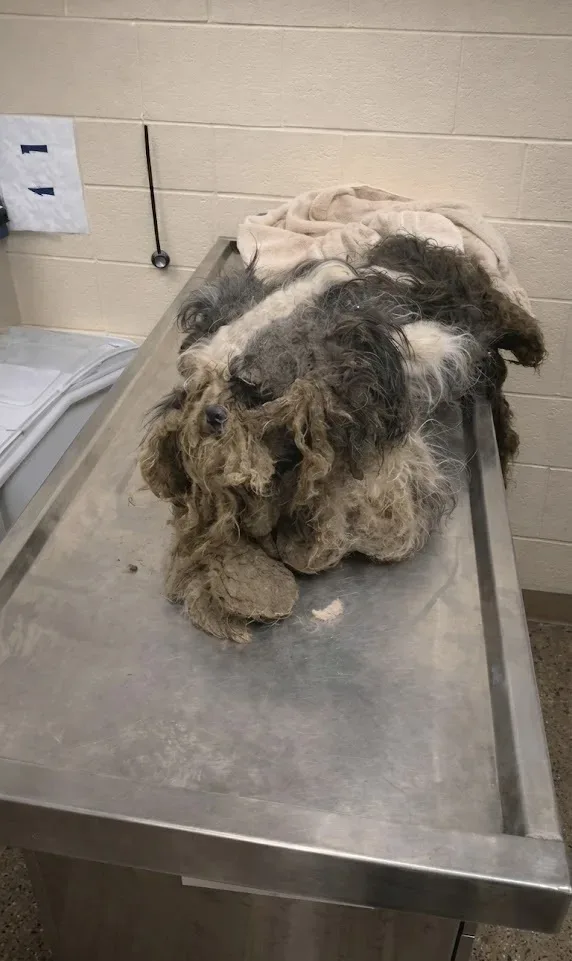
The people who first met Joseph had to stop and ask themselves a basic question: what kind of animal was this?
In front of them stood a dense, shapeless mass of hardened fur, dirt and debris. The coat had knotted so tightly that his face, his legs and even the outline of his body had nearly disappeared inside it.
But the bundle was breathing. Somewhere under that weight, a small dog was watching and waiting to see what these strangers would do.
A Bundle That Breathed
Joseph’s coat had not simply grown long. Over time it had pulled into thick, heavy mats that covered nearly his whole body. Dirt and bits of debris were trapped between the tangled layers, and the whole thing hung on him like a stiff, uneven shell.
His legs were hard to tell apart. His eyes were barely visible. Anyone looking at him for the first time would have struggled to find where the fur ended and the dog began.
How long he had lived this way is not known. What the rescuers could see was the effect: each step looked restricted, and the mats seemed to tug at his skin whenever he moved.
Yet he did not growl, and he did not try to get away as people came closer. He stayed quiet and watched them through small gaps in the tangles. The team decided to take him to a veterinary clinic, where the work of uncovering him could be done safely.
Video: The Matted Coat Comes Off, Piece by Piece
Why a Brush Was Never an Option
It was clear from the start that ordinary grooming would not work. The mats were too dense and too close to the skin, and pulling at them could only have caused more discomfort.
There was also a question nobody could answer yet. Heavy, hardened fur can hide irritated skin or injuries that are impossible to spot from the outside. Until the coat was gone, no one could say what condition Joseph’s body was really in.
So the team chose patience over speed. They planned to work in small steps, handle him gently and pause whenever he needed a break. The clinic made that approach possible, because trained staff could watch how he was coping and look closely at his skin the moment it came into view.
Cut by Cut, a Dog Takes Shape
The mats were trimmed away in small sections, one careful cut after another, and each cut uncovered a little more of the dog underneath.
A paw appeared first. Then part of his face. Then the outline of a small, delicate frame, far lighter than anyone had expected.
As the heavy coat came off, Joseph seemed to shrink with every passing minute. The shapeless figure that had arrived at the clinic was turning into a fragile dog who had been carrying much more than his body should ever have had to bear.
The team stopped often to check on him. Joseph did not resist. He stayed remarkably calm through the work, and every so often he leaned toward the people around him. It was a small gesture, but it said something about the dog they were uncovering.
What the Clinic Could Finally See
When the last of the matted fur was gone, the medical team could examine Joseph’s skin properly. They found areas of irritation, along with signs that his body had endured discomfort for a long time.
Some old marks were also visible. Their cause could not be confirmed from appearance alone, and the rescue account does not guess at one. It is a reminder that what we can see on a rescued animal does not always explain what came before.
The account also does not describe a specific course of treatment, so it is best to stay with what is known. The examination had finally been possible, and the most obvious source of strain had been removed.
That mattered in a very practical way. The constant pulling and pressure from the hardened coat was lifted, and Joseph could move without it restricting every step. After a long period in which his body had been mostly hidden, the people caring for him could now see what he needed.
The Dog Who Leaned Into Gentle Hands
The rescuers had expected fear. Many dogs who have gone a long time without proper handling need plenty of space before they feel at ease around people.
Joseph responded differently. When a gentle hand came near, he did not pull away. He leaned toward it.
The movement was slight, but everyone in the room noticed it. In an unfamiliar place, surrounded by grooming tools and many hands, he seemed willing to accept the help he was being given. He followed soft voices with his eyes, allowed caregivers to clean and examine him, and at times rested his weight against the person supporting him.
That did not mean his fears had vanished. New sounds made him pause, and unfamiliar movements caught his attention at once. Still, he did not shut himself off from affection, and that willingness to connect was visible from the earliest hours of his care.
Learning to Walk in a Lighter Body
Without the mats, Joseph had to get used to the feel of his own body. His first movements were careful and measured. The coat that had once dragged at his skin was gone, and every step felt different. He needed time to regain coordination, strength and confidence.
Caregivers encouraged him without forcing anything. They offered short chances to walk in a safe area and let him stop whenever he wanted to rest.
Gradually his posture changed and his steps grew steadier. He showed more interest in the people who came into the room, turning his head when familiar voices called and following caregivers with his eyes.
Then came another small sign of progress: his tail moved. The wag was hesitant and brief, but it returned later.
There was no single dramatic turning point. Recovery arrived in ordinary moments, such as a few stronger steps, a calm stretch of rest, a meal finished without hesitation and a gentle touch accepted. Together they showed a dog becoming more curious and less guarded.
Quiet Rooms and Full Bowls in Foster Care
Once Joseph was medically stable, he left the clinic for a foster home. Everything there was new to him: soft blankets, quiet rooms, clean bowls filled at regular times, and toys left on the floor simply for him to explore.
At first he approached it all with care. He sniffed unfamiliar objects and watched the movement of the household from a distance, apparently unsure whether he was allowed to relax.
His foster family did not push. They gave him a peaceful place to rest and let him decide when he wanted company.
As the days passed, he began to sleep more deeply, and his body no longer stayed tense at every noise. He ventured farther from his bed and showed growing interest in the toys. What began as cautious sniffing slowly turned into gentle play.
Routine was part of his care. Meals came on schedule, his bed was still there after he left it, and the people around him stayed close while he took his time.
Stronger, Softer, and Still a Little Careful
With regular meals and gentle exercise, Joseph grew stronger. His movements became more confident. He began walking into open spaces without backing away, and instead of hugging the walls, he let himself explore the middle of a room.
His coat started to grow back clean and soft, and his eyes looked brighter. His affectionate side became hard to miss. He sought out the people he trusted, rested near them and accepted being held. Sometimes he followed his foster caregiver through the house, interested in daily routines that seemed to have been outside his experience for a long time.
Caution had not disappeared. In unfamiliar situations Joseph could still hesitate, and healing did not erase every trace of uncertainty. But fear was no longer the only thing steering him. Curiosity, comfort and trust were guiding more of his choices.
The Family Who Said Yes
Eventually Joseph was ready for a permanent home. A family heard about his rescue and looked past the condition in which he had been found. They saw the gentle dog he had become.
They also understood what adopting him would involve. His progress had been built on patience, and trust would keep growing after he came home. Joseph would need consistent routines, careful grooming and people willing to respect his pace.
They chose him.
In his new home, Joseph’s days are made of simple comforts: walks in the sunlight, soft places to sleep, meals he can count on, and hands that touch him gently. The dog who was once almost impossible to recognize now moves through his home with growing confidence.
His appearance has changed a great deal, but the biggest change is not the missing mats or the healthy coat. It is the way he has started to carry himself like a dog who belongs.
Joseph’s story began with a question no one could answer. It ends with a name, a face and a place of his own.