Traffic kept moving past him. Shoes scuffed the pavement, and the sidewalk stayed crowded with people who had somewhere to be.
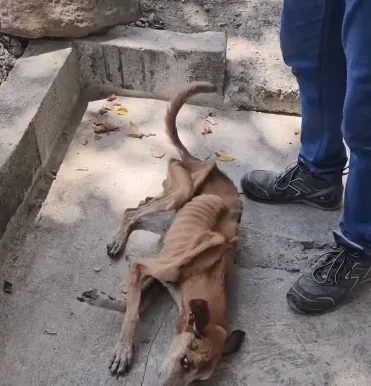
At ground level, a thin dog named Santa was trying to get up.
His front legs trembled and his body rose a few inches. Then it sank back onto the concrete. He did it again, and again. He no longer had the strength to hold himself up, but the attempts did not stop.
That repeated effort was what the rescuers noticed when they reached him. It also shaped the decisions they made over the weeks that followed.
A Dog Who Kept Rising Against the Rush of the City
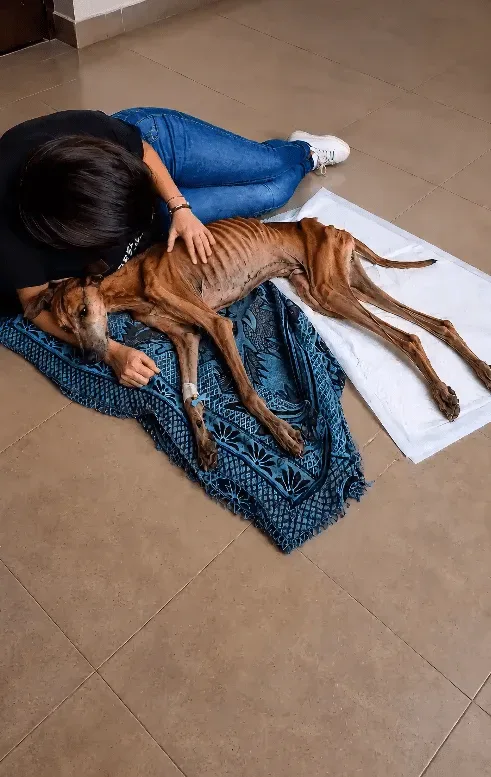
It took the rescuers very little time to see that Santa was in critical condition. His ribs and other bones showed clearly beneath his coat. He was dehydrated, and he looked like a dog who had gone a long time without enough food. Even raising his head seemed to take effort.
Still, he responded to movement close by. When someone shifted near him, he tried once more to stand. Once more, his legs gave way.
The team approached slowly and spoke quietly. Santa did not fight them as they lifted him off the pavement. Whether that was trust or plain exhaustion is not something the account can say. It only shows that he let them carry him. They settled him in their vehicle and drove directly to a veterinary clinic.
How he came to be lying on that sidewalk, and how long he had been there, was not explained.
Video: Santa Is Too Weak To Stand As Rescuers Rush Him Toward Help
Inside the Clinic, Where Every Decision Carried Risk
Veterinarians began examining Santa as soon as he arrived. They found a dog who was severely malnourished and dangerously dehydrated, drained by what looked like a long period without proper care.
There was another concern. The team was worried about his kidneys and his spleen, and that worry affected how they planned his treatment. Santa plainly needed fluids and food, but giving too much too fast could cause new problems. Care would have to be steady and measured rather than rushed.
Tests were run. Staff watched his breathing and heart rate closely. Medication was prepared to stabilize him and ease his discomfort.
In a body with so little reserve, even routine steps had to be weighed carefully.
A Prognosis Without Promises
Then came the news no rescuer wants to hear: Santa might not survive.
His condition was too fragile for anyone to guarantee a recovery. The mood in the clinic turned heavy as the team took in what that meant. They had brought him off the street, and now the result depended on how his body responded.
They also thought back to the sidewalk, to the dog who kept pushing up on shaking legs long after his body stopped cooperating. The outlook was uncertain, but their choice was clear. They would give him every chance they could.
No one could promise a happy ending. They could only promise to keep trying.
The First Real Meal
Santa went into intensive care. Fluids treated his dehydration and medication supported his weakened body. The staff prepared small, careful meals and offered them while watching how he reacted.
Then he ate.
He did not sniff the food and turn away. He ate like a dog who had been hungry for far too long. For the people in the room, that was a small but real sign that his body still wanted to fight.
He remained weak, and the medical risks had not gone away. But the meal gave the veterinary team something solid to build on.
People Who Took Turns Staying Close
The rescuers began raising support to pay for his treatment. Volunteers arranged schedules so Santa would not be alone. During the hardest nights, someone stayed near him to monitor his condition, adjust his bedding, and keep him comfortable.
It was a sharp contrast with the sidewalk. Not long before, he had lain among hurrying strangers. Now several people were paying attention to each breath he took.
Progress Measured in Small, Uneven Pieces
Santa did not improve in a straight line. Some days brought encouraging changes, and others brought new worries. His appetite might be good in the morning and fade by evening. Energy returned in small amounts, then disappeared after only a little activity.
His caregivers learned to track a different kind of progress. A bit more food finished. Brighter eyes. Steadier breathing during sleep. A head that stayed lifted instead of dropping right away.
To someone who had never seen him on the pavement, these changes might have looked minor. To the people caring for him, they were evidence that his body was responding.
Over time, Santa began gaining weight. When familiar volunteers came into the room, his eyes followed them. Earlier he had rested with his gaze on the floor.
The Day He Stayed Standing
After weeks of treatment, Santa tried to stand again. His caregivers stayed beside him, ready to catch him if he fell.
He set his paws beneath him. His legs shook. For a moment it looked as though he would collapse just as he had on the crowded sidewalk.
This time he held. It lasted only a few seconds, but he was upright, and the people around him hardly dared to breathe.
Then he moved one paw forward and paused. He took a second step. His balance was unsure and each movement seemed to need all his concentration, but he stayed on his feet.
Those first steps did not mean he had fully recovered. His muscles were still weak, and his medical condition still needed monitoring. But the dog who could not lift himself from the concrete was now walking.
Onto the Grass, With a Personality Coming Back
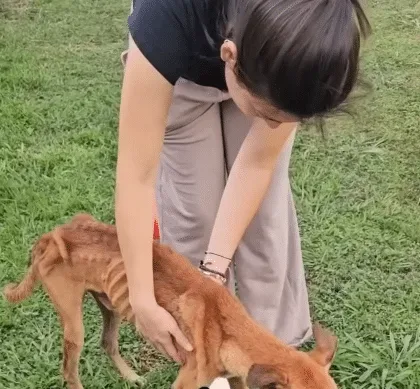
As Santa grew more stable, part of his rehabilitation moved outdoors. Soft grass gave his weakened legs and paws a gentler surface. Early walks were short, with a caregiver at his side ready to help if he lost his balance. He moved slowly and stopped often to rest.
Even so, being outside seemed to draw him out. He lifted his head at new sounds, sniffed the grass, and watched the people encouraging him along.
The distance grew a little at a time. A few steps became several yards. His legs strengthened and healthy weight kept returning.
His personality began to show, too. Santa enjoyed attention and responded to gentle voices. His tail moved when someone familiar came near. He no longer seemed to be simply getting through treatment.
Where Santa’s Story Stands Now
By the later stage of his recovery, Santa looked like a different dog. His body was fuller, his eyes were bright, and his movements showed more confidence than exhaustion.
Medical appointments and rehabilitation still lay ahead, but the immediate danger had passed. The account describes Santa as getting ready for a permanent home with a family who would know him as the affectionate survivor he had become rather than the dog on the sidewalk. No adoption is described as finished, so that home remains a hope rather than an established fact.
What is documented is how much it took to get this far: medical care, carefully managed feeding, long nights of monitoring, and repeated rehabilitation sessions. It also took people who kept working while the outcome was still uncertain.
Santa was first seen lying in the middle of a busy city, unable to stand. Now he walks on grass, on legs that grow stronger, toward the chance of a home of his own.