Rain was coming down on the Bronx when rescuers entered an apartment that looked as though everyone had left it. In one room stood a rusted cage. Inside it, something small lay almost perfectly still.
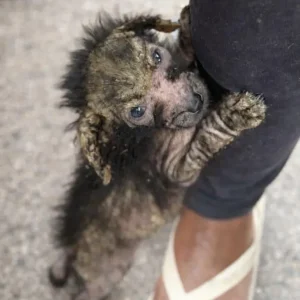
It did not look like a dog. Dirty, hardened fur covered the face, the legs and the body, and the shape behind the bars resembled a heap of discarded cloth. Nobody heard barking as the group came closer. When the cage door opened, nothing pushed back.
One rescuer reached in, gathered the fragile animal against her chest and carried him out into the weather. He would later be known as Teddy. What the mats had been hiding was still a mystery.
Inside the Apartment: A Cage, a Coat, and Almost No Movement
The apartment appeared to have been abandoned, yet a living animal had been left in it. Confined to a rusty cage, the dog had no familiar person nearby and no way to look after himself.
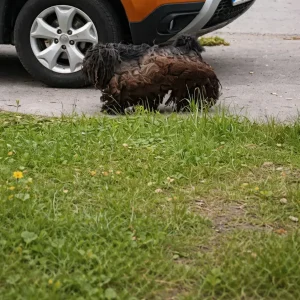
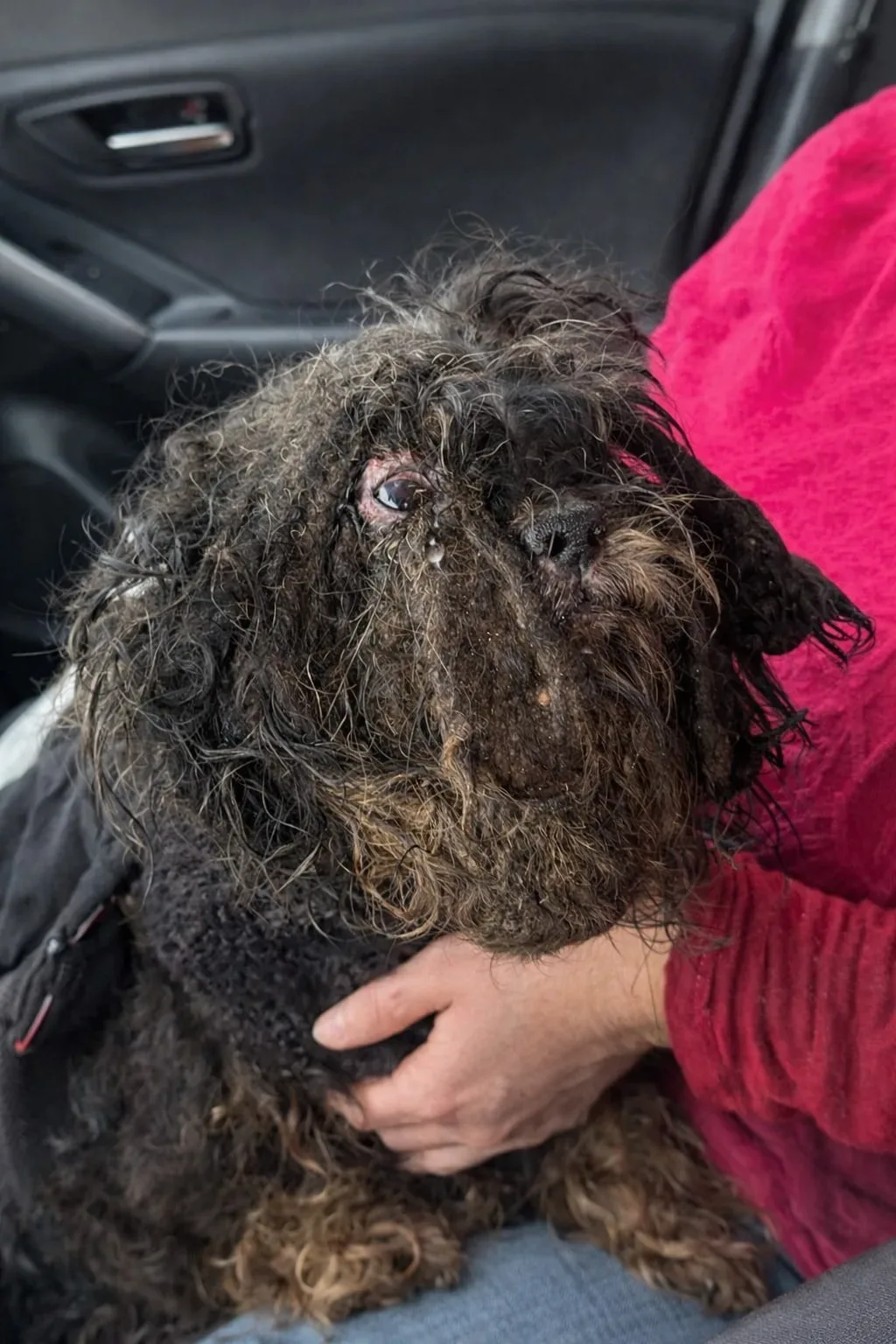
His coat was severely matted. Over a long period it had gathered dirt and debris until his natural outline all but vanished. His eyes were hard to locate behind the tangles, and his paws were buried in knotted fur. Heavy sections wrapped around his chest and belly, limiting even small changes of position.
The rescuers could not say how long he had lived this way. All they could tell was that the problem had built up over an extended time.
It was the stillness that worried them most. When the woman reached toward him, he offered almost no resistance, and he seemed extremely weak. His breathing needed prompt attention. There would be no grooming in the apartment and no waiting for him to get used to strangers. She supported his whole body and hurried him toward emergency care, leaving the cage behind in the empty room.
Video: The Rescue From the Rusted Cage and the Reveal of Teddy’s Face
Why Brushing Was Never an Option
At the veterinary clinic, the medical team began examining him as quickly and gently as they could. Under better light, the coat looked worse than it had in the dim apartment.
The fur had fused into dense layers pressed tight against his skin. Some sections felt almost solid, while others hung heavily around his legs and face. An ordinary brush was out of the question.
Because the mats covered nearly every part of him, the veterinarians had trouble judging his skin, his weight and his overall condition. His breathing remained one of their first concerns. Before attempting a full grooming, they needed to know he was stable enough to handle the touching, the noise and the stress that would come with it.
Under all that coat, he turned out to be tiny. He felt light in the rescuers’ arms, which made it plain how little of the bulk in that cage had actually been dog. Most of it had been neglected fur.
Still, there were faint signs that someone was in there. His eyes followed nearby movement through narrow gaps in the tangles. His tail made a small motion when familiar voices spoke close to him. The responses were brief, but they showed he was aware of the people working around him.
Scissors First, Clippers Second
Once the dog was stable enough, the team began the slow work of grooming. Nothing could be pulled or rushed. The mats sat so close to his skin, and their weight had so changed the way his body rested and moved, that cutting too deep under any section risked injuring skin the groomers could not yet see.
They started with the outermost layers. Scissors opened small gaps in the hardened coat, and clippers followed carefully through the areas where the skin could be identified safely. One person supported the dog while another worked.
The room stayed calm. The tools stopped whenever his breathing changed or his body tensed, and he was given regular chances to rest before the work resumed.
Gradually, the heavy pieces began to fall away. A paw appeared, then part of a leg. The outline of his chest slowly came back. A pile of removed fur grew beside the grooming table while the animal underneath became smaller, and easier to recognize, with each pass.
It was careful, unglamorous work, and its pace was set by the dog rather than by the clock.
The Face Behind the Tangles
Then the team reached his face. The fur around his eyes and muzzle was trimmed away with the same patience as the rest, and the rescuers could finally see the little dog who had been hidden inside the cage.
The change was striking, but it was not a sudden recovery. The dog now in view was thin and delicate. His legs, once buried beneath clumps, could move freely. His uncovered face showed soft features and watchful eyes.
Taking off the coat solved the most visible problem, but it did not make him strong. He remained thin and weak, and his caregivers treated him that way.
For hours, the people around him had been searching for signs of life under the tangles. Now those signs had a face: eyes that tracked movement, and a body that was small but undeniably present.
Steps Without the Drag
With the worst of the matting gone, he looked dramatically different. He was not ready to run or play, though. His body had to adjust to the sudden loss of weight and resistance.
His first steps were hesitant. He moved one paw forward, paused, and carefully repositioned the others. Without the mats, walking felt unfamiliar. Caregivers stayed close enough to steady him if he lost his balance, but they let him decide when to continue.
He took another step, and then another. Each movement showed how much the coat had been holding him back. Turning got easier. Standing took less effort. He could lift his head without tangled fur dragging across his neck and chest.
Afterward, the team wrapped him in a warm towel. With most of his coat removed and his body already weakened, keeping him warm mattered. He rested quietly in the fabric, no longer hidden and no longer confined.
A First Name and a Cautious Start
At first, he was called Uni. The name marked the beginning of his life in care, though it was not the one he would keep. Before a new name could fit, he needed time.
Emergency treatment and grooming had dealt with the most obvious problems. They could not make an unfamiliar place feel safe. During his first days at the shelter, Uni stayed wary. Sudden sounds made him pause. Movement near his resting area caught his attention right away. When hands approached, he watched closely before deciding whether to stay or shift away.
His caregivers did not push affection on him. They set up a quiet resting space and let him watch the rhythm of the place. Food arrived at predictable times. Water stayed within reach. His bedding was kept clean and warm. The same people returned each day, approached slowly and stopped when he seemed uncomfortable.
Little of this was dramatic, and that was the point. Day after day, Uni was finding out that an ordinary stretch of hours could pass without fear, hunger or confinement.
Rescue stories tend to focus on the lifting and the cutting. This stage rarely makes for striking pictures, yet it was where much of the work took place.
Trust, Measured in Small Distances
As the days passed, his behavior began to shift. At first, Uni accepted touch but held very still. Later, he started turning toward the person petting him. He followed familiar caregivers with his eyes and stayed nearby after meals instead of retreating straight to his bed.
Then he began approaching them on his own. The distances were small: a few steps across the room, a pause beside an outstretched hand, a moment when he let his body rest against someone without pulling away.
Trust was not restored by a single scene. It grew through repetition. A hand moved slowly. A touch ended when he needed space. A person left the room and came back later.
Uni seemed to be learning that the people around him were not there only for medical procedures. They brought meals and prepared blankets. They offered company without demanding anything in return.
The guarded dog from the cage began to show curiosity about the world beyond his resting area. The change was gradual, seen in small gestures rather than in any one breakthrough.
A New Name for a Softer Dog
As his coat grew back and his health improved, the name Uni no longer seemed to describe the dog emerging in front of his caregivers. His new fur was soft. His expression had become gentler and more relaxed. He increasingly looked for warmth and closeness from the people around him.
They began calling him Teddy. The name suited a small dog whose appearance and behavior had changed so much since the day he was carried out into the rain.
Teddy explored more of the shelter. He walked with greater confidence and responded to familiar voices. With regular nutrition, rest and continuing medical care, his body grew steadier. His eyes looked clearer and more attentive, and he could lie down without dense mats pulling at his skin or a cage limiting every movement.
He no longer stayed in one protected corner but moved through the shelter with purpose. He approached caregivers and accepted affection. He settled into comfortable spaces as if slowly learning that they would still be there when he came back.
His progress did not erase every cautious reaction. Unfamiliar sounds could still make him stop and watch, and new people needed to approach carefully. But caution was no longer the only thing steering his behavior. There was room now for curiosity and comfort.
The account of his rescue follows him through his recovery at the shelter and does not mention a permanent home. That part of his story remains unwritten.
The Rescue After the Rescue
The most dramatic moment of Teddy’s story may have been the woman lifting him from the cage and carrying him through the rain. But that single act was not enough by itself. His recovery depended on everything that followed.
Veterinarians stabilized his breathing and examined the body beneath the mats. Groomers worked slowly enough to avoid injuring his skin. Caregivers provided warmth once his coat was gone. Other people showed up day after day, long after the apartment and its rusty cage were behind him.
Teddy did not recover because someone picked him up once. He recovered because people kept taking responsibility for him afterward. The mats came off, his body grew stronger, and he gradually learned that human attention does not always disappear when the emergency ends.
In that deserted Bronx apartment, he had looked like a heap of soaked, discarded fabric. Fur hid his eyes, a cage held his body, and weakness left him nearly motionless. Yet he had never been an empty shape. Under it all, a small dog was watching through the mats and responding faintly to familiar voices.
Today, Teddy no longer lies behind rusted bars. He has clean fur, a stronger body and people who notice when he needs food, rest, warmth or reassurance. Someone lifted him because every second counted. Others stayed long enough to show him that the rest of his life counted too.