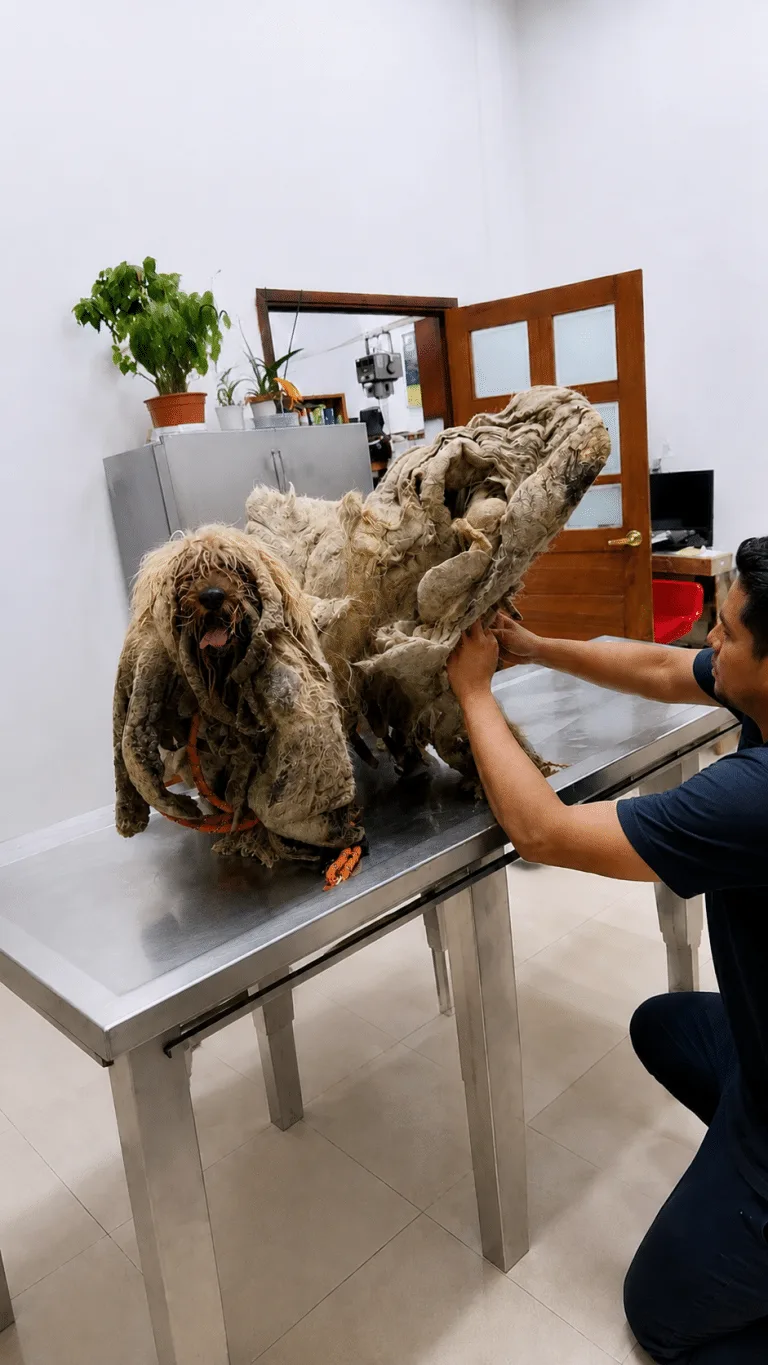
The rescuers could not tell what kind of dog was inside the shed. What they saw was a bulky, shapeless mass of hardened fur, with a pair of watchful eyes somewhere within it.
Dirt was packed into the tangles. Sand and small stones had worked their way deep into the coat. Each time the dog tried to move, the heavy layers dragged at his skin, and even turning around looked like hard work.
The dog would later be named Sonador. The rescuers expected a frightened animal who might lash out. What they met was a dog who held still, watched them, and let a stranger’s hand reach him.
A Shed Where Basic Care Had Stopped
According to the rescue account, Sonador had spent years confined in an isolated shed, without the grooming and everyday care a dog needs. The rescue team noticed the dirty, closed-off conditions right away.
His coat showed how long the problem had lasted. It had compacted into thick sections across his back, stomach, legs, and tail. Some of the mats dragged along the floor. Others sat so close to his skin that they pulled whenever he shifted his weight. His real shape was almost impossible to make out, and when he walked, the whole mass moved with him.
The team approached slowly. After so much time alone, nobody could predict how he would react. Sonador followed every movement and seemed nervous, but he did not growl or lunge. When a volunteer gently reached toward him, he allowed the touch.
That calm gave the team a way forward. They needed to get him somewhere safe, and then find out how much damage the coat had done to his body.
Video: Rescuers Find Sonador Weighed Down by Years of Hardened Fur in an Isolated Shed
Why Every Step Cost Him So Much
This was far more than ordinary tangling. Over time, separate patches of fur had fused into one heavy covering. Sand, dirt, stones, and other debris had collected inside it, and the result limited almost every movement he made.
Turning tugged at his skin. Stepping forward shifted a load he could not put down. Even when he lay down to rest, the hardened coat stayed wrapped around him. He had no way to get relief on his own.
The rescuers also saw that unfamiliar sounds and surroundings made him wary. He seemed more at ease with gentle human contact than with other dogs. The team could not know the reason, and they did not try to guess. They simply concluded that he needed room and time more than forced introductions.
The account says authorities were contacted so the conditions at the property could be documented. The volunteers kept their attention on the dog. He needed a veterinary exam, his skin needed to be looked at, and the coat had to come off before anyone could tell how he was really doing.
Slow Work With the Clippers
Once Sonador reached veterinary care, it became clear that a standard grooming session would not be enough. The fur had set into thick slabs full of compacted debris. In places the mats were so dense that ordinary clippers barely moved through them, and elsewhere they lay dangerously close to his skin.
That made each cut a judgment call. Pulling on a mat could hurt him, and cutting too fast risked injuring skin that was already irritated. So the team went slowly. They supported his body, separated the layers wherever they could, and carefully cut away the sections that had become tightly attached.
The covering came off in stages. Some pieces fell away in large clumps, while others took far more patience. The pile of dirty fur on the floor kept growing, and with each section removed, more of the actual dog came into view.
Through all of it, Sonador stayed remarkably cooperative. He was tired and frightened, yet he let the team keep working.
What the Scale Showed
As the grooming went on, Sonador kept looking smaller. His legs came out from under the mats. The line of his back appeared. The huge shape the rescuers had first met was gone.
Then came the numbers. Before grooming, he reportedly weighed about 12.1 kilograms. After the hardened coat and trapped debris were removed, he weighed about 7 kilograms. That is a difference of more than five kilograms, or over 11 pounds.
For a dog his size, that was an enormous load, and much of it was not his body at all. It was matted fur, dirt, stones, and other material he had hauled around with every move. The figure went a long way toward explaining why walking had been so hard.
The scale revealed something else, too. Sonador was much thinner than the bulky coat had suggested, and the skin underneath needed careful attention.
Walking Lighter
With the last mats gone, Sonador had to get used to moving freely. For years his legs had worked under thick, restrictive fur. Now there was nothing dragging at them.
He did not bolt around the clinic. His muscles needed time to adjust, and his newly exposed skin was still sensitive. He took a few cautious steps, then several more. The difference showed. He could turn more easily, and the weight that used to swing around his body was no longer there.
The team watched closely and let him explore at his own speed. There was no reason to hurry a dog who had just gone through such a major physical change.
A Personality Comes Out Slowly
Taking off the mats changed Sonador’s body, but his comfort around the world needed something different: patience. New places, unfamiliar sounds, people moving nearby, and other dogs could all still unsettle him.
Caregivers noticed that he was more relaxed with gentle human attention. He sometimes approached familiar people and accepted affection. As the days passed, he grew more curious about his surroundings.
Contact with other dogs took more care. Rather than forcing introductions, the team let him watch from a comfortable distance so he could learn that he could explore without being overwhelmed. Little by little, playful behavior began to appear. He followed caregivers, investigated nearby objects, and showed interest in what was going on around him.
The dog who had barely moved under that coat was beginning to take part in ordinary daily life.
Clean Bedding, Regular Meals, and a Brush
Sonador’s new setting offered the basics he had been missing: clean bedding, regular food, veterinary attention, and people who checked on him through the day.
His thin body needed nourishment, and his skin needed continued care after being covered for so long. As his fur grew back, it would need regular attention to keep painful matting from returning. His caregivers understood that the same problem could develop again without upkeep, so brushing, trimming, and skin checks became part of his routine.
In the meantime he kept exploring. He could walk over to people when he wanted attention, pick a comfortable spot to rest, and move around without a heavy coat pulling at his skin. These are everyday things, but for a dog who had reportedly spent years in a dirty shed, they added up to a very different life.
More Than a Haircut
The amount of fur taken off Sonador was striking, but the grooming was only one piece of the rescue. He also needed medical attention, proper nutrition, clean surroundings, and time to adjust after years of isolation.
The team handled these needs step by step. They removed the mats, made sure his skin could be examined, gave him a safer place to stay, and supported him as he got comfortable moving and being around others. They also paid attention to what still made him nervous and did not push him into meetings with unfamiliar dogs.
His confidence was rebuilt in small moments: a familiar voice, a meal that arrived on time, a gentle hand that respected his space, a quiet place to rest undisturbed. His caregivers did not expect him to forget his past. They offered him chances to experience something different, and over time Sonador learned he could approach people without fear.
The Dog Who Can Finally Be Seen
When the rescuers first stepped into that shed, Sonador was nearly unrecognizable. His body was hidden under layers of hardened fur, dirt had collected in the mats, and every step meant pulling a huge weight along with him.
Then help arrived. The team approached gently, brought him to veterinary care, and carefully cut away the coat that had held him back. The scale recorded part of the change, from roughly 12.1 kilograms to about 7, but the most important differences were not numbers. He could walk more comfortably, turn without the same restrictions, approach familiar people, and rest somewhere clean and safe.
The source does not describe a permanent home for him. What it does describe is a recovery in progress, built on regular meals, proper grooming, veterinary attention, and patient care.
Sonador’s story shows how neglect can become a burden an animal cannot shake off alone, and how much careful, compassionate help can change. Where every step once dragged years of tangled fur across the floor, he can now move freely enough to explore. And the gentle dog beneath the coat, hidden for so long, is finally visible.