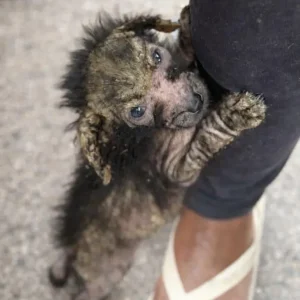
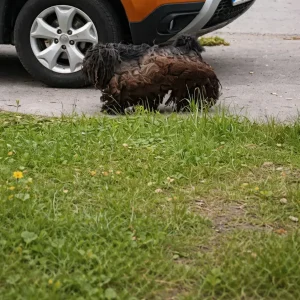
She did not bark, circle, or beg. The dog simply appeared in a Texas yard one day, stopped, and stayed where she was.
Nobody at the home knew where she had come from. She was thin and moved slowly, with the guarded patience of an animal that had been managing on her own for a long time. Her name, according to her rescue account, is Meg.
The story that followed did not begin with a rescue team or a planned operation. It began with a homeowner who looked a little longer than most people had.
A Thin Dog Standing Still in a Texas Yard
Meg showed no sign that she expected a welcome. She did not push toward the house or ask for food. She stood in the yard like a dog at the end of one more long search, with no idea where the next one would lead.
Her condition suggested this was not the result of a single bad week. She was painfully underweight, and fleas covered her coat. One ear showed serious damage, the kind of problem that usually points to something left untreated for a long time. Each step looked slow and deliberate, as if she had to budget her strength.
Her face is what stayed with the homeowner. There was no hostility in it and no warning. Her eyes looked tired, like those of a dog who had learned not to count on help from people.
The homeowner found it hard to look away.
Video: The Moment Meg Appeared in a Texas Yard
Why Food and a Place to Sleep Were Only the Beginning
The homeowner understood that kindness alone would not be enough. A bowl of food and a temporary bed could not address what Meg’s body was showing. She needed people with rescue experience and a veterinarian, and she needed them soon.
So the homeowner took photographs and shared them on social media, along with a description of her condition. The goal was modest: to reach someone familiar with animal rescue who might know what to do next.
From One Yard to Hundreds of Screens
The response came quickly. People reposted the pictures. Others left advice and encouraging words. With each share, the images traveled further from the yard where Meg had stopped, reaching strangers who had never met her.
Eventually the post reached a Houston-based rescue organization with experience helping animals facing serious neglect. The team began arranging help.
It was a striking turn. A dog who seemed to have gone unnoticed for a long time was suddenly in front of a crowd of people. One person had paused, a community had paid attention, and rescuers were now on their way.
Rescuers Who Let Her Set the Pace
When the team arrived, they moved slowly. A dog who has lived on the street can panic if strangers rush toward her, even when they mean well. The rescuers gave Meg room to take in what was happening.
She did not run, bark, or struggle. Despite her discomfort, she let them come close and let them prepare her for the trip to a clinic.
Her gentleness surprised the team. Hunger and hardship had not made her defensive. Whether she was exhausted or sensed that these people were different cannot be known, but the result was the same. When they lifted her, she allowed herself to be carried.
What the Clinic Discovered
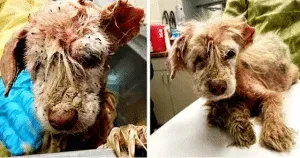
At the veterinary clinic, the full picture came into focus. Meg weighed just over eleven pounds, far below a healthy weight for a dog of her size.
The exam turned up several signs of prolonged neglect. She had a severe flea infestation, and veterinarians also found lice. Her ears were painfully infected, and the damage suggested she may have lived with that discomfort for a considerable time.
The findings matched what the homeowner had seen in the yard. Meg’s problems had built up slowly rather than overnight.
Rebuilding Strength Without Rushing
Her body clearly needed food, but the veterinary team did not hurry it. After long stretches without proper nutrition, offering large meals too suddenly can strain an already weakened system. The clinic monitored her intake closely and built a feeding plan meant to restore her strength safely.
Alongside the diet, she received medication for her infections. Treatment began clearing the parasites, and her skin and coat finally got the attention they had lacked.
She was given something simpler as well: a warm place to rest. Meg no longer had to look for shelter, watch passersby, or ration what little energy she had. For once, she could simply sleep.
A Tail That Began to Move
In the first days of treatment, her progress showed up in small, quiet ways. She began eating regularly. With steady nourishment, the exhaustion that had weighed on every movement started to ease. As the parasites cleared, her skin grew less irritated, and her coat showed early signs of improvement.
The more meaningful changes did not show up on a scale. They showed in how she responded to the people around her.
At first she watched her caregivers closely. Then her posture loosened when familiar faces entered the room. One day her tail moved, a brief and tentative wag that seemed almost uncertain. It suggested that Meg was beginning to link human company with something other than disappointment.
Other changes followed. She began looking toward her caregivers for reassurance. She accepted gentle touch without stiffening. She no longer seemed ready to leave the moment a door opened.
Healing on Her Own Schedule
As the days passed, more of Meg’s personality surfaced from beneath the fatigue. Her eyes looked brighter. Her movements grew more purposeful. Instead of thinking only about food and sleep, she started to notice the people and activity around her.
The change was gradual, which made sense, because so was the hardship behind it. Years of uncertainty could not be undone in a few days. What had changed was that Meg no longer faced recovery alone. Her caregivers tracked her medical needs, prepared the meals her body required, and gave her space whenever she seemed overwhelmed.
Nobody expected her to act like a carefree dog right away. She was allowed to heal at her own pace.
Routine did quiet work. Food kept arriving. Her bedding stayed dry and warm. The same people kept coming back. Each day offered another small lesson that safety was no longer something to be found before nightfall, but something waiting when she woke.
One Photo, Many Hands
Meg’s rescue did not start with a large organization spotting her on the street. It started when a homeowner saw that the dog in the yard needed more than short-term help, took a photograph, and asked for assistance. Others passed the message along. A Houston rescue team answered. Veterinarians treated problems that had gone unaddressed for a long time.
None of those steps looked extraordinary alone. Together, they redirected her life.
Plenty of stray animals live in places people walk past every day. Some shelter under buildings or sleep behind businesses. Others drift through neighborhoods looking for food without drawing much notice. Meg’s story shows what can follow when one person looks a little closer.
Her story is not finished. Her body needs more time to recover fully, and the trust she is building after hard years will need patience to protect. Still, the most important shift has already happened. Today she is resting among people committed to helping her heal. Meg is no longer unseen, and she no longer has to search alone.